



Chainlink (LINK) experienced a significant price surge in April, reaching close to $30. However, in the subsequent months, it has seen a substantial decline, falling by 55% from its peak. Despite this downturn, several factors suggest that the token's valuation might be on the verge of a considerable short-term recovery.
Grayscale Report and Potential ETF Launch
Recently, Grayscale, a prominent digital asset manager, published a report characterizing Chainlink as "the critical connective tissue between crypto and traditional finance." The report elaborates on Chainlink's role, stating, "Chainlink is commonly referred to as a crypto “oracle,” but it’s better described as modular middleware that lets on-chain applications safely use off-chain data, interact across blockchains, and meet enterprise-grade compliance needs."
“Chainlink is commonly referred to as a crypto “oracle,” but it’s better described as modular middleware that lets on-chain applications safely use off-chain data, interact across blockchains, and meet enterprise-grade compliance needs,” the statement reads.
Grayscale also highlighted Chainlink's native token, LINK, referring to it as "the largest asset in the Utilities & Services Crypto Sector" that "provides broad exposure to the crypto economy." This is not the first time Grayscale has praised a cryptocurrency project. Earlier in October, the company highlighted Zcash, noting that its Zcash Trust was open for private placement to eligible accredited investors. Following this announcement, ZEC's price experienced a significant increase, rising by over 600% from its pre-announcement valuation.
Another factor that could potentially trigger a rally in Chainlink's cryptocurrency is the anticipated launch of a spot LINK ETF in the United States. Such a product would offer investors a simpler way to gain exposure to the asset, alleviating concerns about self-custody. This increased accessibility could boost interest in LINK and positively influence its price.
Grayscale is the entity reportedly seeking to introduce this investment vehicle. According to Bloomberg's Eric Balchunas, the ETF could be launched before the end of November. While the introduction of such a product is generally viewed as bullish, traders should remain aware of a potential "sell-the-news" event once the news becomes official. A similar phenomenon was observed following the introduction of Canary Capital's spot XRP ETF in mid-November, although other factors also contributed to the price drop.
Decreasing Exchange Reserves
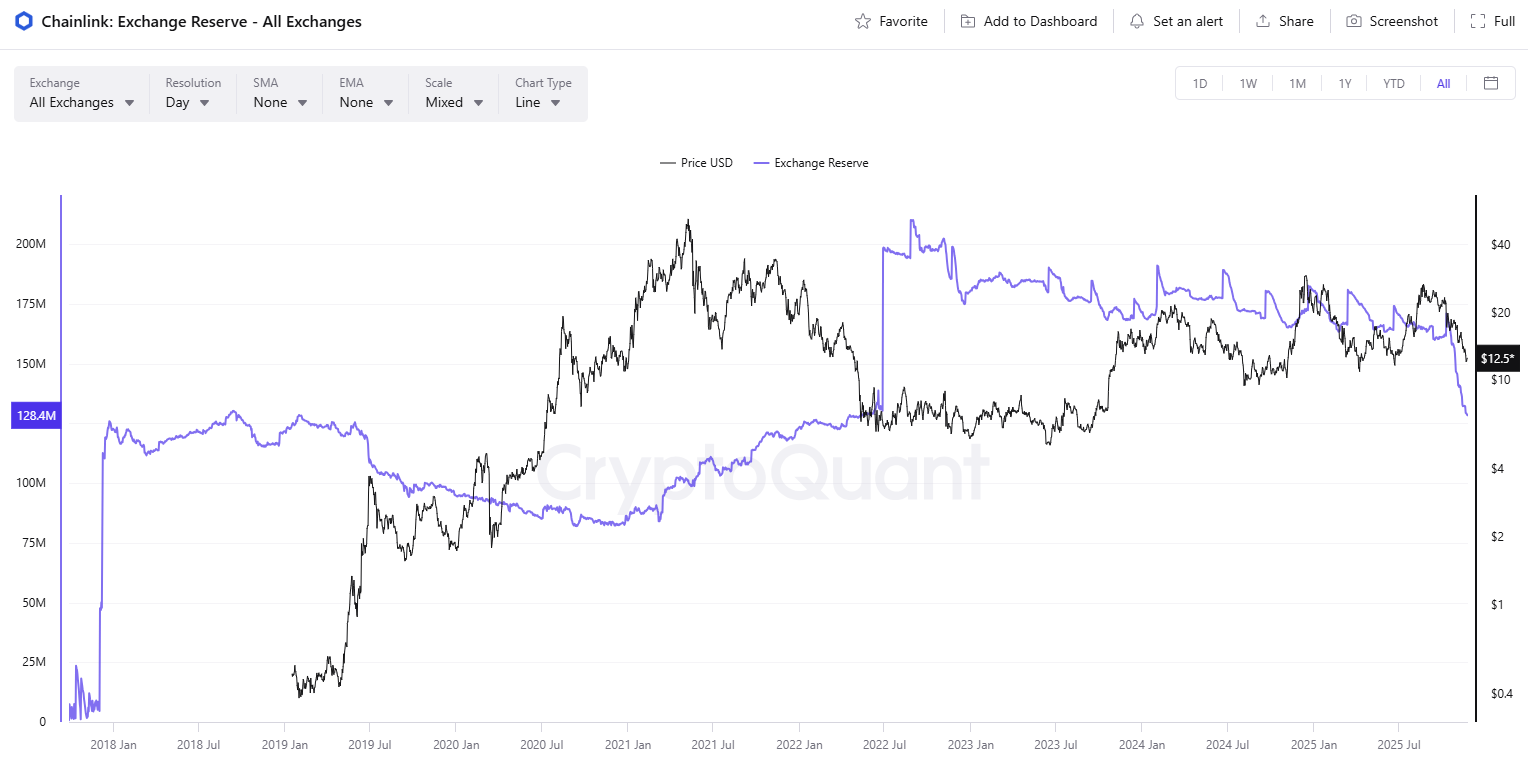
Furthermore, an analysis of LINK's exchange reserves provides a bullish signal. As of November 24, the total amount of LINK tokens held on centralized exchanges has dropped to approximately 128.4 million. This marks the lowest level observed since the summer of 2022, indicating that a significant number of investors have moved their holdings to self-custody solutions, thereby reducing potential selling pressure.
Whale Activity and Bearish Sentiment
Conversely, recent activities by large investors, or "whales," suggest a potential decline in LINK's valuation. X user Ali Martinez reported that over the past three weeks, large investors have sold or redistributed more than 31 million LINK tokens. The value of these tokens is nearly $400 million, and their total holdings have decreased to 158.5 million, representing 22% of LINK's circulating supply.
Such a sell-off can be bearish for the price, potentially triggering panic among smaller investors who might follow the actions of larger players. Additionally, this mass selling could indicate that these whales possess information not widely known, prompting their significant divestment.