


Key Insights
- •Actively Validated Services (AVS) transform digital infrastructure through continuous, automated validation that keeps systems secure, reliable, and efficient.
- •In blockchain networks, AVS enhance validator performance, reinforce decentralization, and prevent failures before they occur.
- •Projects like EigenLayer exemplify how AVS can merge innovation, security, and incentive alignment in decentralized ecosystems.
Introduction
In today’s hyper-connected digital landscape, service reliability and data integrity have become non-negotiable. Outages, exploits, and system errors no longer just disrupt, they erode trust and capital. To counter this, Actively Validated Services (AVS) are emerging as a foundational approach to ensure systems function flawlessly and securely in real time.
More than just a monitoring framework, AVS represents a philosophy of proactive reliability, one where digital systems, especially blockchain networks, are constantly validated, tested, and optimized through automation and intelligent analytics.
What Are Actively Validated Services?
At their core, Actively Validated Services (AVS) are infrastructures that undergo continuous, real-time monitoring and validation. Instead of relying on reactive responses or manual oversight, AVS deploy automated verification systems that consistently test and confirm that every component of a service operates as intended.
This paradigm ensures sustained uptime, early issue detection, and airtight security, bridging the gap between technical resilience and operational trust.
Core Components of AVS
1. Continuous Monitoring
AVS rely on real-time data collection, tracking every operational metric, from node health to latency, throughput, and error rates. This continuous visibility enables instant detection of deviations or anomalies.
2. Automated Validation
Automated scripts and validation engines simulate scenarios, stress-test systems, and verify performance benchmarks to maintain compliance and consistency without manual input.
3. Predictive Issue Prevention
By using pattern recognition and machine learning, AVS forecast potential risks, empowering developers and operators to fix issues before they impact users.
4. Reinforced Security
Through constant auditing, AVS identify vulnerabilities early, fortifying systems against breaches, exploits, or malicious activity.
5. Performance and Reliability Assurance
Automation ensures that system performance always aligns with pre-defined thresholds, minimizing latency, maximizing uptime, and maintaining consistent quality of service.
6. Compliance and Auditability
Every validation cycle creates traceable logs, ensuring transparency for compliance audits and regulatory adherence, a critical advantage in finance, health, and blockchain sectors.
7. Trust and Transparency
When services demonstrate proven consistency and accountability, they naturally foster stronger user and institutional trust.
How AVS Operate in Practice
The architecture of AVS integrates several complementary technologies and processes designed for real-time adaptability:
- •Real-Time Monitoring Systems provide instant insight into system behavior, tracking critical metrics around network traffic, computational loads, and validator activity.
- •Automated Testing Pipelines execute predefined scripts that evaluate system performance and simulate stress conditions.
- •AI-Driven Anomaly Detection identifies irregularities across datasets, flagging potential issues before they evolve into failures.
- •Autonomous Incident Response frameworks can automatically isolate issues, trigger mitigations, or initiate protocol-level recovery processes.
- •Comprehensive Reporting enables full visibility into performance metrics, security posture, and compliance status, supporting data-driven governance.
This multi-layered design transforms AVS from a simple validation mechanism into an intelligent, self-regulating ecosystem.
The Role of AVS in Blockchain Ecosystems
Blockchain networks are inherently designed for validation and consensus, but even decentralized systems can face challenges like validator inefficiency, network latency, or malicious activity. This is where AVS adds an additional, dynamic layer of protection and assurance.
Continuous Validation Across Nodes
Every blockchain node can benefit from AVS by undergoing automated checks for transaction integrity, synchronization status, and consensus participation. This keeps the network robust and ensures state consistency across distributed participants.
Strengthening Network Security
AVS continuously evaluate validator behavior, helping identify malicious actors or inconsistencies that could threaten the network, for example, potential 51% attacks or consensus manipulation attempts.
Optimizing Network Efficiency
Constant monitoring reveals performance bottlenecks, allowing for rapid optimizations at the protocol or node level to improve scalability and transaction throughput.
Regulatory and Institutional Alignment
As decentralized systems increasingly enter regulated industries, AVS ensures compliance through automated audit logs and standardized reporting structures, key for attracting institutional adoption.
EigenLayer: A Real-World Example of AVS in Action
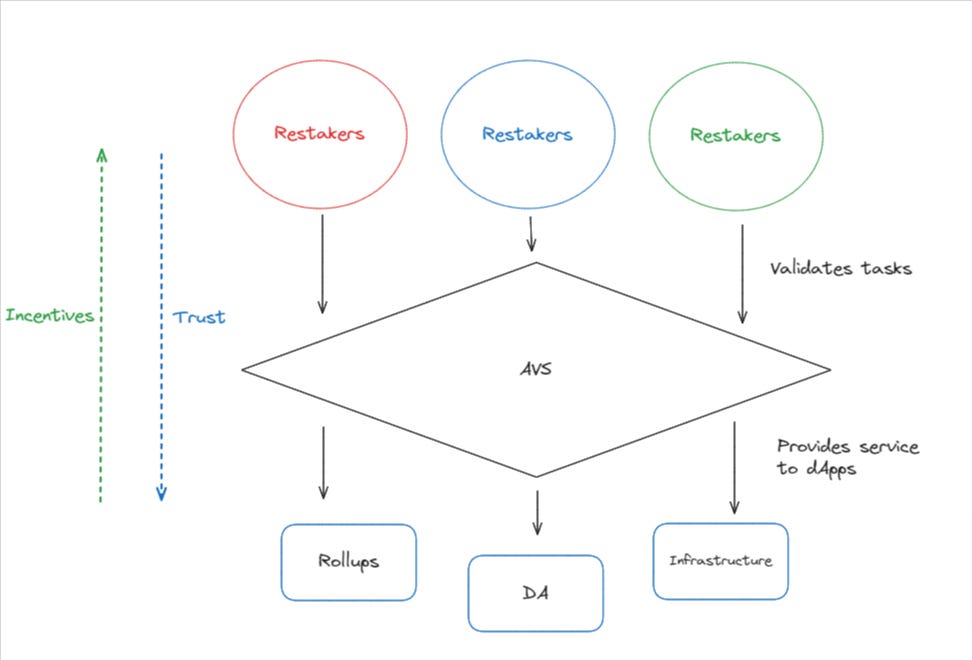
Among emerging blockchain projects, EigenLayer demonstrates the practical integration of Actively Validated Services at scale. Built on the Ethereum network, EigenLayer introduces the innovative concept of restaking, enabling stakers to reallocate their ETH to secure multiple protocols simultaneously.
1. Restaking and Multi-Service Security
Through restaking, validators extend Ethereum’s security guarantees to multiple services at once, amplifying trust and capital efficiency.
2. Continuous Validator Monitoring
EigenLayer continuously tracks validator performance, ensuring adherence to operational and security standards across all supported protocols.
3. Incentive-Based Validation
Validators are rewarded for reliable performance and penalized for negligence through slashing mechanisms. This economic model ensures validators are consistently motivated to maintain optimal performance.
4. Automated Issue Detection
EigenLayer integrates proactive diagnostics that identify potential faults early, safeguarding dependent services from cascading failures or downtime.
This framework showcases how AVS principles can be embedded into decentralized infrastructure to enhance scalability, trust, and composability across Web3 ecosystems.
Why Actively Validated Services Matter
The future of digital systems, centralized or decentralized, hinges on proactive reliability and adaptive intelligence. AVS offer exactly that: a framework where issues are detected before disruption, where validation never stops, and where security evolves dynamically.
For blockchain specifically, AVS will likely become the new industry baseline, driving the next generation of decentralized finance (DeFi), infrastructure protocols, and real-world asset systems.
By merging continuous automation with cryptographic assurance, AVS turn blockchain from a static trust machine into a living, self-healing network, one that adapts, validates, and strengthens itself autonomously.
Conclusion
Actively Validated Services are more than an operational upgrade; they are a paradigm shift in digital reliability. By merging automation, real-time intelligence, and continuous validation, AVS redefine what it means for systems to be secure and trustworthy.
Projects like EigenLayer illustrate how AVS can extend far beyond monitoring, becoming a foundational mechanism for decentralized trust, economic alignment, and network scalability.
As blockchain technology matures, AVS will play a pivotal role in shaping a more resilient, compliant, and transparent digital future, one where reliability isn’t maintained but actively validated.