


The Elephant in the (Block)chain: Why Bitcoin’s So Slow
Bitcoin is a blockchain that processes just three to seven transactions per second. In the time it takes you to read this sentence, Visa and Solana will each have processed thousands of transactions, while Bitcoin will still be validating your coffee purchase from yesterday.

During peak congestion, sending $50 worth of $BTC can cost you more than $30 in gas fees. That’s financial mugging with extra steps. Try explaining to a crypto newbie why they just paid 60% in fees to send crypto to their friend, and watch their eyes glaze over faster than a bear market portfolio.
Bitcoin’s 1MB block size limit means the network can handle only about 400K transactions per day, max. Meanwhile, the world processes billions of digital transactions daily. It’s like trying to fit the entire internet through a dial-up modem while everyone else is running on fiber optic.
Bitcoin needs to be more than digital gold sitting pretty in cold storage. It needs speed, scalability, and to actually work for payments, DeFi, dApps, and even meme coins. And that’s where Bitcoin Hyper ($HYPER) steps up to the plate.
Bitcoin Hyper ($HYPER) – Bitcoin’s Long-Overdue Glow-Up
Bitcoin Hyper ($HYPER) is a full Layer-2 Bitcoin ecosystem that will integrate the Solana Virtual Machine, which is one of the fastest and most battle-tested blockchain technologies out there. Finally, Bitcoin will be able to compete with modern payment systems instead of cosplaying as a telegraph machine.
You’ll be able to send your $BTC to a special address. Bitcoin Hyper will verify your deposit using a smart contract that reads Bitcoin blocks directly, without middleman or trust-me-bro vibes. Once verified, the same amount of $BTC will be minted on the Bitcoin Hyper Layer-2.
Bitcoin Hyper will bundle transactions and prove them valid using zero-knowledge (ZK) proofs. It will also regularly commit the Layer-2 state back to Bitcoin’s Layer-1 blockchain. That means Solana-level speed with Bitcoin-level security.
If you want your $BTC back on the main chain, just request a withdrawal. The system will verify everything, unlock your $BTC on Bitcoin Layer-1, and you’re done.

Bitcoin Hyper will make Bitcoin actually useful through real payments, DeFi protocols, meme coins, and dApps.
The Bitcoin and Solana ecosystems essentially merge under Bitcoin Hyper’s umbrella. This cross-chain interoperability from day one means your assets and apps can move freely across Bitcoin, Ethereum, Solana, and beyond.
This could push Bitcoin even higher in dominance. Bitcoin is already the biggest crypto by market cap, absolutely towering over everything else. But imagine if it could also compete on utility, speed, and developer activity.
Why Smart Money Is Moving Now
Whales are rushing to Bitcoin Hyper because they’re reading the room. When Bitcoin corrects, smart money looks for the next opportunity, especially one that could ride Bitcoin’s recovery while offering exponential upside.
$HYPER is the native token that powers the entire ecosystem. Every transaction, every stake, every governance decision runs on $HYPER. This is the fuel for what could become Bitcoin’s execution layer.
Having already raised over $25.8M, including whale buys of $379.9K and $274K, the presale is currently live, with a price of $0.013225 per token and staking at 45% APY. Early buyers get:
- •Priority staking access with higher yields
- •Airdrops from Bitcoin Hyper ecosystem projects
- •Governance rights to shape the platform’s future
- •Token launch access before anyone else
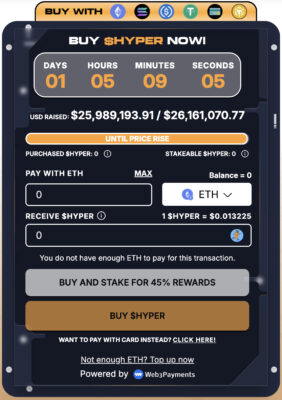
The timing is perfect. The Bitcoin Hyper presale is happening as the market realizes Bitcoin’s limitations are becoming liabilities. Institutional adoption needs scalability. Retail needs usability. Developers need speed. Bitcoin Hyper delivers all three.
Bitcoin’s dropping to $98K is a reminder that even kings need evolution. And Bitcoin Hyper is set to be the evolution Bitcoin has been waiting for. It’s fast, cheap, scalable, and ready to unlock what Bitcoin was always supposed to be.
Whales are already moving. The question is: are you?