



When nearly two hundred million dollars exit spot bitcoin ETFs in a single day, it indicates that market sentiment is not collapsing but rather shifting its approach. Such significant outflows often signal traders repositioning themselves ahead of a macroeconomic trigger, rather than abandoning the asset altogether. This analysis breaks down the recent activity in a clear, reader-friendly manner.
What Triggered the Largest Outflow in Two Weeks?
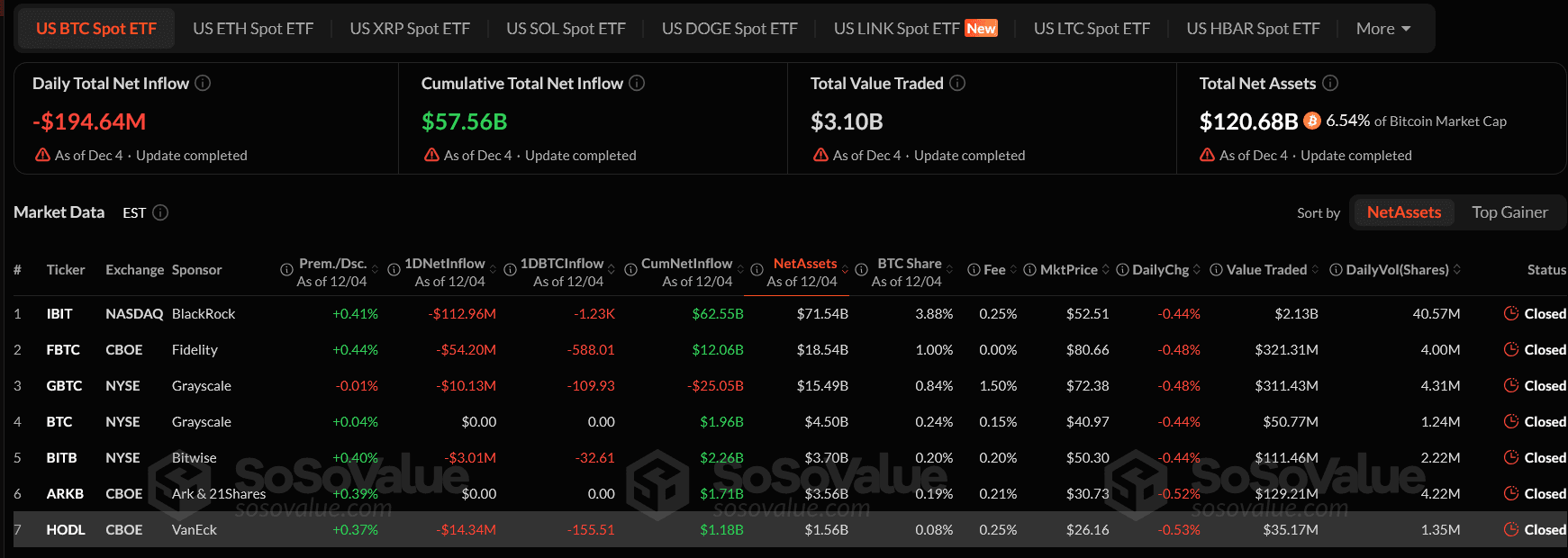
U.S. spot bitcoin ETFs reported $194.6 million in net outflows on Thursday, a sharp increase from the modest $14.9 million observed the day before. This marked the largest single-day exit since November 20th and occurred amidst a volatile trading week. The pressure primarily stemmed from major ETF providers. BlackRock’s IBIT experienced outflows of $112.9 million, while Fidelity’s FBTC saw $54.2 million depart. VanEck’s HODL, Grayscale’s GBTC, and Bitwise’s BITB also recorded consistent redemptions.
Beyond just the flow of funds, trading volume across the ETF ecosystem declined to $3.1 billion, down from $4.2 billion on Wednesday and over $5 billion on Tuesday. Lower trading volumes accompanying substantial outflows typically suggest a market rotation rather than panic selling.
How Market Structure Played Into It
Nick Ruck of LVRG Research explained that this wave of outflows was linked to the unwinding of basis trades. When the spread between futures and spot prices narrows to below breakeven, arbitrage traders lose the incentive to maintain their positions. Their subsequent exits create ripple effects that impact ETF balances. The spread compression observed this week, combined with sharp intraday price swings, necessitated significant unwinding activity.
Concurrently, traders are adopting a cautious stance in anticipation of the upcoming inflation data release and the Federal Reserve's interest rate decision on December 10th. The baseline expectation is a 25-basis-point rate cut. Should the Fed signal further easing measures, market sentiment could stabilize rapidly.
What’s Happening on the Bitcoin Price Side?
Bitcoin experienced a decline of approximately 1.4 percent over the past 24 hours, trading near $91,989 early Friday. Earlier in the week, it briefly dipped towards the $84,000 zone before recovering. This price action reflects a market testing its support levels while ETF outflows temporarily temper momentum.
Despite the recent volatility, on-chain indicators remain noteworthy. Timothy Misir from BRN highlighted that exchange balances have decreased to 1.8 million BTC, the lowest level recorded since 2017. A reduction in supply on exchanges typically indicates that more long-term holders are securing their coins. He further noted that accumulation remains steady, and the price is holding above the True Market Mean. The missing element for a confirmed upward trend is a decisive move into the $96,000 to $106,000 trading range.
Ethereum ETFs Didn’t Escape the Pressure Either
The pressure of withdrawals was not limited to bitcoin products. Spot Ethereum ETFs recorded $41.6 million in net outflows on Thursday, following a substantial $140.2 million in inflows the previous day. Grayscale’s ETHE led these redemptions, with $30.9 million exiting the fund.
This stark contrast in consecutive-day flows suggests that traders are still assessing their desired exposure levels heading into the key macroeconomic events scheduled for December.
The Bottom Line
The outflows observed in Spot Bitcoin ETFs are not indicative of underlying structural weakness. Instead, they represent a market adjusting its positions in anticipation of significant economic signals. Bitcoin's supply continues to tighten, support levels are holding firm, and traders are actively seeking a clear breakout into higher price ranges. If the Federal Reserve adopts a more dovish stance next week, the prevailing market narrative could shift rapidly.