



Key Insights on Bitcoin's Future
Vineet Budki, CEO of Sigma Capital, a Middle East-based firm, has projected that Bitcoin could experience a significant decline of up to 70% during the upcoming bear market. This forecast is attributed to recurring cyclical patterns and the propensity for rapid sell-offs in the market. Despite these anticipated short-term fluctuations, Budki maintains a long-term optimistic outlook, believing Bitcoin has the potential to reach $1 million per coin within the next decade.
Budki's prediction underscores the inherent volatility of the Bitcoin market, a characteristic that affects both current holders and the broader cryptocurrency sentiment. The CEO's analysis points to a potential 65–70% drop in Bitcoin's value during the next bear market, a scenario he links to the market's tendency towards rapid sell-offs when faced with unfavorable signals. He noted that a lack of deep understanding of Bitcoin's economic fundamentals often leads to hasty selling decisions, exacerbating price volatility.
Long-Term Optimism Amidst Volatility
"The next bear market could see a decline of up to 70%. Despite short-term volatility, I expect Bitcoin could reach up to $1 million per coin over the next decade." — Vineet Budki, CEO, Sigma Capital
Budki's forecast emphasizes a divergence between short-term market turbulence and long-term growth potential. While acknowledging the possibility of a substantial price correction, he remains confident in Bitcoin's trajectory towards achieving the $1 million mark. This long-term target is supported by expectations of increasing adoption and utility of the cryptocurrency. The community's reaction to Budki's views is varied, with ongoing discussions about Bitcoin's market cycles. Notably, no immediate reactions from prominent figures such as Arthur Hayes or CZ have been recorded concerning Budki's specific outlook.
Historical Patterns and Institutional Influence
Did you know? Similar Bitcoin drawdowns ranging from 50% to 80% have occurred following cycle peaks in 2013, 2017, and 2021. These patterns have historically influenced movements in correlated cryptocurrencies like Ethereum and major altcoins.
Historical price patterns suggest that significant drawdowns are a recurring feature of Bitcoin's market cycles. These drawdowns, often ranging from 50% to 80%, have been observed after peaks in 2013, 2017, and 2021. Such historical movements have historically had a ripple effect on correlated cryptocurrencies, including Ethereum and other major altcoins.
Current market data from CoinMarketCap, as of November 2, indicates that Bitcoin is trading at $109,923.61, with a market capitalization of $2.19 trillion, representing 59.23% of the total crypto market. The 24-hour trading volume has seen a decrease of 56.14%, settling at $25.51 billion. Over the past 30 days, Bitcoin's price has experienced a decline of 8.56%.
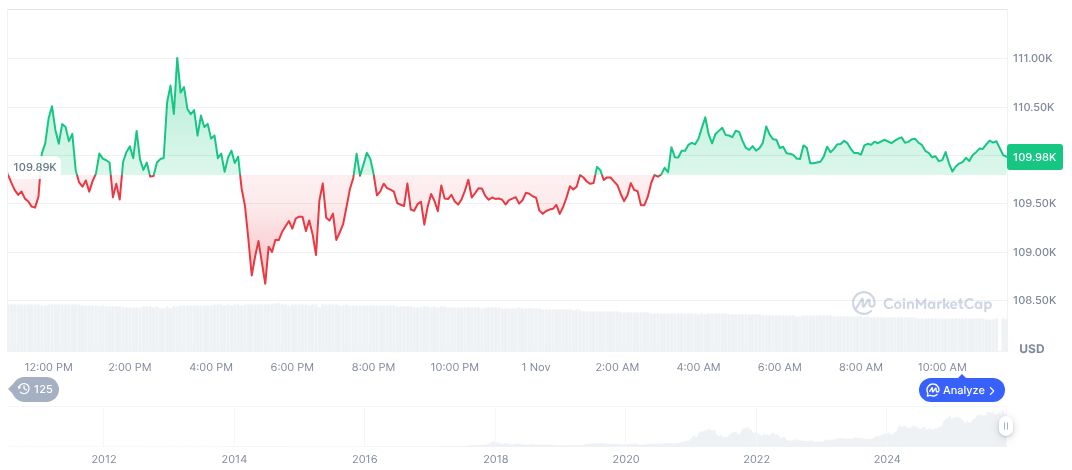
Research from Coincu indicates that the market's reaction to price movements is increasingly shaped by evolving institutional trends. Analysts suggest that retail speculation is playing a diminishing role in cycle predictions, with a greater emphasis placed on macroeconomic conditions that influence institutional investors. Furthermore, regulatory developments and technological advancements are expected to continue shaping the overall market landscape.