



Senate Democrats are preparing to introduce legislation aimed at counteracting President Trump's newly announced tariffs on European nations. These tariffs, revealed via Truth Social, are directly linked to the ongoing issue of Greenland's annexation and are set to take effect on February 1.
The imposition of these tariffs carries the potential to significantly strain relations between the United States and its European allies. This development could have far-reaching consequences for international trade dynamics and broader geopolitical stability, as President Trump's tariff strategy intensifies economic and political friction with key strategic partners.
Tariff Announcement and European Impact
On January 18th, President Donald Trump announced the implementation of a 10% tariff on European countries that have expressed opposition to U.S. plans concerning Greenland. This move represents an escalation of existing trade tensions. The tariffs are specifically targeting nations including Denmark, Norway, and Sweden, with provisions for the rates to increase to 25% by June 1st.
These tariffs are anticipated to disrupt established international trade flows, placing considerable pressure on the economic connections between the United States and Europe. As the tariff rates rise, European exports destined for the U.S. market will become progressively more expensive. This price increase is likely to have a notable impact on market dynamics and consumer costs.
Several prominent political figures have voiced their concerns regarding this trade policy. Chuck Schumer, a leading Democrat, has criticized the tariffs, arguing that they risk harming the vital connections between the U.S. and Europe. He emphasized the potential for significant economic ramifications that could affect both regions.
Geopolitical Context of Greenland
It is noteworthy that Greenland's strategic geographical position has been a focal point of geopolitical interest for decades, dating back to the Cold War era. This enduring significance highlights Greenland's consistent role in international negotiations and strategic considerations.
Market Data and Financial Commentary
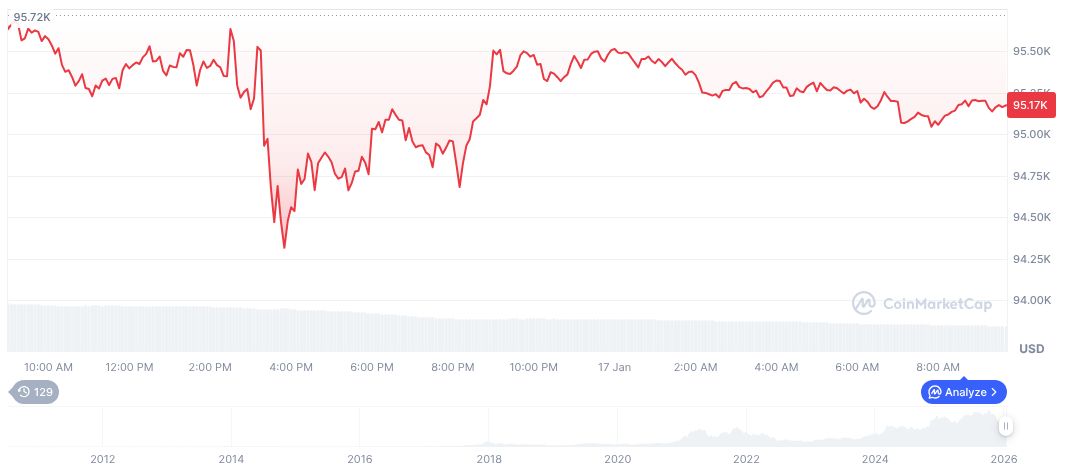
Bitcoin (BTC) is currently trading at $95,043.44, with an overall market capitalization of $1.90 trillion. The cryptocurrency holds a dominant market share of 58.93%. However, its 24-hour trading volume stands at $16.49 billion, reflecting a 43.63% decrease. Recent market performance indicates a 7-day gain of 4.84%, contrasted with a 90-day decrease of 14.21%, according to data from CoinMarketCap.
Researchers at Coincu suggest that the heightened geopolitical tensions may lead to potential modifications in regulatory frameworks. The financial outcomes of these developments could include increased market volatility. Concurrently, a period of heightened intervention might lead to greater regulatory clarity, which in turn could influence the broader economic landscape.