


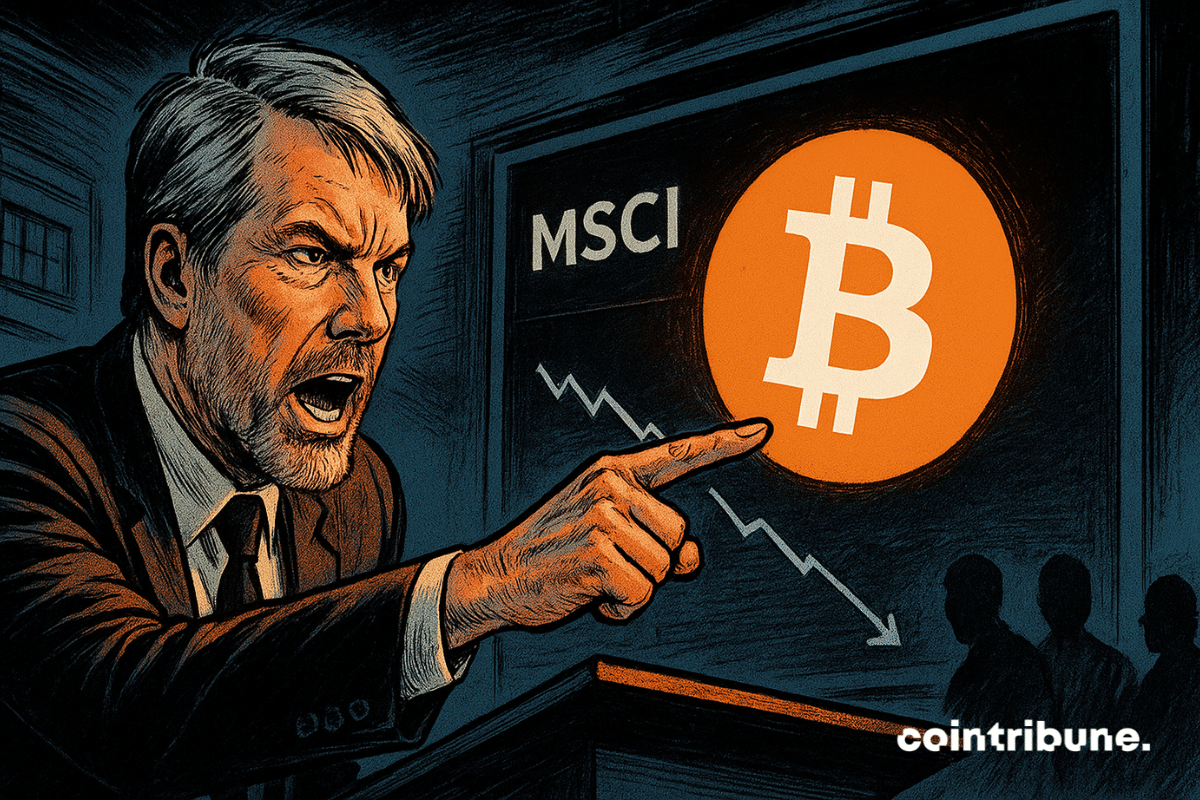
The cryptocurrency community is abuzz following the announcement that companies holding a significant portion of their assets in cryptocurrency may be excluded from major stock indices. A boycott movement is reportedly gaining momentum, with some questioning if JP Morgan will become the next target of this evolving digital asset landscape.
In Brief
- •Companies with over 50% of their balance sheet in crypto risk exclusion from MSCI indices as early as January 2026.
- •Prominent investors are publicly advocating for a boycott of JP Morgan, which is accused of relaying this decision.
- •Michael Saylor, CEO of Strategy, defends his company, stating it is "neither a fund nor a trust" but a structured finance company.
- •Such an exclusion could lead to massive automatic sales of affected companies' stock, potentially causing cryptocurrency prices to decline significantly.
A Bitcoin Community in Stir
Tensions escalated on Sunday when MSCI, formerly known as Morgan Stanley Capital International, announced its intention to exclude companies holding more than 50% of their balance sheet in cryptocurrency from its indices.
JP Morgan relayed this information in a research note, subsequently drawing the ire of many in the Bitcoin community.
Reactions were swift and strong. Grant Cardone, a real estate investor and Bitcoin advocate, declared, "I just withdrew 20 million dollars from Chase and I am suing them for misconduct."
Max Keiser, a well-known figure in the cryptocurrency ecosystem, issued a more direct call to action: "Take down JP Morgan and buy Strategy and BTC."
The boycott movement appears to be growing among a community that is often fragmented. This time, the perceived threat is directed at Strategy, the world leader in institutional Bitcoin holdings, with 649,870 BTC on its balance sheet.
Strategy joined the Nasdaq 100 in December 2024, a move that allowed it to benefit from passive capital inflows. This position is now under threat due to the potential MSCI exclusion.
The implications extend far beyond Strategy's specific situation. Exclusion from MSCI indices would compel many funds and asset managers to automatically sell their positions in these companies. Such a large-scale sell-off could significantly impact the entire cryptocurrency market, with analysts expressing concerns about a potential domino effect on digital asset prices.
Michael Saylor Counterattacks Against New Rules
Strategy's founder, Michael Saylor, responded assertively to the proposed changes. On Friday, he published a pointed response on social media.
"Strategy is neither a fund, nor a trust, nor a holding company," Saylor asserted.
He further elaborated that his company "creates, structures, issues, and manages," defining it as a "structured finance company backed by bitcoin."
This distinction is crucial and lies at the heart of the ongoing debate: should Strategy be categorized as a passive investment vehicle or as an active operating company?
For Saylor, the classification is clear. He argues that Strategy's business model is based on the strategic accumulation of Bitcoin, financed through the issuance of preferred shares that prevent dilution for existing shareholders.
The proposed MSCI change presents these companies with a difficult choice. They must either reduce their cryptocurrency holdings below the 50% threshold to remain eligible for index inclusion, or they risk losing access to institutional capital flows.
Several companies, including Bitmine, Metaplanet, and Upexi, are reportedly already seeing their net asset value ratio fall below this critical threshold, which could compromise their ability to raise capital.
Despite these challenges, Strategy appears to be maintaining a strong position. Although its stock price has experienced a significant decline from its peak of $474, the company has reportedly accelerated its Bitcoin purchases. In mid-November, Strategy acquired an additional 8,178 BTC for $835 million.
Saylor has stated that his company is "designed to withstand an 80 to 90% drop and keep operating."
A Turning Point for Institutional Bitcoin Adoption
This unfolding situation highlights a compelling paradox within the financial world. On one hand, Strategy is being considered for inclusion in the S&P 500 as early as December, with analysts estimating a 70% probability according to 10X Research. This would mark a historic milestone for a company focused on Bitcoin.
On the other hand, index organizations are contemplating the exclusion of these very companies from their traditional benchmarks.
Institutional finance appears to be in a state of cautious evolution. While there is a growing recognition of Bitcoin as a legitimate asset, there is a reluctance to fully embrace companies that have made it their core business. Even JP Morgan, a major player, is reportedly exploring Bitcoin-backed credit solutions.
S&P Global Ratings has assigned a "B-" rating to Strategy, which is a notable development for this type of company. These mixed signals reflect a transitional period in the financial paradigm, where Bitcoin is gradually establishing its place, yet traditional financial entities are still navigating how to best regulate and integrate it.