


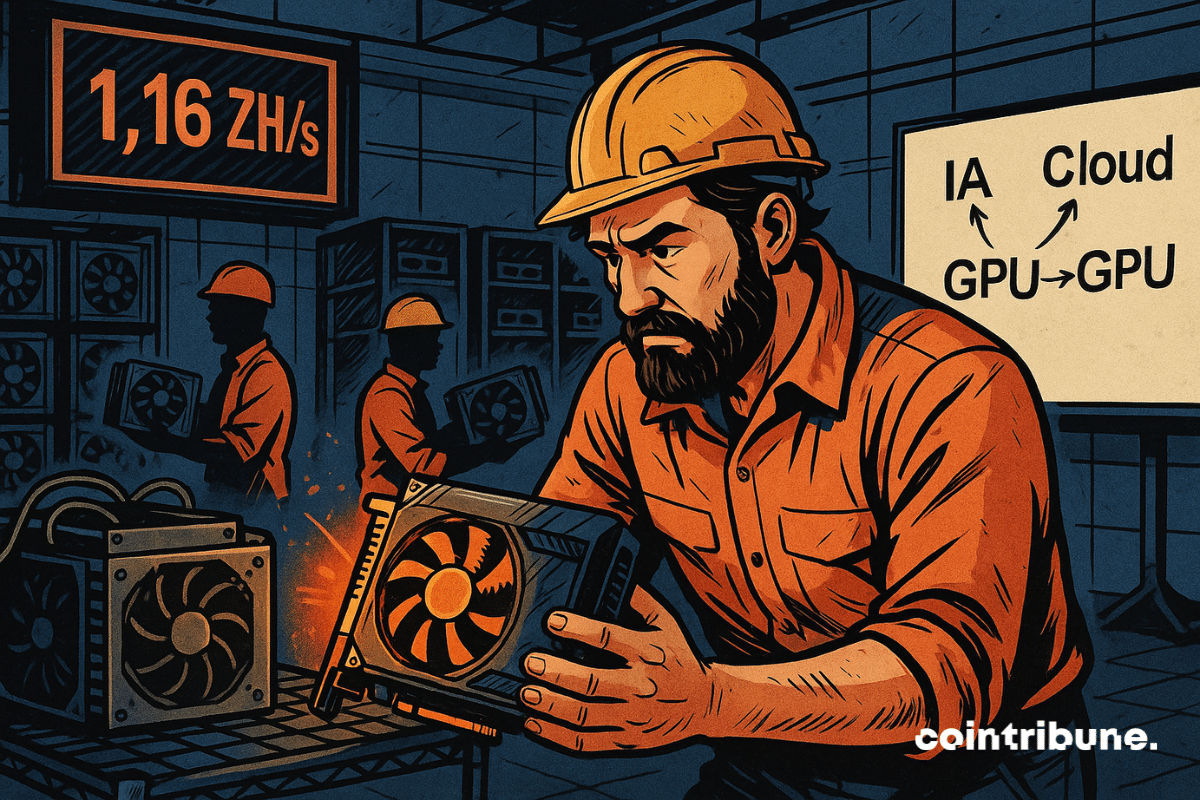
Recently, bitcoin has experienced a downturn. The euphoric highs of six-figure values are gone. Reality has set in: BTC hovers around 87,000 dollars, and the environment is shifting for those who depend on its network activity—notably the miners. While less visible than traders, they are the primary sentinels of the network. Currently, their business model is under significant pressure. Between an exploding hashrate and falling revenues, the industry is navigating a pivotal period. This is a look behind the scenes of an ecosystem attempting to evolve towards AI.
In Brief
- •The global hashrate is exploding, but miners’ revenues are stagnating or even approaching critical levels.
- •The return on investment for new bitcoin mining machines now exceeds three years.
- •Companies like Cipher, IREN, and CleanSpark are turning to AI and cloud computing to diversify their revenue streams.
- •Stock markets are experiencing a boom, driven by announcements despite a sharp decline in real profitability.
Bitcoin Facing Financial Challenges, Hashrate Reaches New Peaks
On one hand, the global hashrate for bitcoin mining has reached a historic peak of 1.16 ZH/s. On the other hand, the hashprice has fallen to $35/PH/s, severely impacting profit margins. In essence, there is more computing power being used, but with less revenue generated. The return on investment for mining machines now exceeds 1,200 days. At this rate, even the most efficient mining rigs are becoming costly to operate due to energy consumption.
The report from The Miner Mag accurately summarizes the situation, stating that mining margins have weakened as hashprices have fallen and machine amortization periods have lengthened. This is occurring even as publicly traded mining companies have seen a rebound, attributed to analyst recommendation upgrades and new deals in high-performance computing (HPC).
In this challenging climate, some mining operations are resorting to increased debt. Others are simply enduring the difficult period, hoping for an improvement in BTC prices. Meanwhile, the underlying infrastructure continues to expand, driven by the network's mechanics.
Cloud-Based Bitcoin Mining: Miners Invest in AI Solutions
In response to this downward trend, major players in the industry are adjusting their strategies. Companies such as CleanSpark, Cipher Mining, and IREN are redirecting their computing power towards cloud services and High-Performance Computing (HPC), with the aim of generating new revenue streams.
This shift is beginning to show positive results, at least in the stock market. J.P. Morgan has recently raised its forecasts, suggesting Cipher could reach $18 and IREN $39. This enthusiasm is fueled by significant developments: Cipher has already secured 600 MW of capacity for AWS and Google through Fluidstack, while IREN has signed a $9.7 billion contract with Microsoft to host Nvidia GB300 GPUs.
However, it is important to consider the impact of these developments. The report from The Miner Mag indicates that while revenues from these new services are increasing, they are not yet sufficient to fully offset the substantial decline in bitcoin mining profits.
In summary, AI is not expected to be an immediate solution for all mining operations.
Stock Market Surges While Bitcoin Mining Faces Headwinds
Interestingly, despite the challenging fundamental conditions, mining stocks are experiencing a significant increase. Cipher Mining has risen by 4.59%, CleanSpark by 4.42%, and even companies like RIOT and MARA are showing signs of recovery. This surge is driven by optimistic analyst ratings, lucrative agreements with major technology firms, and a continued belief in the long-term potential of BTC.
However, not all aspects are positive. Analysts at J.P. Morgan have reduced their price targets for MARA to $13 and RIOT to $17. They cite the companies' substantial bitcoin reserves and the potential for stock dilution as concerns. Essentially, these companies are accumulating bitcoin, but the cost and implications are being closely scrutinized.
The entire bitcoin mining ecosystem is currently in a complex state of balance, influenced by innovation, speculation, and a degree of disillusionment.
Key Figures to Remember
- •The global hashrate has reached a peak of 1.16 ZH/s.
- •The bitcoin price at the time of writing is $87,243.
- •The hashprice has dropped to $35/PH/s, a decrease from $55 just a quarter ago.
- •AI/HPC contracts signed are valued at nearly $10 billion, but the generated revenues remain minimal.
- •The return on investment now exceeds 1,200 days, contrasting with an industry historically profitable within a few months.
While the United States is providing significant funding and Europe is focusing on regulatory frameworks, China is operating discreetly. Officially, bitcoin mining remains banned in China. Unofficially, however, it accounts for up to 20% of the global hashrate. The low-cost electricity available in regions like Xinjiang and Sichuan is powering an increasing number of clandestine mining operations. This shadow strategy highlights the geopolitical complexities surrounding BTC. For Beijing, mining discreetly might be a more advantageous approach than relying on the dollar.