



Market Volatility and Sell-Off Dynamics
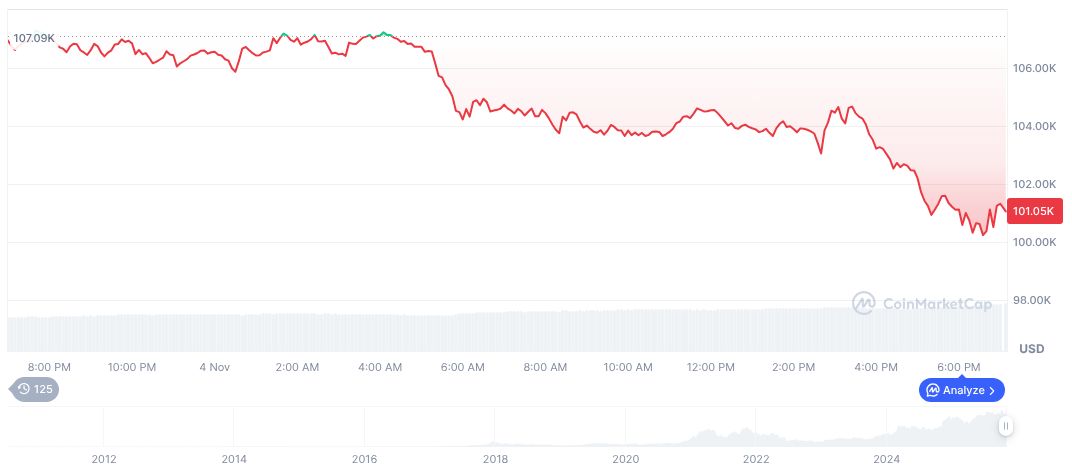
Bitcoin has dropped 7.4% to below $100,000 due to significant sell-offs by long-term holders, leading to a considerable market imbalance, as reported on November 5, 2025. This decline emphasizes heightened market volatility, primarily driven by spot market selling pressure, influencing major cryptocurrencies and prompting actions from regulators and industry leaders.
Long-Term Holders' Impact on Bitcoin Price
Michael Saylor maintains "long-term conviction remains unchanged". Regulatory bodies like the SEC are closely monitoring market activity. As of the latest update, Bitcoin (BTC) trades at $102,382.25 with a market cap of 2 trillion. Its 24-hour trading volume surged by 35.08%, reaching 112 billion. BTC has experienced a 17.73% decline over 30 days. Coincu analysts highlight that the ongoing sell-off could prompt regulatory tightening as agencies scrutinize market integrity. Data show alignments with prior events where liquidity shocks catalyze mid-term market corrections. Industry resilience and regulatory clarity could stabilize conditions.
Historical Parallels and Regulatory Outlook
Bitcoin's price decline is reminiscent of its 2021 fall to $20,000 when the market faced macroeconomic pressures. Historical patterns often reflect similar long-term holder behaviors. As of the latest update, Bitcoin (BTC) trades at $102,382.25 with a market cap of 2 trillion. Its 24-hour trading volume surged by 35.08%, reaching 112 billion.
Industry Leader Perspectives
Michael Saylor, CEO, MicroStrategy, stated, "We continue to hold our Bitcoin position. The recent volatility is a feature, not a bug, of the asset class. Long-term conviction remains unchanged."