


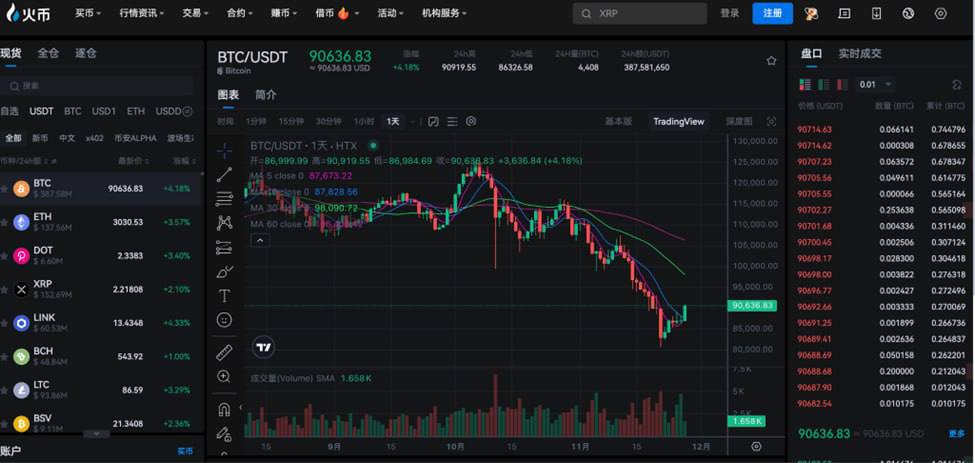
Volatility is a constant in the digital-asset market, and each significant drawdown prompts a re-evaluation of its underlying fundamentals. Bitcoin has risen back above $91,000, marking a 4.18% increase over the past 24 hours. This late-November recovery offers a welcome sign of optimism after Bitcoin slid from its early October peak of $126,000 to below $81,000, a nearly 30% retracement. For the first time in several weeks, indicators of stabilization are beginning to emerge.
According to Molly, an official spokesperson for HTX, the recent market correction is not solely attributable to a collapse in sentiment. Instead, it is understood to reflect a three-layered repricing influenced by macro conditions, capital flows, and the overall market structure.
Early Stabilization Following a Market Meltdown
After enduring several consecutive weeks of declines, Bitcoin has finally demonstrated a constructive rebound. BTC climbed back above the $90,000 mark, achieving a 4.18% gain in the last 24 hours. This recovery extended to other major assets within the broader market, with ETH showing a 3.15% increase, XRP up 6.98%, BNB up 2.03%, and SOL up 3.72%.

Despite the recent rebound, market sentiment remains fragile. According to Alternative, the Crypto Fear & Greed Index has seen only a slight increase from 20 to 22, continuing to reside firmly within the Extreme Fear zone. Rebuilding investor confidence is a process that requires time.

Macro Outlook: A Data Vacuum and Policy Crosscurrents
Market analysts have characterized this week in the U.S. crypto market as a period that was initially tight but subsequently loosened. The Thanksgiving holiday and Black Friday compressed trading activity, concentrating major trading operations into the Monday through Wednesday period. Delays in U.S. government shutdown-related data releases, coupled with the absence of October non-farm payrolls, have led markets to rely more heavily on high-frequency labor data. Today's report indicated a decline in weekly initial jobless claims, suggesting that the labor market has not experienced material weakening. While markets broadly anticipate the Federal Reserve to implement rate cuts in December, some institutions contend that the Fed still has room to maintain its current policy stance.
A series of speeches from Federal Reserve officials preceding the November 29 blackout period are anticipated to introduce further short-term volatility. The probability of a 25 basis point rate cut in December has significantly increased to 69.3%, a substantial rise from last week's 22%, indicating a notable shift in market expectations.
Market Structure: Defensive Posture and Fear-Driven Pricing
The crypto market continues to process the October drawdown. Bitcoin remains approximately 30% below its recent high, ETF funds are experiencing net negative flows, and the Coinbase premium is weakening. These indicators collectively point to a reduced appetite for risk among investors.
Options markets are reflecting easing stress. The 1-week put-call skew has fallen sharply from 11% last Friday, which was a 2025 high, to approximately 4.5%.
Technical indicators are signaling oversold conditions. Bitcoin's 14-day Relative Strength Index (RSI) has dropped to 32, a level below that seen in early October and nearing oversold territory. Implied volatility has reverted to levels observed in April, suggesting that traders are positioning for a potential upward price movement.
Broadly, BTC is currently in a late-stage decline phase where panic has subsided, but the appetite for risk has not yet recovered. If incoming economic data continues to show softening consumption and employment without triggering recession concerns, markets may transition into a technical recovery phase. However, with holiday liquidity at seasonal lows, the risk of short-term downward extensions persists.
Short-Term Outlook: An Inflection Point and Opportunity
Bitcoin's key support level is situated near $80,000, with resistance anticipated between $90,000 and $95,000. The ability to decisively surpass this upper resistance band will be crucial in determining whether the current rebound can become sustainable.
Current options skew suggests an improving sentiment towards upside scenarios. Short positions in BlackRock's IBIT have also decreased significantly, indicating a weakening bearish conviction among investors. Although investors remain cautious, there is a noticeable rotation in allocation away from simple price speculation towards strategies focused on capital efficiency, yield generation, and information-driven pricing. This capital rotation is already evident across stablecoins, perpetual futures, and other market sectors.
Industry Perspective: Finding Opportunity Amidst Panic
In the midst of heightened market volatility, Molly emphasized that compliance and innovation should not be perceived as conflicting objectives. She stated, "This is not a binary choice. Multiple systems can evolve in parallel. Our long-term value lies in helping users identify trustworthy, high-quality assets."
She further added that market sentiment is transitioning from fear towards hope. In an environment where the industry often competes based on marketing and hype, HTX's differentiated approach is to compete with sincerity, not with gimmicks. Every sincere action taken is intended to build long-term trust with users.
Analysts anticipate that crypto investments in 2025 will concentrate on platform ecosystems, the convergence of AI and Web3, policy-driven opportunities, and long-term value creation. The cryptocurrency space has always been rich in narratives, but the ultimate outcomes are determined by the ability to capture consensus-driven upside.
Maintaining composure during periods of volatility and identifying opportunities amidst fear may prove to be the most effective strategy for the current market environment. As global digital-asset markets continue to evolve, exchanges remain the essential gateway connecting users, innovations, and the future trajectory of crypto ecosystems.