


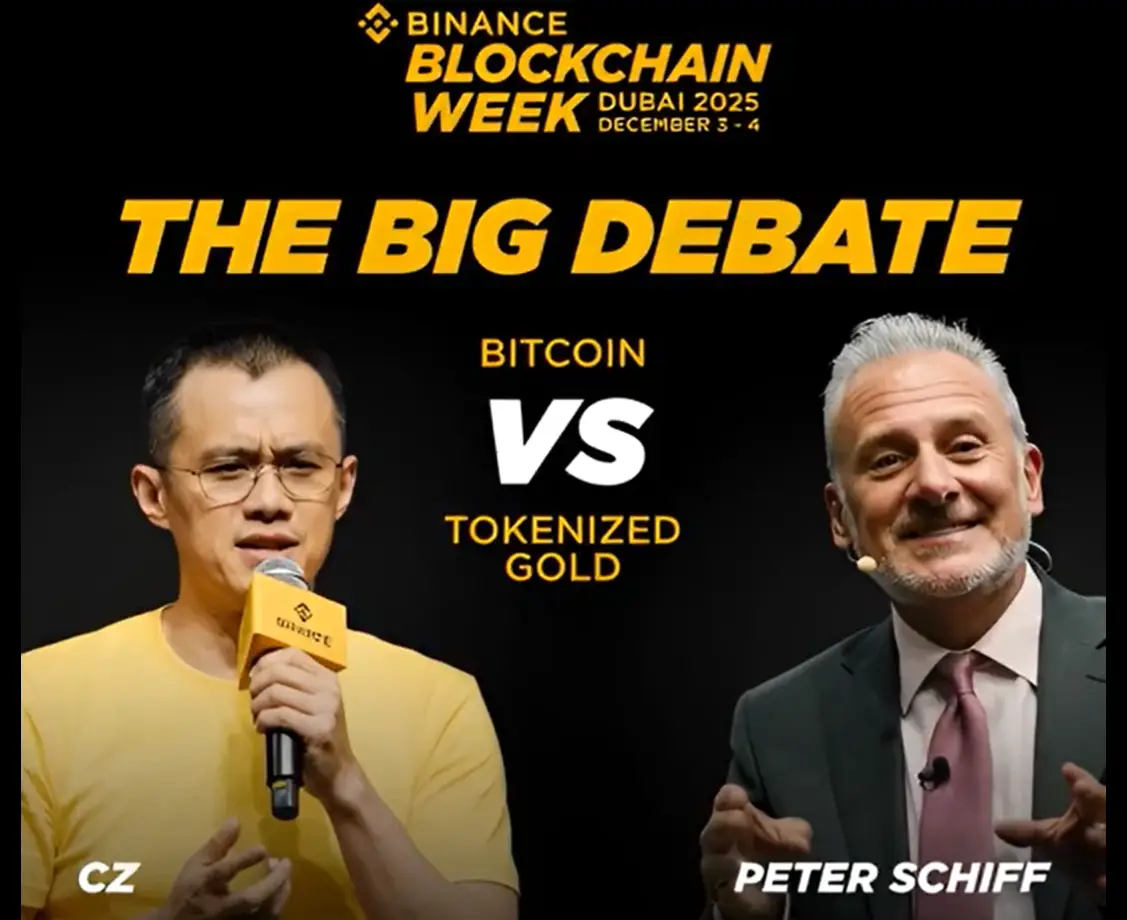
Binance Blockchain Week Features Landmark Debate
One of the most anticipated events in the crypto industry and beyond is the “Bitcoin vs Tokenized Gold” debate between gold advocate Peter Schiff and Binance’s founder Changpeng Zhao. The debate is scheduled to take place on December 4th, during the second day of the Binance Blockchain Week in Dubai, which officially debuts on December 3rd. The event will be held at the Coca-Cola Arena in City Walk and will feature focused conversations, hands-on workshops, and dedicated networking opportunities designed to connect traders, builders, founders, institutions, and policymakers.
CZ and Peter Schiff – The Big Debate: Bitcoin vs. Tokenized Gold
The significant debate will occur on December 4th on the main stage at Binance Blockchain Week, commencing at 15:55 and lasting approximately 45 minutes. Two prominent figures from traditional finance and Web3 will engage in a head-to-head discussion on whether the future will be dominated by Bitcoin or tokenized gold.
Peter Schiff and Changpeng Zhao
Peter Schiff, representing traditional finance, is a respected economist, Chief Market Strategist, and Founder at Euro Pacific Asset Management and Schiff Gold. He is also an American stockbroker, financial commentator, and radio personality, having co-founded Echelon Wealth Partners in Canada, a wealth and capital markets firm. Schiff is also the founder of the Schiff Sovereign publishing company, which provides financial insights and advice through newsletters and membership services. He is a staunch advocate for gold, emphasizing the precious metal’s “objective value” due to its conductivity, malleability, corrosion resistance, and real industrial and commercial uses. He has been critical of Bitcoin and the crypto industry, stating that “Bitcoin’s value is purely subjective, as it has no utility beyond belief.”
Changpeng Zhao, widely known as CZ, is the founder of Binance, the world's largest cryptocurrency exchange. He established Binance in 2017 and, in the same year, founded Binance Labs (later rebranded to YZi Labs in 2025), a family office focused on investments in Web3, AI, and biotech. After stepping down as Binance's CEO in 2023 due to legal matters, CZ has remained involved in the ecosystem, supporting the crypto exchange, the BNB Chain, and YZi Labs. In 2024, CZ founded Giggle Academy, a free English learning application for children globally, driven by the belief that everyone should have access to education. The platform's primary mission is to make learning fun and accessible to all. CZ has participated in various charitable initiatives and invested in projects across the Web3 ecosystem and beyond. Binance remains CZ’s most significant creation, currently managed by Richard Teng following CZ’s departure from the CEO role. With over 300 million registered users, the exchange continues to lead the crypto industry, maintaining its reputation through a strong culture and resilient principles, despite market volatility and challenges. CZ is recognized as one of the most influential advocates for Bitcoin and cryptocurrencies worldwide, promoting global adoption and highlighting the benefits of digital assets.
The Origins of the Bitcoin vs Tokenized Gold Debate
Following CZ’s pardon by the US President, Donald Trump, in October 2025, Peter Schiff extended his congratulations via a post on X, proposing a Bitcoin versus tokenized gold debate to celebrate. CZ responded positively, expressing his willingness to participate and noting that despite Schiff’s strong criticism of Bitcoin, he has always maintained a professional and non-personal approach, which CZ appreciates.

Since October, both prominent figures in the financial ecosystem have exchanged views on the subject via X. The highly anticipated face-to-face debate is now set to take place this Thursday during the Binance Blockchain Week.

Who Wins between Bitcoin and Tokenized Gold?
Bitcoin, the pioneering cryptocurrency, was created in 2008 as an electronic peer-to-peer cash system amidst a global financial crisis by the pseudonymous entity or group known as Satoshi Nakamoto. Its use as a currency began in 2009 with the release of its open-source implementation. Since its inception, Bitcoin has become a crucial component of the financial system, and in technological terms, it is regarded by some as one of the most disruptive technologies since 1,000 AD. Bitcoin offers an alternative to the traditional financial system, functioning as a censorship-resistant asset built on innovative technology and free from centralized control. In an era where a few entities control money and the financial system faces challenges, the demand for decentralization and financial freedom has grown significantly. Bitcoin reached an all-time high above $126,000 on October 6, 2025.

Gold, a precious metal, has traditionally been the asset of choice for storing value in conventional markets. Gold has proven its reliability as a safe haven for preserving value over time, exhibiting less volatility compared to Bitcoin. While this lower volatility might be seen as an advantage for gold in value storage, Bitcoin's price has experienced exponential growth relative to gold.

Tokenizing gold involves representing digital gold through blockchain tokens, where each token corresponds to a specific quantity of physical gold stored securely in vaults. Although gold and Bitcoin are distinct assets with different characteristics, some may perceive tokenized gold as a competitor to Bitcoin. However, several key distinctions between these asset classes are worth noting.
Tokenized Gold is Not Onchain Gold
As CZ has pointed out, tokenized gold is not the same as on-chain gold. Tokenization of gold involves trusting a third party to provide gold at a later date, even after management changes, potentially decades later, or during times of conflict.

Underlying Assets
Tokenized gold is linked to physical gold and its value, meaning the value of digital gold will fluctuate in relation to its underlying physical asset. Bitcoin, on the other hand, was not designed with an underlying asset; it is not tied to anything material and was created directly on-chain. While people measure Bitcoin's value against various fiat currencies to assess its volatility, it is crucial to understand that Bitcoin was created to possess intrinsic value, independent of any underlying physical asset.
Predictability
Tokenized gold's value is tied to physical gold, which, while not infinite on Earth, lacks a finite, known limit. For instance, China recently discovered the largest single gold deposit in over 70 years. The world's future gold discoveries and their timing remain uncertain. In contrast, Bitcoin has a predetermined scarcity; it is certain that only 21 million Bitcoins will ever exist, a limit set by Satoshi Nakamoto. This finite supply gives Bitcoin a distinct advantage in predictability.
Programmability
While the underlying asset of tokenized gold is subject to unpredictability regarding future discoveries, Bitcoin was designed with built-in programmability. Every four years, Bitcoin undergoes a halving event, which reduces the rewards for BTC miners. In 2024, miner rewards decreased from 6.25 BTC to 3.125 BTC per block. This halving schedule also provides an approximate timeline for when the last Bitcoin will be mined, estimated to be around the year 2,140. Thus, while the discovery of the last piece of gold on Earth is uncertain, the approximate date when all BTC will be in circulation is known.
Bitcoin Builds a New Financial System
Tokenized gold is predicated on a tangible asset and requires trust in a third party. Bitcoin, conversely, is a peer-to-peer electronic cash system based solely on itself—intangible, censorship-resistant, and built upon mathematics, predictability, programmability, energy, and incorruptibility. Its intrinsic value is understood by its supporters. Bitcoin has the potential to transform the world positively, establishing a new financial system grounded in truth, resilience, and transparency.