



Bitcoin's rally to an all-time high above $126,000 on October 6th marked the peak of a historic expansion. However, within days, the trend reversed sharply.
According to new analysis from The Kobeissi Letter, the turning point occurred on October 10th. This was the day President Trump threatened 100% tariffs on China, an announcement that coincided with the largest single-day crypto liquidation ever recorded, totaling –$19.2 billion.
This liquidation shock disrupted the market's momentum. Bitcoin failed to regain its footing, even during subsequent periods of improved macro news.
Trade Relief Failed to Calm the Market
The situation deteriorated on October 30th, when a U.S.–China trade deal was reached. Instead of stabilizing sentiment, liquidation pressures intensified. Elevated leverage and crowded speculative positions led to continuous forced selling across derivatives markets.
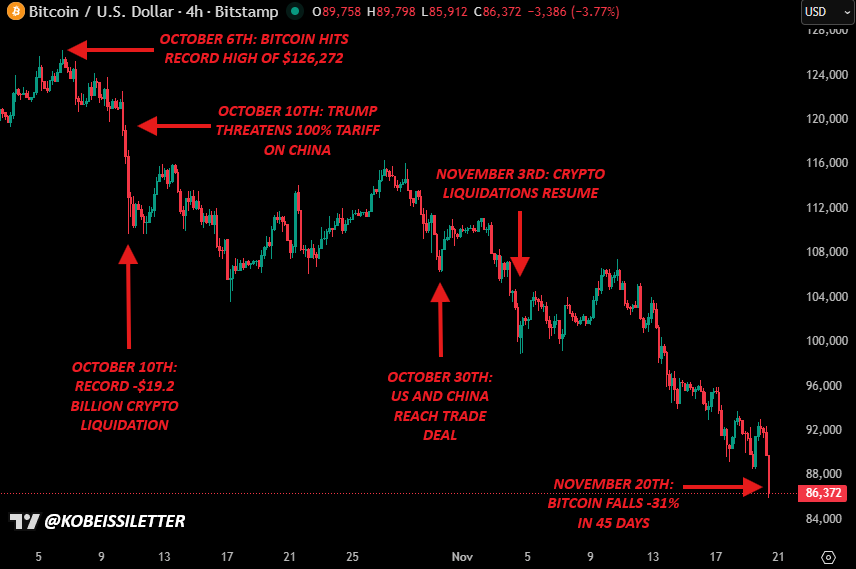
By November 3rd, liquidation waves resumed. From November 10th onward, Bitcoin experienced a notably linear decline, drifting lower. Average daily liquidations approached $1 billion, indicating a market driven by mechanical forces rather than reactions to new fundamental risks.
A 31% Decline Without a Fundamental Catalyst
By November 20th, Bitcoin had fallen 31% in 45 days, dropping to approximately $86,000. Significantly, this decline occurred without any substantial bearish macro events. Equities and metals continued to reach new highs during the same period, underscoring the isolated nature of the crypto downturn.
The analysis concludes that the drawdown reflects a mechanical bear market. This was driven by excessive leverage, thin liquidity, and sporadic liquidation clusters feeding into one another. Structural fragility, rather than deteriorating fundamentals, was the primary force behind this downturn.
A Market Clearing Process
Mechanical selloffs typically resolve once leverage fully unwinds and spot-driven flows regain dominance. If this pattern holds true, the recent correction may represent a structural reset rather than a long-term shift in crypto’s fundamental trajectory.