



Key Developments in Bitcoin's Institutional Phase
Bitcoin's institutional adoption has seen a significant increase, with exchange-traded funds (ETFs) and corporate treasuries now holding approximately 12% of the total Bitcoin supply. This development marks a crucial phase in Bitcoin's maturation, with its future trajectory increasingly influenced by investor exposure rather than solely by belief in the asset.
Ark Invest analyst David Puell highlighted this trend, emphasizing that the growing institutional involvement is contributing to a reduction in Bitcoin's volatility. This stabilization is making Bitcoin more appealing to a broader range of investors, including those with lower risk preferences, and is bolstering its status as "digital gold."
ETFs and Corporate Treasuries Drive Institutional Growth
The increasing percentage of Bitcoin supply held by ETFs and digital asset treasuries signifies a growing confidence in Bitcoin's stability and potential as an investment. The anticipated launch of spot Bitcoin ETFs in 2024 is expected to further reduce market volatility and create a more stable investment environment, thereby encouraging wider institutional participation.
This shift towards institutional tools like ETFs is seen as a pivotal moment for mainstream adoption. Analysts note that while the broader market may remain hesitant, investors with lower risk tolerances are increasingly showing interest in Bitcoin due to its narrowed pullback magnitudes and lower volatility observed over the past year.
Bitcoin's Role as "Digital Gold" Strengthened by Institutional Support
In 2024, public companies held approximately 1 million Bitcoin, representing a 40% quarterly increase. This trend indicates a significant shift towards regulated and institutional utilization of Bitcoin.
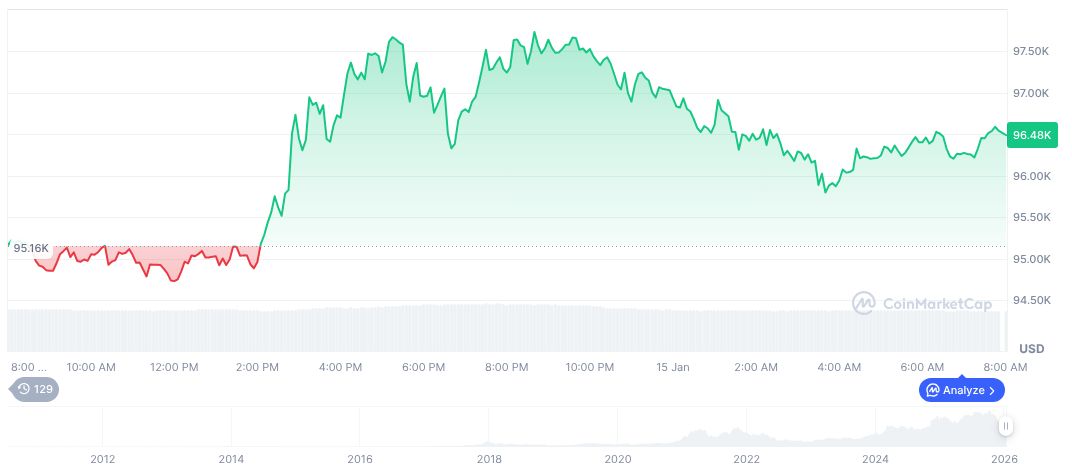
As of January 15, 2026, Bitcoin (BTC) was trading at $96,810.06, marking a 1.25% increase over the preceding 24 hours. The market capitalization stood at $1.93 trillion, with Bitcoin maintaining a 58.94% dominance. Despite an 11.49% gain over 30 days, the 24-hour trading volume experienced a 29.65% drop.
These institutional trends are predicted to influence regulatory developments and potentially create new opportunities for Bitcoin's integration within financial markets. The increasing focus on institutional adoption underscores Bitcoin's evolving role as "digital gold," supporting its use as a treasury asset and collateral on a larger scale.