



Key Developments
BlackRock's tokenized fund, BUIDL, has deposited approximately $500 million on the Polygon network. This significant transaction has been confirmed by the CEO of Polygon, marking a notable moment of institutional engagement within the blockchain space.
This development underscores the increasing interest from institutions in blockchain-based financial systems. It is expected to boost demand for Polygon's ecosystem and influence the market dynamics surrounding tokenized real-world assets.
Strategic Implications of BlackRock's Investment
BlackRock's BUIDL fund has deposited approximately $500 million onto the Polygon network. This substantial transaction has been confirmed as a legitimate deployment by Polygon’s CEO. It signals deepening institutional engagement with decentralized ledger technology and demonstrates confidence in Polygon's infrastructure.
The $500 million infusion makes a direct liquidity impact within the Polygon ecosystem. By increasing the Total Value Locked (TVL) specifically related to BUIDL, this new cash flow showcases Polygon’s growing role in blockchain finance structures. The introduction of institutional assets into the network further integrates traditional finance with decentralized innovations.
"The on-chain $500 million BUIDL deposit... is legitimate and pertains to BlackRock's deployment." - Sandeep Nailwal, CEO of Polygon.
Rising Institutional Adoption in Blockchain Finance
In 2025 alone, BlackRock’s BUIDL fund strategically expanded across seven major blockchain networks, showcasing a trend of diverse, institutional blockchain adoption.
As of the last update, Ethereum (ETH) holds a price tag of $3,966.69, boasting a market cap of $478,772,812,450 and commanding 12.78% market dominance. Over the past 24 hours, trading volume reached $38,019,059,854, though it experienced a decline of 12.32%. Notably, ETH's price saw a 3.25% increase within the last day and a 5.79% uptick over 90 days.
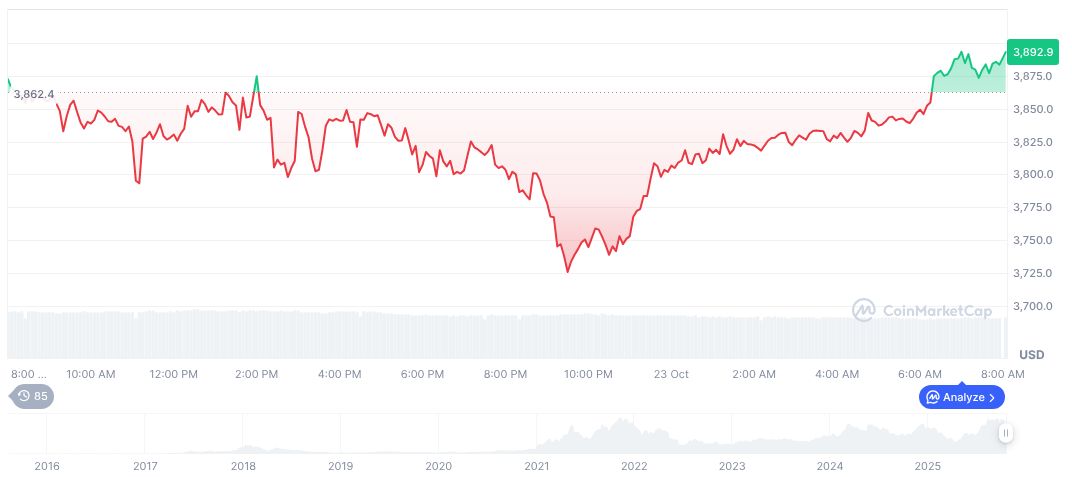
Market analysts at Coincu reflect on this massive infusion of institutional capital onto blockchain platforms as indicative of a long-term shift. This adoption not only illustrates regulatory acceptance but also marks a transformation towards more compliant and secure digital asset usage within traditional finance realms. Incorporating blockchain's decentralization and efficiency may continue to shape financial sectors.