


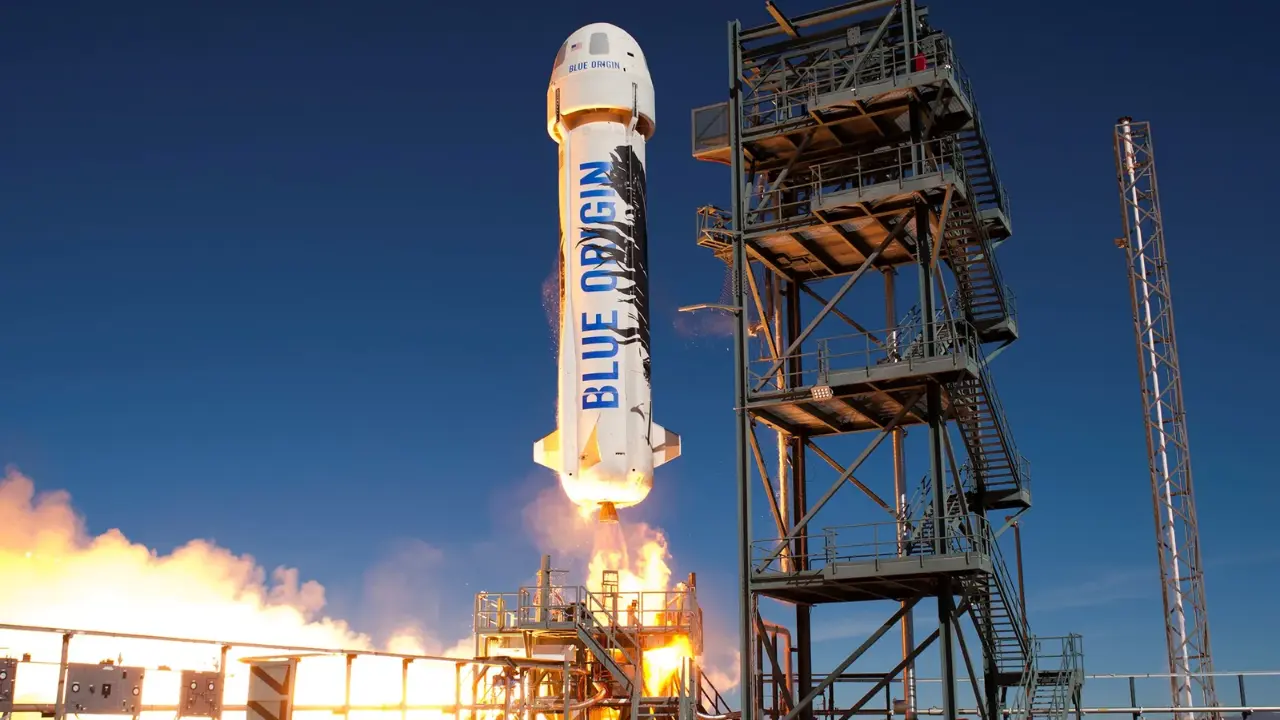
Jeff Bezos’ aerospace company, Blue Origin, is emerging as a direct competitor to Elon Musk’s SpaceX with its announcement of developing the technology necessary to launch data centers into space.
Blue Origin has been engaged in developing space-based data center technology for over a year, while SpaceX is reportedly focused on upgrading its satellites to accommodate AI computing capabilities.
Blue Origin and SpaceX Compete for Space AI
Blue Origin has been developing the necessary technology for artificial intelligence data centers in orbit for more than a year, according to reports citing individuals familiar with the matter.
The concept of data centers in space has garnered significant interest from major tech companies, driven by the substantial electricity and water consumption of traditional Earth-based facilities.
Currently, data centers account for approximately 415 terawatt hours of electricity globally, representing about 1.5% of the total power consumption in 2024, according to the International Energy Agency. Large-scale facilities can consume up to five million gallons of water daily for cooling purposes.
SpaceX is reportedly planning to utilize upgraded Starlink satellites to host AI computing payloads, presenting this technology as part of a share sale that could potentially value the company at up to $800 billion. Elon Musk has publicly denied this valuation figure on social media, deeming such reports inaccurate.
He further clarified that SpaceX conducts regular stock buybacks twice a year to provide liquidity for employees, rather than to raise new capital.
Amazon founder Jeff Bezos predicted in October that gigawatt-scale data centers would be constructed in space within the next 10 to 20 years. He posited that the continuous availability of solar energy would eventually render space-based facilities more cost-effective than those situated on Earth.
“We will be able to beat the cost of terrestrial data centers in space in the next couple of decades,” Bezos stated.
Other Companies Exploring Space Data Centers
The Nvidia-backed startup, Starcloud, recently launched a satellite equipped with an Nvidia H100 graphics processing unit into space. The company successfully trained and operated Google’s Gemma AI model in orbit for the first time.
Philip Johnston, CEO of Starcloud, informed CNBC that the company’s orbital data centers are projected to have energy costs ten times lower than facilities built on Earth. The startup intends to construct a five-gigawatt orbital data center featuring extensive solar and cooling panels, measuring approximately four kilometers in both width and height.
Aetherflux announced its “Galactic Brain” project on December 9. The company's objective is to deploy its initial low Earth orbit data center node in the first quarter of 2027, with thousands of satellites expected to follow.
Axiom Space announced in April 2025 that it would launch its first two Orbital Data Center nodes into low Earth orbit by the end of the current year. Google also unveiled a “moonshot” initiative named Project Suncatcher in November, aiming to deploy solar-powered satellites equipped with Google’s tensor processing units into space.
Analysts from Morgan Stanley have raised concerns that harsh radiation could potentially damage computer chips. Challenges may also arise from difficulties in maintaining systems in orbit, hazards posed by space debris, and regulatory complexities concerning data governance and space traffic management. Furthermore, the ongoing cost of equipping orbital data centers with the latest hardware could prove substantial.
However, recent analyses suggest that the significant carbon footprint associated with launching hardware into space could be offset within five years of operation. Following this period, such facilities could theoretically operate indefinitely on renewable energy sources.
SpaceX is also reportedly seeking to raise more than $25 billion through an initial public offering scheduled for 2026, a move that could elevate the rocket maker's valuation to over $1 trillion.