


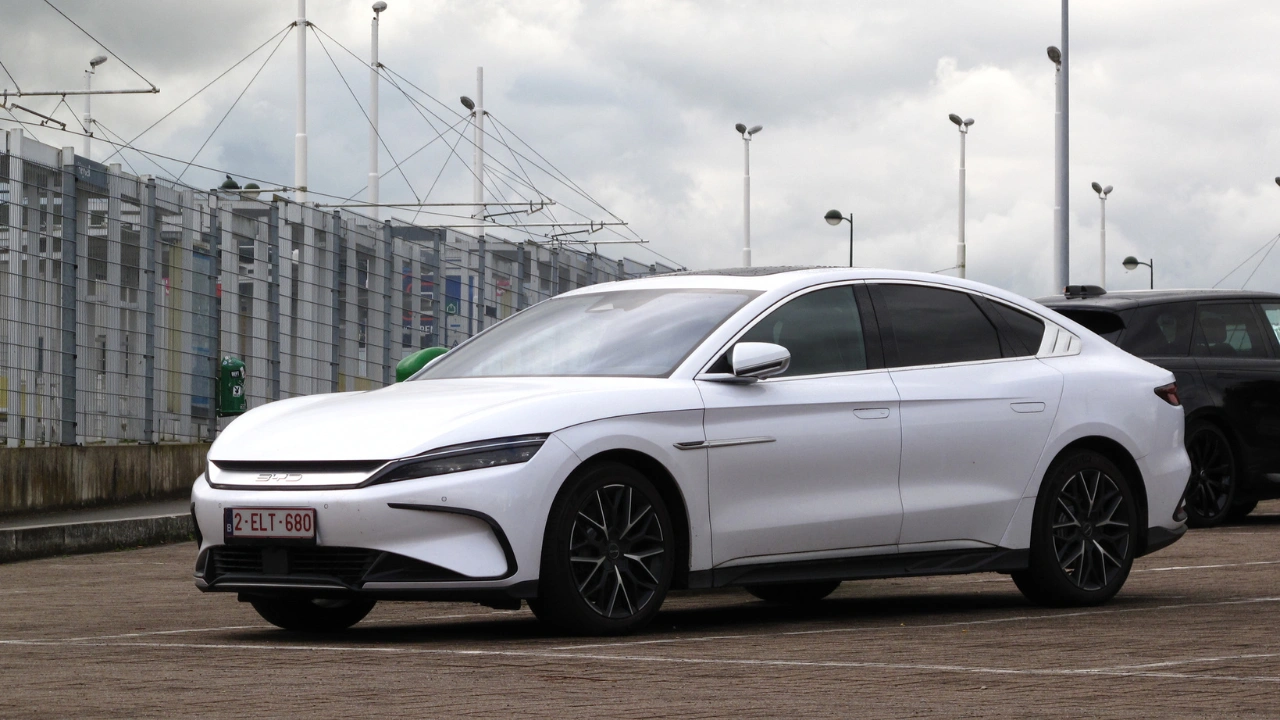
BYD Faces Domestic Challenges
BYD, the Chinese electric vehicle manufacturer, has reported its third consecutive monthly decline in sales, delivering 480,186 vehicles in November. This represents a 5.3% decrease compared to the previous year, a significant downturn occurring at a critical juncture when Chinese consumers typically accelerate purchases to take advantage of the full new-energy vehicle tax exemption before its year-end expiration.
The slowdown in BYD's domestic sales is attributed to diminishing interest in its vehicle models across China. Competitors such as Geely Automobile Holdings Ltd. have successfully launched updated versions of their popular mass-market cars, while Xiaomi Corp. has seen its SU7 model emerge as a breakout success. These developments have impacted BYD's market share in both the budget-friendly and more premium segments of the electric vehicle market.
With only one month remaining in the year, BYD faces the challenge of selling approximately 418,000 more cars in December to meet its revised full-year target of 4.6 million vehicles. This situation is further compounded by two consecutive quarters of declining profits, occurring as China implements stricter regulations on deep discounting, a strategy that had previously been instrumental in BYD's market growth over the past two years.
Export Performance and International Headwinds
BYD's export performance offered a glimmer of positivity, with 131,935 vehicles shipped abroad in November. However, this international success was insufficient to offset the decline in domestic sales. The company's global expansion strategy is also encountering significant obstacles.
Rising trade barriers in Europe and North America are increasingly impeding BYD's ability to penetrate these markets, particularly as China's domestic electric vehicle supply continues to grow. This challenging international landscape is also reflected in BYD's registration figures across Europe, which are showing signs of deceleration.
In Sweden, November registrations for BYD vehicles saw a notable drop of 51%, and in Norway, a decrease of 50.3% was recorded. Denmark emerged as an exception, with a modest 6% increase in registrations during the month. These figures underscore that the pressure on the BYD brand is not confined to China but is a discernible trend across multiple international regions.
Tesla's European Struggles and Market Dynamics
Meanwhile, Tesla has also experienced its share of difficulties in the European market during November. Registrations in France plummeted by 58% to 1,593 vehicles, while Sweden recorded a 59% decline, with 1,466 vehicles registered. Denmark saw a 49% fall to 534 vehicles. These decreases occurred despite Tesla's recent updates to its Model Y earlier in the year.
The sole region where Tesla found traction was Norway, where registrations nearly tripled to 6,215 vehicles, thereby setting the country's annual EV sales record with a month still remaining in the year. This contrasts sharply with its performance in other key European markets.
Tesla's European sales slowdown reportedly began in late last year, following controversial public statements by Elon Musk. The situation was further complicated in November by a fire at a Tesla dealership in Southern France, which prompted an official criminal investigation. Despite Musk's subsequent withdrawal from political commentary, the company's European performance has not yet recovered to previous levels.
Analysts point to rapidly increasing competition as a major factor. European consumers now have a wider array of choices, particularly from Chinese manufacturers. Tesla's current vehicle lineup is perceived as aging, and consumer trust may be eroding.
A recent study conducted by Escalent, surveying over 2,000 individuals across Europe's five largest automotive markets, indicated that 38% of respondents believe Tesla's appeal has diminished. The study suggests that Tesla lags behind its rivals in terms of design, quality, and emotional connection with consumers.
In an effort to re-ignite interest, Tesla introduced new, more affordable versions of the Model Y, priced around €40,000 in Germany. However, only a limited number of these vehicles reached Europe by the end of November. In Sweden, Model Y sales experienced a significant decline of 67%, totaling 426 units.
In Norway, Model Y sales increased by 19% to 3,648 units. Denmark, however, saw a substantial 74% plunge in Model Y registrations, reaching just 206 units, according to data from Bilstatistik.dk. The Model 3 performed slightly better in Denmark, with a 29% rise to 326 units, making it the eighth best-selling car in the country for November.
Returning to Scandinavia, BYD also faced setbacks. The company's November registrations dropped by 51% in Sweden and 50.3% in Norway. Denmark again stood out as an exception, experiencing a 6% increase in registrations.