


The start of 2026 brings mixed messages for Cardano. ADA still trades inside a bullish falling wedge pattern. The coin holds steady near $0.38 support. But blockchain data reveals a dramatic change in buying and selling behavior. This split forces traders to think twice. Is the current price stability a real accumulation? Or are we watching redistribution happen in real time?
At the same time, Zero Knowledge Proof (ZKP) catches attention for different reasons. Its Proof Pods offer hardware-based systems that prove contributions instead of assuming them. These two stories shape how the market now decides what counts as the best crypto to buy now in 2026.
Cardano Blockchain Data Reveals 135% Surge in Long-Term Selling Activity
The biggest signal in ADA's recent price movement comes from holder behavior, not chart patterns.
Blockchain data reveals:
- •Holders of 365 days to 2 years boosted selling from ~1.92M ADA to ~4.51M ADA within 24 hours, a 135% increase
- •Holders of 30 to 60 days cut selling from ~55.4M ADA to ~4.28M ADA, a 92% drop

This shift tells a clear story. Long-term participants cash out during strength. Short-term traders rush in to buy the available supply.
Cardano's Price Stability Stands on Shaky Ground
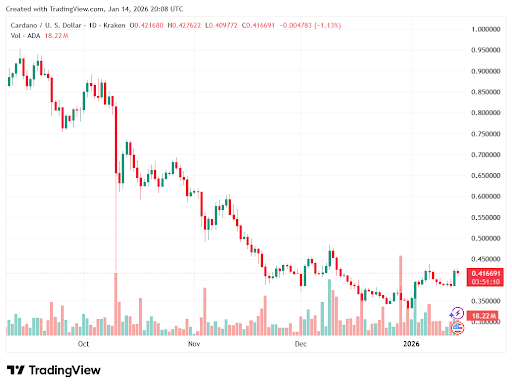
From a technical view, ADA sits inside a falling wedge that started forming in early November. This pattern usually signals bullish momentum as selling fades over time.
Critical price levels to watch:
- •Support: ~$0.351, with deeper risk toward ~$0.328 if this breaks
- •Bullish trigger: Daily close above $0.437, opening a potential ~49% rally
- •Current trading range: ~$0.38–$0.41
But derivatives activity makes things complicated. Long-term holder exits, heavy leverage positions, and short-term buying create an unstable balance.
Here's what this means:
- •Traders prop up the price, not true believers
- •Stability relies on leverage staying intact, not growing network use
- •Breaking support could trigger fast drops through forced sell-offs
This keeps ADA stuck in short-term trading mode. The coin lacks structural strength right now.
Zero Knowledge Proof Captures Massive Attention in 2026
Zero Knowledge Proof (ZKP) operates as a Layer 1 blockchain. It uses zero-knowledge cryptography (zk-SNARKs/zk-STARKs) to verify computations while keeping data hidden. Ethereum shows everything publicly. ZKP works differently. It lets AI train on encrypted hospital records, banking files, and business data without exposing anything.
The team poured $100 million into building infrastructure before the presale auction. A live testnet runs today. Proof Pods ship now and generate passive income. A Miami Dolphins partnership proves the technology works. ZKP tackles the $100+ billion AI privacy problem. It proves calculations happened correctly while keeping everything confidential. This opens markets that transparent blockchains simply cannot reach. The presale auction runs for 450 days. It distributes 200 million coins daily through a proportional system. Entry starts at just $20.
Proof Pods Explained: What Makes Them Different?
Zero Knowledge Proof takes a completely fresh approach to network participation. It skips staking stories, social numbers, or guessed engagement. ZKP brings Proof Pods to the table. These are custom-built hardware units that create verifiable computational output.
Proof Pods turn participation into something you can measure.
The network doesn't ask if users stay "active." Instead, it verifies:
- •What computation happened
- •When it happened
- •That it ran correctly, all without showing the underlying data
Zero-knowledge cryptography powers this system. It proves work got done without revealing sensitive inputs or results.
Proof Pods change crypto participation from vague contribution to actual physical output.
What changes at the structural level:
- •Participation gets proven, not guessed
- •Contribution links directly to hardware output, not feelings
- •Network activity faces audits without losing privacy
- •AI and regulated workloads run safely without data exposure
Most markets measure "engagement" through wallet numbers or speculative trading volume. Proof Pods break this mold. They create a system where value creation becomes clear and provable.
Why ZKP Commands Growing Market Interest
Markets now focus harder on ZKP because its design puts structure before speculation. Privacy-first technology built on zero-knowledge proofs powers the system. Proof Pods turn participation into measurable output.

ZKP clears up the confusion that often surrounds early-stage networks. As capital grows pickier, systems with verifiable contribution attract stronger interest than those based on guesswork.
Final Thoughts
Cardano's current situation follows a familiar script. Short-term traders hold up price stability. Long-term holders quietly reduce their exposure. This doesn't destroy ADA's long-term case. But it does make near-term price action look structurally weak.
Zero Knowledge Proof sends a different message. Proof Pods tie participation directly to hardware-based output. This removes all guessing about engagement. Markets now look closer at substance over story. That difference now plays a central role in finding the best crypto to buy now.
FAQs
Why do long-term Cardano holders sell while ADA's price stays stable? Blockchain data shows older holder groups distribute coins to short-term trader demand. This supports price but doesn't show renewed belief in the project.
What breaks ADA's bullish pattern? A drop below $0.351 would damage the structure. This would open downside risk toward $0.328.
How do Proof Pods work in Zero Knowledge Proof? Proof Pods are hardware devices that produce verifiable computational output. They make participation measurable instead of assumed.
What qualifies as the best crypto to buy now based on structure? Markets now prefer projects where supply, participation, and output can be verified. Story-driven projects lose appeal.