



Key Developments in Crypto Regulation
Michael Selig, Chairman of the U.S. Commodity Futures Trading Commission (CFTC), announced the launch of the "Future Proof" program, an initiative aimed at modernizing the regulation of digital assets.
This program signifies the CFTC's proactive approach to adapting its oversight for emerging digital markets, especially in light of ongoing legislative challenges that impact the cryptocurrency regulatory landscape.
CFTC's Modernization Drive: "Future Proof" Initiative Announced
On January 20th, Michael Selig detailed the "Future Proof" initiative, a comprehensive program designed to update the CFTC's regulatory framework for digital assets. Selig emphasized the critical need to modernize regulations, noting that rules established decades ago are no longer suitable for the contemporary digital economy.
The objective of this initiative is to implement a regulatory approach that is effective without hindering innovation. The program is expected to enhance the CFTC's capacity to oversee not only existing derivative markets but also evolving products such as digital assets and prediction markets.
"Aims for a durable, adaptable framework via formal rules on registration, customer protection, market surveillance for crypto." - Michael S. Selig, Chairman, U.S. Commodity Futures Trading Commission (CFTC)
Market analysts have generally reacted positively to the CFTC's announcement, recognizing the agency's preparedness to address new challenges in the digital asset space. Despite the stalled legislative progress, the CFTC's proactive measures are considered significant. Chairman Selig has extended an invitation for experts to join the newly formed Innovation Advisory Committee.
Bitcoin Faces Market Fluctuations Amid Regulatory Developments
Historically, the CFTC's focus has been on derivatives. The "Future Proof" initiative represents a notable shift, signaling a broader evolution in regulatory strategies to effectively manage digital asset oversight.
As of January 20, 2026, Bitcoin (BTC) was trading at $89,464.19, with a market capitalization of $1,787,357,110,343.69. Over the preceding 24 hours, BTC experienced a 3.77% decrease, reflecting the broader volatility in the cryptocurrency market. Despite these fluctuations, Bitcoin maintained a strong market dominance of 59.18%.
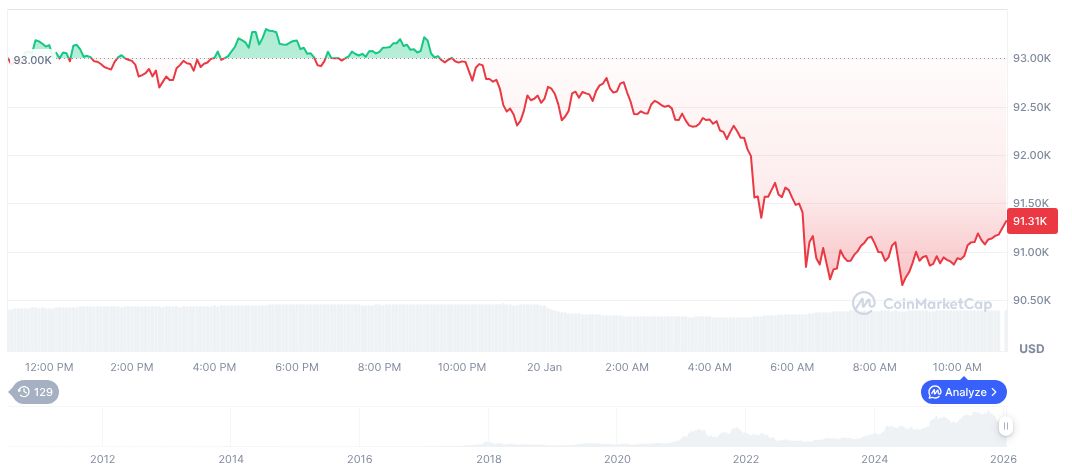
The Coincu research team highlights the strategic importance of the CFTC's new initiative, suggesting it could foster greater stability and enhance investor confidence in the digital asset market. The development of a more harmonized regulatory framework may encourage broader market participation as formal regulations are established. Developments in other regions, such as China's recent enhancements to its crypto regulations, also contribute to the evolving global landscape of cryptocurrency oversight.