



Key Developments in China's Regulatory Approach
The People's Bank of China has significantly strengthened its regulatory efforts to combat virtual currency speculation. This intensified approach is a direct response to a surge in virtual currency hype within China, emphasizing stricter regulations and advanced technical monitoring systems to curb money laundering activities. These measures are particularly aimed at safeguarding socioeconomic youth from the potential pitfalls of unchecked virtual currency dynamics.
The enhanced regulations are designed to mitigate financial crimes and protect the broader economy from the evolving challenges posed by virtual currencies. This strategic shift in financial policy is impacting market activities and provoking considerable strategic financial shifts within the country.
Intensified Crackdown and Prosecutions
China's regulatory efforts against virtual currency speculation have reached a new level of intensity. Prosecutions for money laundering involving cryptocurrencies saw a substantial rise, with 3,032 individuals prosecuted in 2024 alone. This figure highlights significant regional concentrations of such illicit activities. Central to the ongoing efforts are the enhancement of monitoring capabilities and improved coordination among various regulatory bodies.
China's comprehensive regulatory approach imposes restrictions on all virtual currency-related financial activities. A particular focus is placed on stablecoins, which have been identified as a tool for cross-border finance. In contrast, Hong Kong is planning to implement a stablecoin licensing regime, indicating a divergence from the mainland's more restrictive policies. This divergence is further underscored by a strict requirement for full identity verification to limit access to such financial instruments.
Prominent figures in the cryptocurrency space, including Changpeng Zhao of Binance and Vitalik Buterin of Ethereum, have offered insights into China's stringent restrictions. Their comments highlight the limitations these policies may place on innovation while also underscoring the importance of regulated financial systems. Industry responses indicate a prevailing caution regarding compliance with these evolving regulations.
Impact on the Bitcoin Market
China's robust crackdown has led to a significant number of prosecutions for crypto-related money laundering, with 3,032 individuals prosecuted in 2024. This statistic serves as a stark illustration of the profound impact of enhanced monitoring and strict regulatory enforcement within the region.
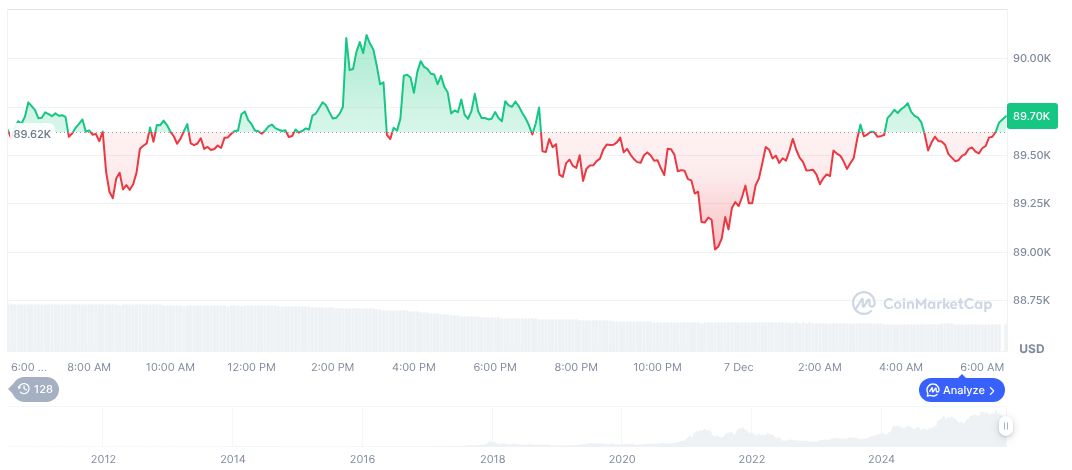
As of December 7, 2025, Bitcoin (BTC) holds a substantial market capitalization of 1,782,300,753,063.34, representing 58.57% of the total market share. In recent times, BTC has experienced a 30-day price decrease of 10.46%, a trend that reflects the heightened regulatory environment. This data is sourced from CoinMarketCap.
Expert analysis from Coincu suggests that China's resolute regulatory stance, coupled with its emphasis on continuous monitoring, continues to impose limitations on decentralized finance activities. These restrictions are observed to be pushing technological adaptation and investment offshore. Concurrently, the controlled rollout of the digital yuan provides a state-sanctioned alternative to decentralized cryptocurrencies.