



Key Smart Contract Features and Design Principles
China's digital renminbi (e-CNY) smart contracts are designed with a focus on security and compliance with fiscal guidelines. These contracts are limited in their Turing completeness and are based on an account system, which distinguishes them from the more open-ended Ethereum-style contracts. This approach prioritizes conditional execution for robust risk control.
The e-CNY's smart contract model supports Ethereum's Solidity language, with an emphasis on simplified functional execution. The design is guided by financial compliance and risk management principles, ensuring that contracts remain within the People's Bank of China's security constraints to bolster user protection. While there is technical potential for broader capabilities, the current design prioritizes security and impacts future integration with financial systems.
There is no official confirmation from PBOC leadership on the full scope of new features, such as comprehensive Solidity support. Market observers are awaiting further details as the central bank focuses on ensuring transactions align with domestic regulations while minimizing risks.
Cross-Border Prospects and Market Context
Blockchain technology, exemplified by Ethereum, has long been used to ensure transparency. In contrast, China's digital renminbi prioritizes state control through an account-based system. While cross-border blockchain applications are being researched, they have not yet been fully implemented.
Ethereum (ETH) is currently priced at $3,205.82, with a dominant market cap of $386.93 billion. Over the past 24 hours, trading volume reached $21.67 billion, showing a 2.96% decline. The coin's 90-day trend reflected an 18.53% decrease, indicating ongoing market fluctuations.
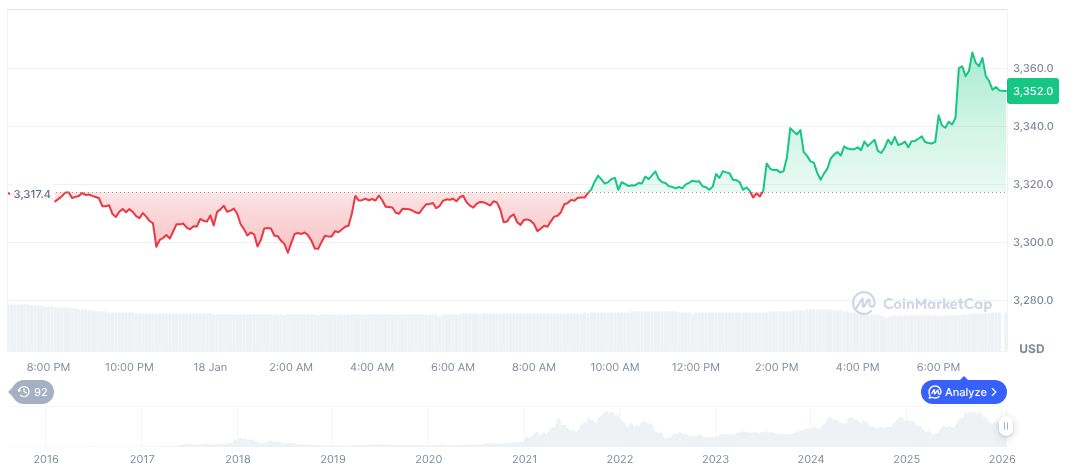
The e-CNY's emphasis on a restricted smart contract model may complicate wider blockchain adoption, although it effectively mitigates risks domestically. Potential integration in cross-border payments could significantly reshape global digital currency transactions.
"The People's Bank of China (PBOC), under Lu Lei, has outlined an action plan for e-CNY set to begin on January 1, 2026, focusing on integrating interest accrual into bank balance sheets and real-name wallet deposit insurance, but did not mention smart contracts or their characteristics."