



Key Developments in Cryptocurrency Regulation
On November 28, 2025, the People's Bank of China convened a high-level meeting in Beijing, intensifying its crackdown on virtual currency speculation and illegal financial activities across the nation.
This decisive action underscores China's stringent approach to cryptocurrency regulation, reinforcing the prohibition of virtual currencies and promoting the digital yuan to ensure economic stability.
China Tightens Control on Virtual Currencies
The People's Bank of China led a significant meeting advocating for tighter control on virtual currencies. This included high-ranking officials from China's major regulatory bodies, reinforcing the nation's strong stance against cryptocurrencies.
Virtual currencies, emphasized as not having legal status, include Bitcoin and stablecoins, which came under particular scrutiny for risks. China's legal and economic framework rejects cryptocurrency circulation, pushing for e-CNY adoption.
Stablecoins were flagged for inadequate controls over money laundering and fraud, reinforcing strict prohibition. China's zero-tolerance policy affirms its claim that only state-backed currencies are acceptable in its markets.
Pan Gongsheng, Governor of the People's Bank of China, emphasized, "Virtual currencies do not have the same legal status as fiat and should not and cannot be circulated as currency in the market."
China's stringent crypto ban has effectively eliminated domestic trading, with offshore markets absorbing previous volume and influencing global price stability.
Impact on Global Markets and Future Speculations
Bitcoin (BTC) recently priced at $91,352.91, has a market cap of $1.82 trillion and 24-hour trading volume of $37.75 billion—a 30.75% decrease. The price reflects a 5.99% increase over seven days but shows longer-term declines.
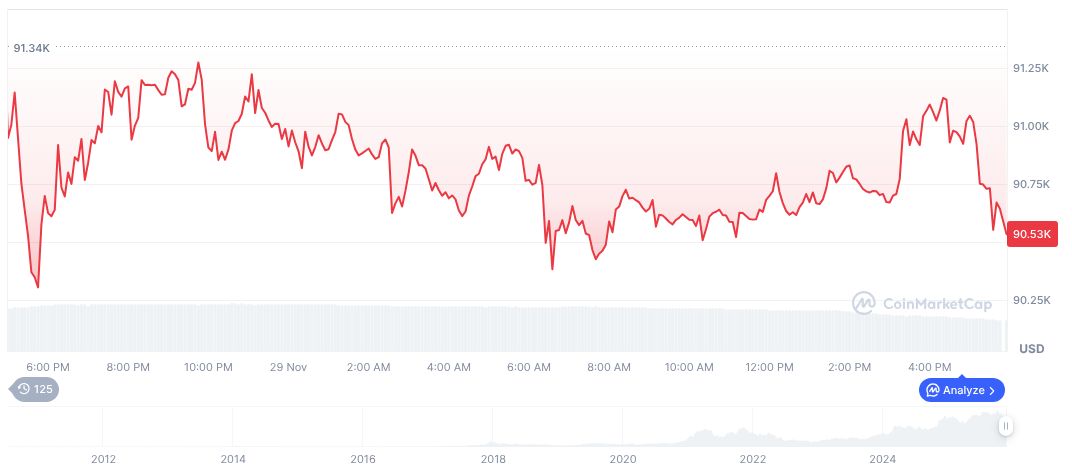
Coincu research analysts highlight that China's ban may shift crypto trading offshores, potentially causing fragmentation in global markets. Long-term, this could catalyze regulatory adjustments in jurisdictions observing China's model.