



Emphasis on Risk Management in Financial Sectors
Wu Qing, Chairman of the China Securities Regulatory Commission (CSRC), has underscored the critical need for stringent risk management practices, particularly concerning crypto assets. This emphasis was a central theme in his recent address at the Securities Association of China's annual meeting.
The CSRC chair specifically highlighted the necessity for heightened vigilance in sectors such as margin financing, over-the-counter (OTC) derivatives, and crypto assets. His remarks were geared towards reinforcing the rigor of financial analyses and enhancing the robustness of regulatory frameworks to preempt potential financial instability.
This stance by China's top financial regulator signifies a deliberate and cautious approach to the regulation of crypto assets. It suggests that institutional involvement in these markets might face significant limitations, a development that could potentially influence global market dynamics.
The immediate consequences of this directive involve the adoption of a more stringent risk management approach. This will particularly impact businesses operating within the crypto asset space. Wu Qing's advocacy is clear: the development of sectors where risks cannot be definitively managed should be avoided.
Market reactions to these pronouncements have been diverse. While some industry leaders interpret this as a reinforcement of China's consistent and predictable regulatory posture, others have voiced concerns about the potential for this approach to stifle innovation within the crypto-related industries. The overarching objective of the government's position appears to be the safeguarding of financial stability in the face of rapidly evolving technologies.
Historical Context of China's Crypto Regulation
China has a history of implementing cautious regulatory measures concerning cryptocurrency. Notably, in 2017, the country banned domestic cryptocurrency exchanges, marking a significant step in its ongoing pattern of closely monitoring and controlling the crypto asset landscape.
As of December 7, 2025, Bitcoin (BTC) continues to hold a dominant position in the cryptocurrency market. It boasts a market capitalization of $1.78 trillion and accounts for 58.52% of the total market share. Data from CoinMarketCap indicates a 24-hour trading volume of $35.98 billion, representing a substantial decrease of 40.79%. Bitcoin prices have shown a downward trend across various timeframes, with a notable reduction of 26.48% over the past 60 days.
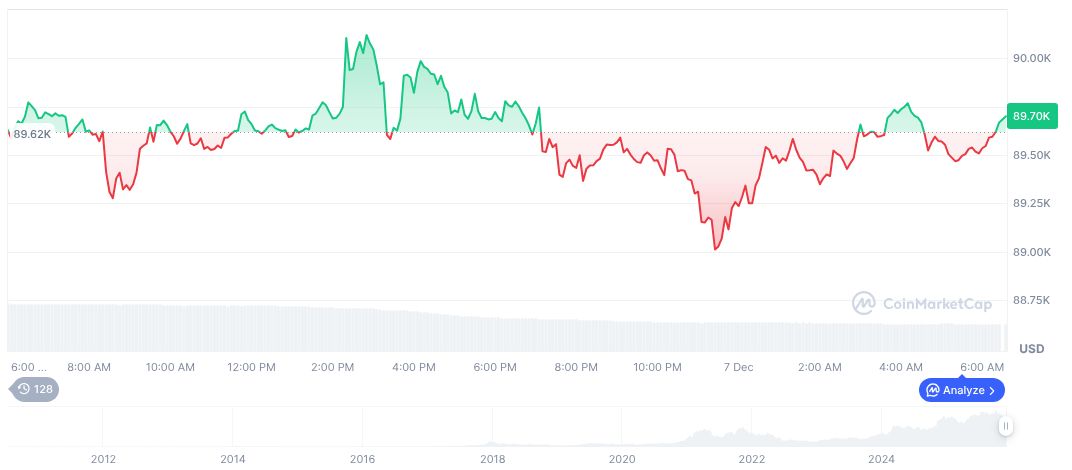
From an economic perspective, these regulatory shifts could lead to a more controlled financial environment within China. This might result in a slower pace of innovation for crypto-linked financial products in the country. This trend aligns with broader global efforts to strike a balance between maintaining financial stability and fostering technological advancement.