


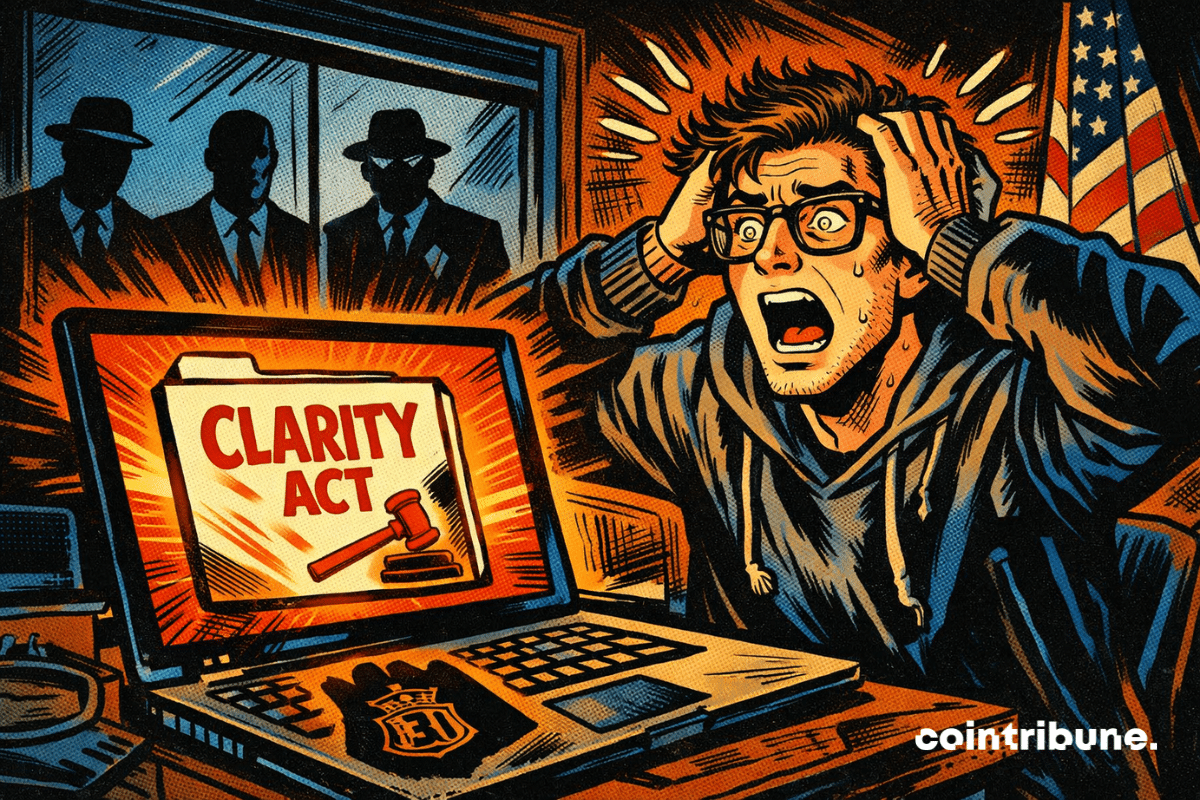
In the United States, crypto industry regulation efforts are turning into cacophony. After the Genius Act, it is now the Clarity Act stirring Washington. This text, supposed to clarify the structure of the digital market, has turned into a political and ideological battleground. Senators, banks, platforms, and developers clash with amendments and statements. And while the law stalls, DeFi feels threatened, caught between regulators and traditional finance.
In brief
- •The Clarity Act aimed for clarity but plunges DeFi into American regulatory uncertainty.
- •Coinbase blocks the legislative process, revealing crypto sector’s growing political power.
- •Section 604 creates a legal standoff between open source developers and US senators.
The Clarity Act: A Promise of Clarity Turned Gray Area
Originally, the Digital Asset Market Clarity Act, or Clarity Act, was supposed to give the United States a modern framework for digital assets. Presented by Senator Tim Scott, the bill aimed to protect consumers while strengthening national security. However, in practice, the law has the opposite effect.
The DeFi Education Fund, very active on X, denounced a series of amendments capable of destroying DeFi technology and worsening legislation for developers. These changes, notably amendments 42 and 45, would allow the Treasury to sanction smart contracts and impose identity checks (KYC) on developers who often have no contact with users.
In the thread, Jake Chervinsky, a recognized lawyer in the crypto sphere, did not mince his words:
The latest draft leaves ambiguity over whether all kinds of developers and infrastructure providers might be forced to verify users’ identities, register with the SEC, or comply with other rules that do not fit DeFi. On this point, zero tolerance for ambiguity.
This text, supposed to clarify the rules, thus plunges developers into worrying legal fog. The paradox is obvious: the promised “clarity” becomes a political and technical headache, threatening the vitality of decentralized finance.
Coinbase vs. Congress: When Crypto Asserts Itself as a Political Force in the United States
The Clarity Act episode marks a historic break. For the first time, a major crypto player, Coinbase, publicly blocked a federal initiative. A simple message from its CEO, Brian Armstrong, on X was enough to push the Senate Banking Committee to suspend the session planned to vote on the law.
The sudden collapse of the CLARITY Act markup was not a mere procedural delay in the legislative process. It was a revelatory moment in Washington, highlighting both the growing power of the crypto lobby and the increasingly visible rifts between crypto, the banking sector, and traditional finance.
Behind this episode lies a reality: crypto now has real political power. Coinbase acts as a center of gravity, federating developers, investors, and crypto NGOs.
But the move has also fractured the industry. Platforms like Kraken reproached Brian Armstrong for stopping a flawed but necessary process. This disagreement reveals a paradox: crypto demands regulation but fears it will arrive too quickly and in the wrong way.
In the United States, this standoff shows that crypto regulation is no longer a technical question but a power issue. And DeFi risks bearing the cost.
Section 604, Stablecoins, and Influence War: The Hidden Battle of the Clarity Act
Behind the suspension of the vote lies a cold war between two Congressional committees. The Banking Committee, led by Tim Scott, defends a pro-developer approach. But the Judiciary Committee, embodied by Senators Grassley and Durbin, accuses the bill of opening a “dangerous loophole” in the fight against money laundering. Their letter denounces the famous Section 604, which would exempt certain open source software creators from financial licensing, at the risk – according to them – of protecting players like Tornado Cash.
On the other side, Cynthia Lummis defends another bill, the Blockchain Regulatory Certainty Act, which aims to protect those “who simply write code without ever touching users’ funds.” A clear line: defending code neutrality against criminalization.
The debate also extends to stablecoins, the new battleground between banks and crypto firms. The former want to limit yields and programmability to retain monetary control. The latter denounce an attempt to expropriate innovation. For Todd Phillips, this opposition is a zero-sum game: if banks win, crypto loses.
Key Points of the Clarity Act and the DeFi Crisis
- •Vote suspension: no resumption date has been set;
- •Section 604: at the heart of the conflict between banks, senators, and developers;
- •Coinbase: first crypto player to block a federal initiative;
- •DeFi Education Fund: alert on anti-DeFi amendments;
- •Stablecoins: new frontline between traditional finance and crypto.
The United States is still trying to find the right balance between innovation and security. And while the Clarity Act bogs down, another debate resurfaces: stablecoin regulation. Players like JPMorgan remind that the Genius Act remains the best basis to frame these digital assets and avoid a prolonged legal void.