



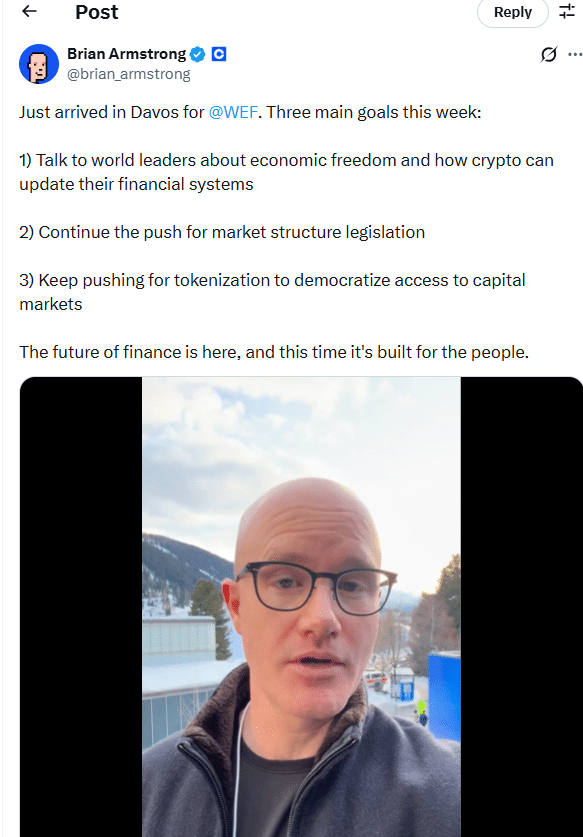
Coinbase CEO Brian Armstrong is bringing discussions on the U.S. crypto market structure bill to Davos this week amidst ongoing challenges to keep the legislation on schedule. Armstrong shared this update via a video posted on X, emphasizing Coinbase's continued engagement in policy discussions during the World Economic Forum. He also indicated plans to meet with several bank CEOs.
Coinbase Pushes Compromise as Market Structure Bill Faces Agency Debate
Armstrong described Coinbase's approach as practical and solution-driven, aiming to identify terms that are agreeable to both crypto platforms and traditional financial institutions. He stated that these discussions would be communicated to lawmakers and the administration.
The proposed crypto market structure bill seeks to define the regulatory framework for digital assets in the United States. A central point of contention is whether tokens should be classified as securities or commodities, which dictates the jurisdiction of regulatory agencies.
The bill also intends to restructure oversight of spot crypto markets, potentially granting the Commodity Futures Trading Commission (CFTC) a more significant role. This has been a long-standing objective for several major exchanges. Supporters of the bill argue that it will reduce regulatory ambiguity, foster safer growth, and enhance investor protection through clearer definitions.
Coinbase Pulls Back After Draft Review
Coinbase recently withdrew its support for the crypto market structure bill, with Armstrong citing significant issues within the latest Senate Banking text. He publicly stated that Coinbase could not endorse the bill in its current form.
This statement garnered considerable attention, given Coinbase's positioning as a compliant industry player and its influence in Washington. Industry observers interpret Coinbase's stance as an indicator of the difficulties in achieving a consensus.
Armstrong explained that the bill contains policy choices he finds unacceptable, warning that its current language could stifle innovation while failing to establish practical clarity. He emphasized the need for substantial revisions before the bill can advance.
Tokenized Equities Become a Major Flashpoint
A significant point of contention highlighted by Armstrong is what he described as a de facto ban on tokenized equities. Tokenized equities represent stock-like instruments issued or traded on blockchain technology, which proponents believe could streamline trading and settlement processes.
However, some banks and regulators have expressed reservations regarding investor safeguards and the broader market structure implications. Armstrong cautioned that overly restrictive language could impede innovation in this area.
This dispute underscores the sensitivity of the bill, extending its scope beyond crypto exchanges to encompass the future design of financial markets.
DeFi and Privacy Concerns Add More Tension
Armstrong also voiced concerns about potential restrictions on decentralized finance (DeFi) platforms. DeFi often operates using open-source smart contracts and user-controlled wallets, differing from traditional intermediary models.
Privacy issues were also raised, as policymakers often seek enhanced monitoring tools to prevent illicit activities. Crypto advocates, however, maintain that privacy features can be integrated with compliance requirements.
Armstrong warned that broad limitations could negatively impact legitimate uses of the technology and that ambiguous language might lead to extensive enforcement actions. He also suggested that the Market Structure Bill could unduly increase the authority of the Securities and Exchange Commission (SEC).
Stablecoin Rewards Debate Splits Banks and Crypto
Stablecoins have emerged as another contentious issue in the crypto market structure bill discussions, particularly concerning reward programs. Banks are advocating for limitations that would prevent crypto firms from offering interest rates comparable to traditional deposits.
Conversely, the crypto industry argues that broad prohibitions could hinder product development. They contend that rewards can be linked to transactional activities or loyalty programs, and that stablecoins play a role in facilitating payments and commerce.

The draft legislation proposes to restrict interest payments solely for holding a stablecoin, while allowing rewards tied to payments or loyalty programs. Disclosure rules for these programs would be established by the SEC and the CFTC.
This nuanced distinction has become a critical element of ongoing negotiations, with both sides concerned about the other gaining a competitive advantage.
Senate Banking Markup Paused as Talks Continue
Coinbase's withdrawal of support coincided with the Senate Banking Committee's scheduled markup of the bill, which was subsequently postponed. Bipartisan negotiations are reportedly still in progress.
Chairman Tim Scott has indicated that stakeholders remain actively involved, suggesting the Market Structure Bill is not abandoned. However, delays introduce increased risks, as each pause allows for further lobbying efforts and potential amendments.
The prolonged timeline makes achieving consensus more challenging and leaves markets in a state of uncertainty. Many companies are seeking a clear regulatory framework to guide their product strategies and compliance efforts.
Conclusion
Armstrong views Davos as a new platform to advance discussions on the crypto market structure bill, with the objective of fostering a compromise draft that lawmakers can approve. The future direction of the Market Structure Bill is likely to be shaped by resolutions on stablecoin rewards, tokenized equities, and jurisdictional authority. Unresolved issues in these areas could lead to further delays.
Appendix: Glossary of Key Terms
Crypto market structure bill: A proposed U.S. law designed to establish regulations for crypto tokens, exchanges, and oversight responsibilities.
Token taxonomy: The classification of a token to determine whether it should be treated as a security or a commodity within the United States.
SEC: The U.S. Securities and Exchange Commission, responsible for regulating securities markets and overseeing many token disclosures.
CFTC: The Commodity Futures Trading Commission, a U.S. regulator overseeing commodities, which may also gain oversight of spot crypto markets.
Spot crypto market: A trading market where crypto assets are bought and sold for immediate settlement.
Stablecoin rewards: Incentives offered to users for holding or using stablecoins, often debated as interest-like rewards.
Tokenized equities: Blockchain-based representations of stock exposure aimed at simplifying trading and settlement.
Frequently Asked Questions About Market Structure Bill
1- What is the crypto market structure bill?
It is a proposed U.S. framework to define how crypto tokens and exchanges are regulated.
2- Why is Coinbase discussing the Market Structure Bill at Davos?
Armstrong seeks direct engagement with bank leaders to reduce friction and shape a workable draft.
3- Why did Coinbase pull support for the latest draft?
The company states that the text contains significant policy issues that could restrict innovation.
4- What role would the CFTC play under the proposal?
The bill could expand CFTC authority over spot crypto trading markets.