



Key Developments in Crypto Regulation
The future of the Crypto Markets Structure Act is uncertain as Coinbase CEO Brian Armstrong has withdrawn support for the legislation. This move has ignited significant debate among prominent figures in the cryptocurrency industry, including the CEOs of Kraken and Ripple, regarding the best path forward for U.S. regulatory strategies.
This division within the industry underscores a critical regulatory crossroads for cryptocurrency. The implications are potentially far-reaching, affecting not only future legislation but also the pace of technological innovation and the United States' international competitive standing in the global digital asset landscape.
Coinbase's Stance Fuels Industry Division Over Legislation
Several leading figures in the cryptocurrency industry, including Brian Armstrong of Coinbase, have publicly voiced concerns regarding the current iteration of the Crypto Markets Structure Act. Armstrong stated his position clearly, emphasizing, "I would rather have no bill than a bad one." In response, Ripple CEO Brad Garlinghouse advocated for continued negotiation, urging a resolution to specific stipulations concerning "stablecoin yield bans and DeFi restrictions."
The immediate consequence of Coinbase's withdrawal is a potential delay in achieving regulatory clarity for the cryptocurrency sector. This could leave the industry vulnerable to unforeseen regulatory shifts. Prominent crypto advocates, such as Chris Dixon from a16z, are emphasizing the importance of a timely resolution to capitalize on a potentially favorable legislative environment. Both Kraken and Ripple have asserted the necessity of continuing bipartisan efforts to advance the legislation.
Market reactions to these developments are varied. While many developer teams and exchanges express apprehension about losing legislative momentum, key industry leaders remain optimistic that a "negotiated resolution" will ultimately be achieved. Tim Scott, the Chair of the Senate Banking Committee, has postponed the markup of the bill, indicating his intention to address the concerns raised before the end of the month.
XRP Market Sees Volatility Amid Legislative Uncertainty
The current legislative uncertainty surrounding the Crypto Markets Structure Act has created market volatility, particularly for assets like XRP. The postponement of the CLARITY Act echoes the 2024 delay of FIT21, highlighting a recurring pattern of uncertainty in cryptocurrency legislation and its tangible impact on market stability.
XRP, which was trading at $2.05 with a market capitalization of $124.65 billion, demonstrated a notable responsiveness to the prevailing regulatory uncertainty. Its 24-hour trading volume saw a decrease of 25.78%. Over the past 30 days, XRP’s price increased by 9.54%, although it experienced a 16.52% drop over the preceding 90 days, according to data from CoinMarketCap.
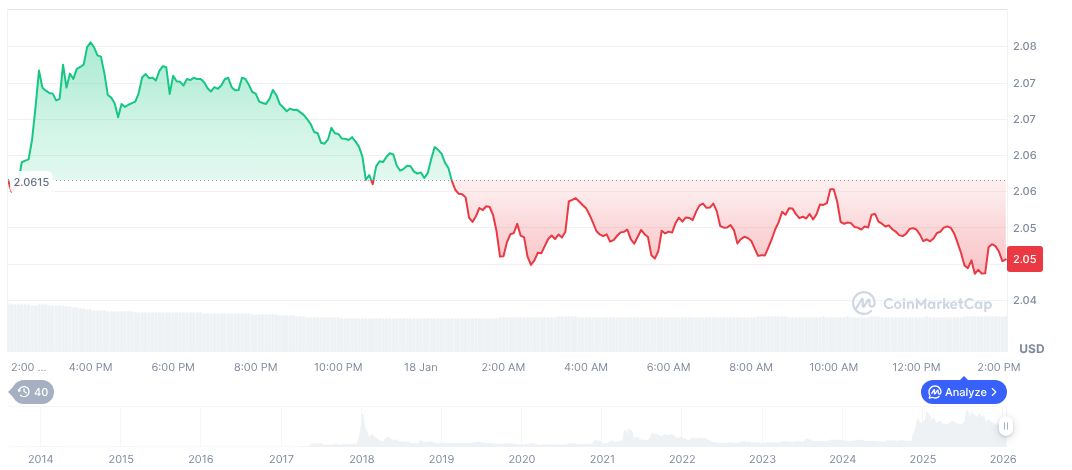
Research from Coincu suggests that potential shifts in legislation could significantly reshape cryptocurrency taxation and compliance frameworks, leading to dynamic policy developments. This aligns with historical patterns where regulatory progress has consistently influenced the evolution of financial innovations and the strategies employed in emerging markets.