


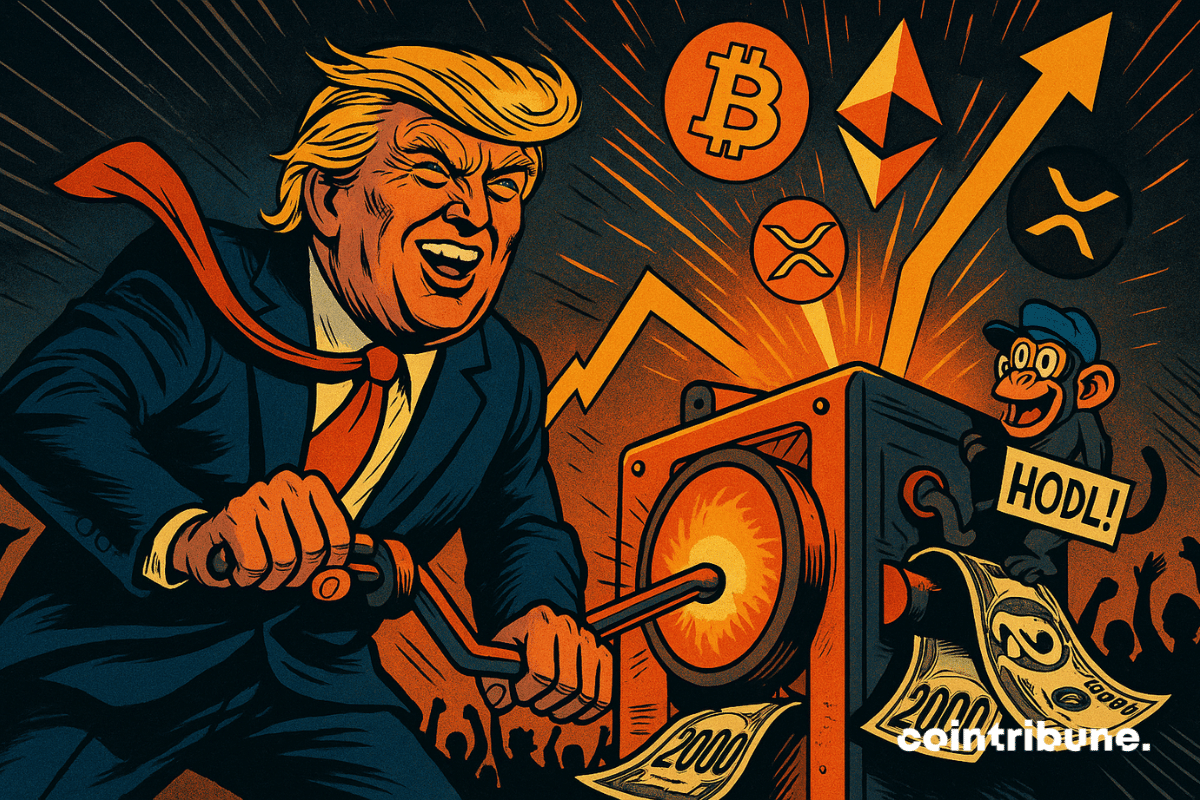
The President of the United States just announced a $2,000+ dividend to American citizens that are not high income.
— Anthony Pompliano
Stocks and bitcoin only know to go higher in response to stimulus. pic.twitter.com/ZDoOfywK3R(@APompliano) November 9, 2025
"In Brief"
- •Donald Trump has proposed a "tariff dividend" of at least $2,000 for most Americans, to be funded by customs revenues.
- •Approximately 85% of U.S. adults are estimated to be eligible for this payment.
- •The announcement has already impacted markets, leading to increased interest in cryptocurrencies.
- •Commentators like Anthony Pompliano suggest this stimulus could be a positive signal for Bitcoin and other risk assets.
$2,000 to Restart the Engine
Donald Trump, after previously impacting the crypto ecosystem with his tariffs, has surprised markets with an unexpected economic announcement. He declared on Truth Social, "a dividend of at least $2,000 per person, except for high-income individuals, will be paid to all."
This initiative, presented as a redistribution of revenues generated by his tariff policies, aims to directly inject purchasing power into the American economy, bypassing traditional stimulus plans. Although the announcement does not yet have the force of law, it has immediately triggered reactions in the financial sphere, notably within the crypto ecosystem.
The details available at this stage provide a clearer understanding of the proposal:
- •Announced Amount: $2,000 per person, excluding high-income individuals.
- •Funding Source: Revenues generated by tariffs imposed by the Trump administration.
- •Estimated Eligibility Rate: Approximately 85% of American adults, based on criteria used for previous stimulus checks.
- •Immediate Market Reaction: Crypto investors have interpreted this promise as a bullish signal.
This promise, perceived as a form of "stimulus without the Fed," evokes memories of the COVID stimulus checks and their subsequent impact on the crypto market. At that time, a significant portion of those funds was redirected to cryptocurrencies, leading to substantial price increases.
Trump's announcement appears to aim at recreating a similar effect, this time through a unilateral measure with political undertones.
A Conditional Stimulus: The Legal Barrier and Systemic Risks
Despite the apparent market enthusiasm, the announced measure faces significant legal uncertainty. The United States Supreme Court is currently reviewing the legality of the tariffs that would fund this dividend.
Expectations regarding the Court's decision are not highly favorable. According to predictive market platforms Kalshi and Polymarket, the chances of the Court approving the tariffs are 23% and 21%, respectively. Trump has expressed strong disapproval of this institutional opposition, arguing, "the President of the United States is authorized, with Congressional approval, to stop all trade with a foreign country… but could not impose a simple tariff, even for reasons of national security?"
This legal hurdle is compounded by economic warnings from several analysts. The Kobeissi Letter pointed out that while some injected funds might fuel asset markets, the long-term consequences would be far from neutral, including an increase in public debt, inflationary pressure, and erosion of purchasing power.
Anthony Pompliano commented, "Stocks and bitcoin tend to rise whenever an economic stimulus is announced."
Analyst and Bitcoin advocate Simon Dixon also issued a warning: "if you don’t put the $2,000 into assets, it will simply be eroded by inflation or go to pay interest to banks."
If enacted, this measure could inject billions of dollars into the American economy. This injection could potentially fuel risk appetite and influence the price of Bitcoin and other cryptocurrencies, which are already known to be sensitive to political announcements. The central question remains whether the judiciary will validate this strategy, which blurs the lines between economic stimulus and political propaganda.