



Market Analysis and Deleveraging Cycles
BitMine Chairman Tom Lee likens current crypto market weakness to the October 10 crash, attributing it to deleveraging cycles nearing completion, as stated on CNBC. This cycle's end may stabilize markets, affecting investments and liquidity, with long-term crypto growth prospects still uncertain. Institutional capital inflows may offset liquidation risks.
Institutional Shifts and Ethereum Holdings
Institutional activity is notable, with major firms like JP Morgan, Invesco, and BlackRock moving capital to BitMine, a non-leveraged ETH holder. This shift towards long-term ETH holdings may help reduce future risks of forced liquidations. However, ETH's value fell 8-12% recently, reflecting the period's volatility.
The crypto community remains attentive to institutional maneuvers. Tom Lee's commentary highlights a strategic pivot to non-leveraged ETH to shield from liquidation impacts. He notes the importance of "sticky" holders to stabilize the market, sending a signal of confidence amid temporary upheavals.
"The languishing of crypto prices in the past 2 weeks since October 10th has the signs of a market maker or maybe more than one having a problem with their balance sheet... These are levels that you saw at the April tariff lows. So, I don't think this is a time to be panicking." — Tom Lee, Chairman, BitMine
Ethereum's Volatility and Market Stability Factors
In October, the crypto market faced its largest liquidation due to a stablecoin error, paralleling 2025's deleveraging cycle. Such cycles typically last eight weeks, with recovery observed thereafter.
According to CoinMarketCap, Ethereum (ETH) trades at $2,818.80, with a market cap of $340.22 billion (11.53% dominance). ETH experienced a notable decline: 7.03% over 24 hours, 12.94% in a week, 27.11% in 30 days, and 40.10% over 90 days. Trading volume has changed by 6.30% recently. These metrics indicate ongoing volatility amid broader market shifts.
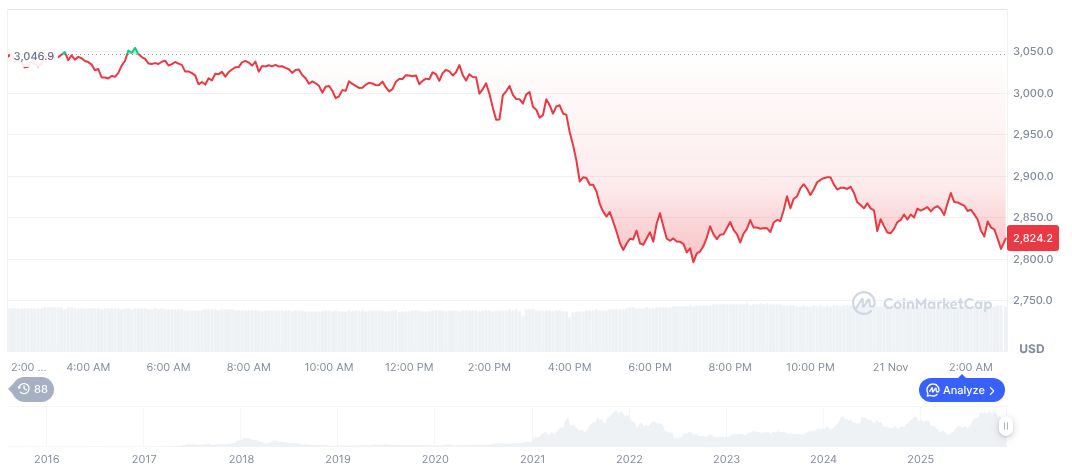
The Coincu research team anticipates that Ethereum's adoption as a core treasury asset by institutions may bolster future price stability. Regulatory pressures are expected to tighten around leverage and stablecoin mechanisms, potentially fostering a more resilient market structure long-term.