


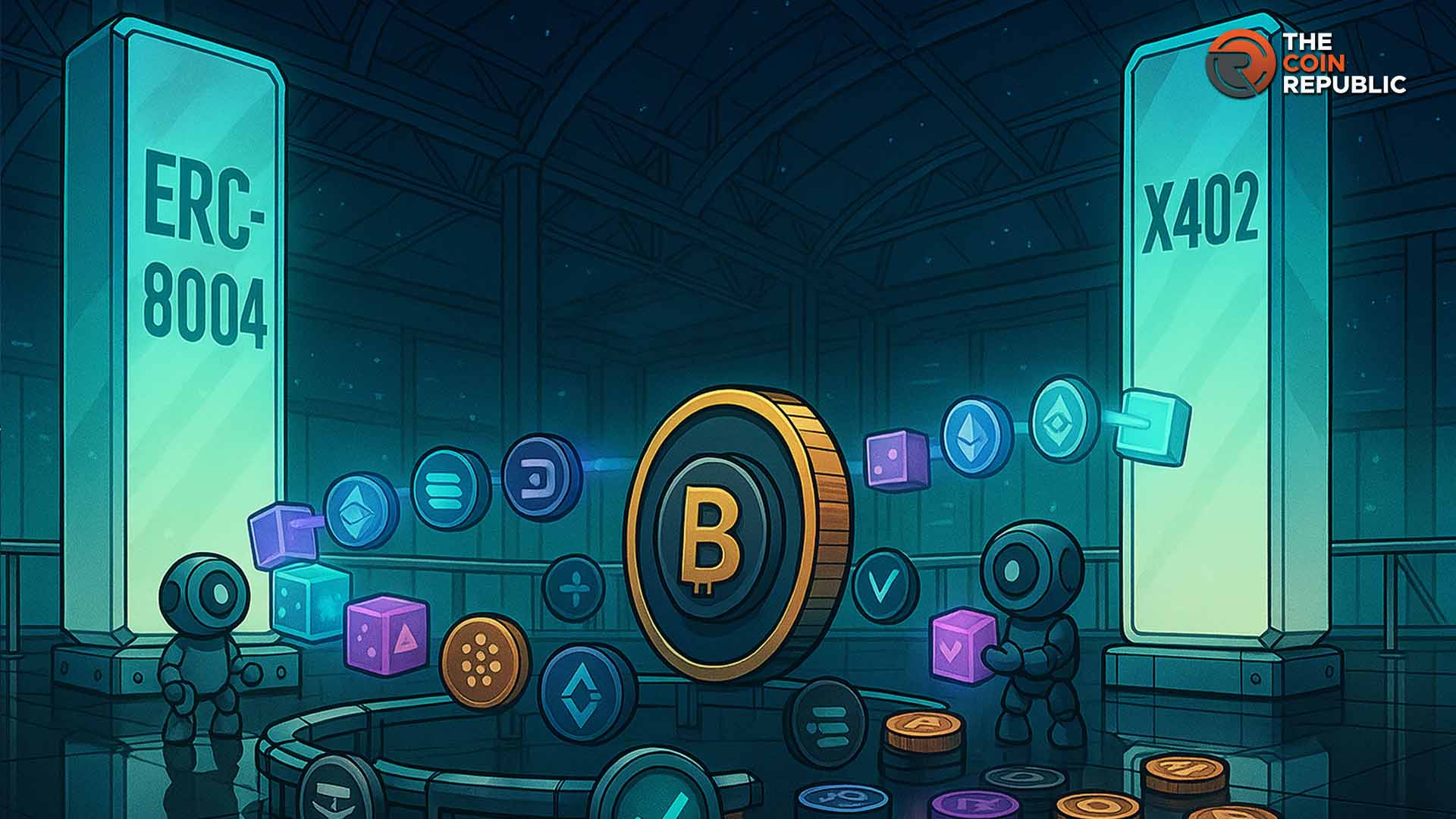
In August 2025, the cryptocurrency news landscape was marked by the introduction of the ERC-8004 standard. This new standard addresses a fundamental challenge in the crypto space: how crypto agents can execute transactions without operating on a shared framework for trust or coordination.
ERC-8004 aims to establish an on-chain Agent-to-Agent protocol by introducing three key registries: Identity, Reputation, and Validation.
The standard was co-authored by Marco De Rossi from MetaMask, Davide Crapis from the Ethereum Foundation, Jordan Ellis from Google, and Erik Reppel from Coinbase.
The core innovation of ERC-8004 is its ability to allow crypto agents, regardless of their underlying protocols or organizational affiliations, to interact safely and securely without the need for pre-existing relationships.
How Trust Registries Work for Crypto Agents
The Identity registry serves as the foundation for establishing legitimacy among crypto agents. It provides them with a mechanism to prove they are bona fide entities within the network.
Each agent registers an on-chain identity that points to an off-chain JSON document, referred to as an "agent card." This card contains crucial information such as the agent's capabilities, network endpoints, and cryptographic keys.
The Reputation registry is designed to track the past behavior and reliability of agents across their interactions. This process generates machine-readable histories that crypto agents can query before deciding to coordinate with unfamiliar counterparties.
The Validation registry verifies whether an agent is capable of safely executing specific actions. For operations involving higher risk, calling agents can confirm that their counterparties have successfully passed required audits or security reviews.
In a recent post, Abstract's Abril Zucchi discussed how ERC-8004 has the potential to create the agentic internet.
Crypto News: x402 Provides Payment Infrastructure
While ERC-8004 focuses on establishing trust, the x402 protocol concentrates on the execution of payments. This protocol effectively transforms the HTTP 402 "Payment Required" status code into a functional micropayment rail, specifically designed for APIs and machine-to-machine transactions.
When a client requests access to a paid endpoint, the server responds with an HTTP 402 status code. This response is accompanied by detailed payment instructions, specifying the exact amount, the asset to be used, the blockchain network, and the designated receiving address.
Following these instructions, the client initiates an on-chain payment, typically using stablecoins like USDC. Subsequently, the client retries the request, including an X-PAYMENT header that serves as proof of the completed transaction. The server then verifies the on-chain settlement of the payment before delivering the requested resource.
The x402 protocol is built to operate as a token- and chain-neutral infrastructure. While Coinbase's reference implementation utilized USDC on the Base network, the protocol is flexible enough to support any compatible asset. For crypto agents, x402 provides the essential execution layer for seamless inline service payments.
How ERC-8004 and x402 Connect
The integration of ERC-8004 and x402 is facilitated through sophisticated cross-referencing mechanisms. ERC-8004 agent cards are designed to include HTTP endpoints and x402 payment configurations. This ensures that crypto agents are fully aware of where to direct their requests and how the payment process functions.
Consider a scenario where a portfolio agent requires yield data. It would first query the Identity registry to identify legitimate providers.
The registry would then return agent cards that explicitly list x402-enabled endpoints. The calling agent would proceed to check the Reputation scores of these providers, verify their validations, and subsequently initiate the x402 payment flow.
Payment addresses provided in x402 responses can be configured to reference ERC-8004 identities. This crucial feature allows crypto agents to confirm that they are making payments to registered entities, thereby preventing potential impersonation attacks and ensuring transactions are directed to legitimate sources rather than random addresses.
This robust feedback loop is closed when x402 transactions are successfully completed.
Successful interactions generate verifiable on-chain records that are used to update the ERC-8004 Reputation registries. This continuous process ensures that future crypto agents can easily identify counterparties who have consistently delivered reliable results.
Imagine a portfolio agent rebalancing stablecoins. It could utilize ERC-8004 to identify yield agents that meet specific security criteria. Following this, the entire operation, including borrow, swap, and deposit steps, could be executed seamlessly through x402 in a single, unified flow.
What previously required eight distinct user interface interactions can now be consolidated into a single, autonomous intention, significantly streamlining complex financial operations.

Crypto News: Agent-Native Infrastructure Emerges
The development of ERC-8004 and x402 signifies a significant shift in the cryptocurrency space towards an agent-native architecture. These standards are transforming coordination and payment into fundamental protocol-level primitives that software can access directly, bypassing the need for traditional human wallet interactions.
The ERC-8004 standard achieves this by unifying how on-chain agents prove their identity and accumulate reputation through shared Ethereum registries.
This foundational capability enables a wide range of automated entities, including bots, solvers, market makers, and AI agents, to coordinate effectively without the necessity for custom, bespoke integrations.
The anticipated outcome is the creation of an addressable network of services, moving beyond the current paradigm of isolated smart contracts.
Concurrently, the x402 protocol embeds stablecoin payments directly into HTTP responses. This innovation allows any API or DeFi backend system to implement per-call charging mechanisms.
As a direct consequence, infrastructure providers such as node operators, data networks, and intent routers can now monetize their services through standardized micropayments. These payments are accessible to both humans and crypto agents in an identical manner.
Infrastructure providers offering critical services like data feeds, risk scoring, and compliance checks can efficiently charge per request, creating new revenue streams and service models.
Within this emerging structure, ERC-8004 plays a vital role in assuring that payments are consistently directed to known agents with verifiable track records, thereby enhancing security and trust.
These advancements collectively tilt the cryptocurrency ecosystem away from traditional retail-focused interfaces and towards a more robust, machine-to-machine infrastructure.
If these standards achieve widespread adoption, the primary users of the crypto space are likely to shift from individual traders to sophisticated automated systems. This includes rollup operators, quantitative funds, DeFi routers, and advanced AI agents.
Consequently, crypto agents are poised to evolve from simple scripts that execute a single task to becoming persistent, continuous services that operate around the clock.
In essence, ERC-8004 provides the critical trust graph, while x402 delivers the essential payment rail. Together, they are building the infrastructure necessary for seamless coordination without requiring human oversight at every single step of the process.