



Newton's Analysis Challenges Market Peak Narratives
On November 2, 2025, Fundstrat's Head of Technical Strategy, Mark Newton CMT, shared his perspective on the current state of the cryptocurrency market, refuting claims that it has reached its peak. Newton's analysis, posted on the X platform, indicated ongoing market stability and potential for further growth in major cryptocurrencies like Bitcoin and Ethereum.
Newton highlighted that technical indicators, specifically the Elliott Wave pattern, do not show any signs of a topping pattern, which would typically signal a finalized peak in market cycles. This suggests that the current market conditions are not indicative of an end to the upward trend.
Institutional Interest Remains Strong
Market participants have responded with measured optimism, a sentiment that aligns with the sustained institutional interest in the cryptocurrency space. Despite experiencing broader market volatility, Bitcoin (BTC) and Ethereum (ETH) continue to attract significant attention from institutional investors. This ongoing interest reinforces Newton's observations about the underlying strength of these digital assets.
Bitcoin's Market Data Contradicts Peak Concerns
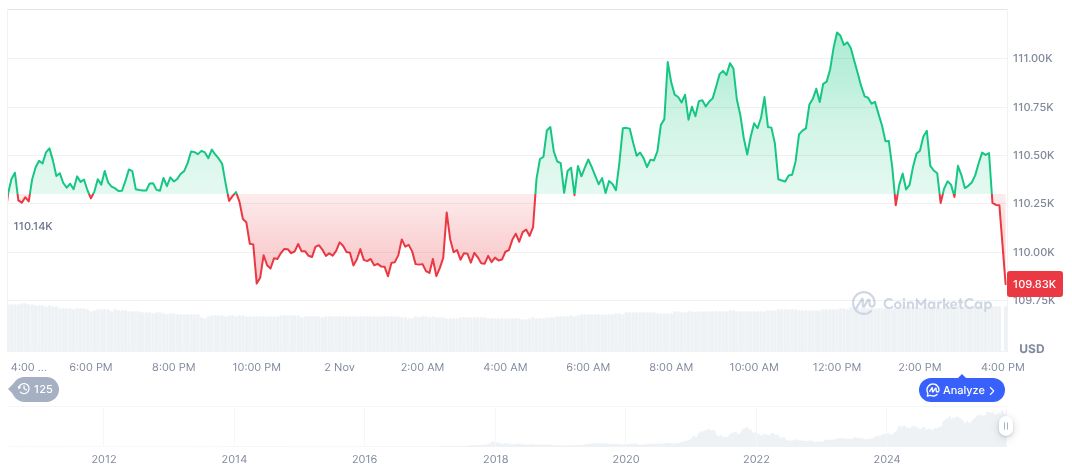
Recent market data for Bitcoin further supports the argument against immediate peak concerns. According to CoinMarketCap, Bitcoin is trading at $110,032.21, with a market capitalization of $2.19 trillion and a dominance of 59.30%. While it experienced a slight decrease of 0.24% over the past 24 hours, its fundamentals remain robust.
With a circulating supply of 19,943,490 BTC out of a maximum of 21 million, the cryptocurrency's scarcity is a key factor. The trading volume for Bitcoin reached $32.90 billion in the past day, marking a decrease of 3.37%. These figures, viewed in conjunction with the Elliott Wave analysis, suggest that the market is not exhibiting characteristics of a peak.
The Coincu research team emphasizes that a comprehensive understanding of potential future trends in cryptocurrency valuations requires analyzing ongoing market conditions alongside technological advancements and evolving regulatory landscapes. These factors play a crucial role in shaping the market's trajectory.