



Deluthium Debuts Zero Slippage and Gas-Free Trading
Deluthium announced the Alpha version of its AI-native liquidity infrastructure on January 15, focusing on zero slippage trading and MEV preemption through the Deluthium Synthesis Engine. This launch represents a potential shift in trading efficiency for digital assets.
The Alpha version integrates the Dual Sharded Liquidity Market and Credit Vault architecture. This new structure promises zero slippage and zero gas trading, along with MEV preemption elimination via a protective intent mechanism. Deluthium now also supports asset trading on FLock.io FOMO.
Immediate implications include enhancing asset liquidity management while ensuring deterministic execution services across financial assets. The inclusion of a "Real Model Asset" empowerment campaign offers notable incentives, granting users tenfold Deluthium Alpha points for specific trades, potentially attracting more market participants.
Despite the promising features, market reactions are subdued due to a lack of on-chain data verification or leadership confirmation. The absence of statements from industry leaders or government entities contributes to market hesitancy. Current references appear primarily in secondary sources without robust primary backing.
Ethereum Market Holds Despite New Alpha Launch
The introduction of zero slippage trading positions Deluthium as a competitive entity among liquidity infrastructure providers, potentially mirroring past innovations such as Uniswap's influence within decentralized exchanges.
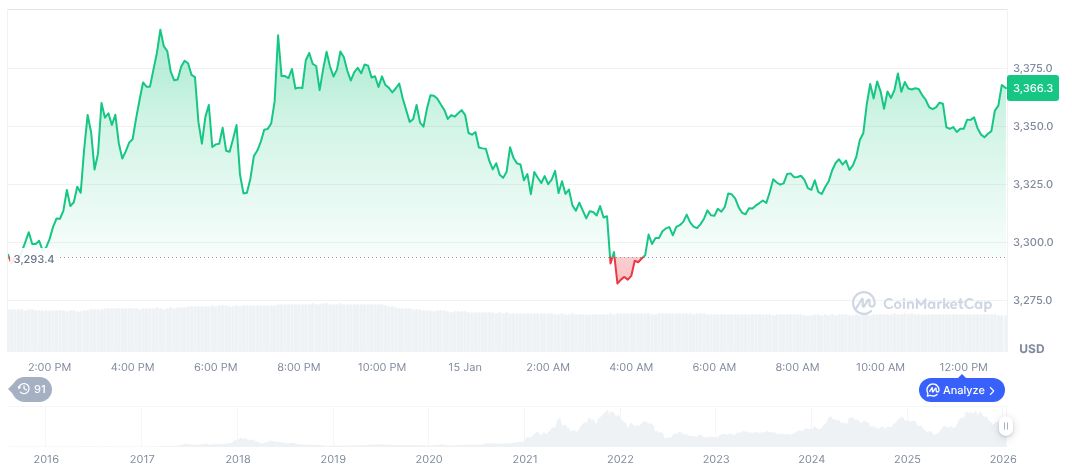
Ethereum (ETH) trades at $3,298.26 with a market cap of $398.08 billion as of January 15, 2026. Despite a 24-hour price decrease of 1.88%, ETH holds a 12.33% dominance in the market. Recent month trends show a 11.77% increase.
The Coincu research team highlights Deluthium's potential to disrupt current liquidity paradigms, provided adoption scales effectively. Historical data indicate that technological advancements often face regulatory scrutiny, prompting future compliance strategies in the financial and technological sectors.