



Key Points
- •Digital yuan's smart contracts utilize restricted Turing completeness for enhanced security.
- •This design prioritizes security and risk control, differentiating it from public blockchain contracts.
- •Potential challenges include integrating the system and establishing acceptable auditing mechanisms within the financial sector.
Digital Yuan's Smart Contract Design and Security Focus
The digital yuan incorporates smart contracts that are limited in Turing completeness, a design choice aimed at enhancing security and risk control. This restriction ensures the central bank's directive control over the digital yuan's programming capabilities, thereby safeguarding the financial system while aligning with existing security measures.
Smart contracts within the digital yuan rely on restricted Turing completeness. This design choice limits programming to template scripts approved by the People's Bank of China, mitigating security risks but also limiting functional flexibility. The People's Bank of China, alongside major commercial banks and fintech companies, plays a pivotal role in this system. This system supports programming languages such as Solidity. However, a core issue remains the design of a compatible auditing mechanism that is acceptable to traditional financial systems. No formal responses or reactions have emerged from government officials or industry leaders concerning this development, underscoring its nascent stage in public discussions.
Implications for Global Blockchain and Financial Systems
While the digital yuan's restricted Turing completeness abstracts it from public blockchains, this design is increasingly relevant, considering that cybersecurity has become a top priority in the global financial ecosystem.
The digital yuan's restricted model may influence central banks' adoption strategies for Central Bank Digital Currencies (CBDCs). As a controlled programmable currency, its security-focused constraints might limit global blockchain interactions but align well with regulatory standards. Observations indicate that strict regulations by China on virtual currency governance have been pivotal.
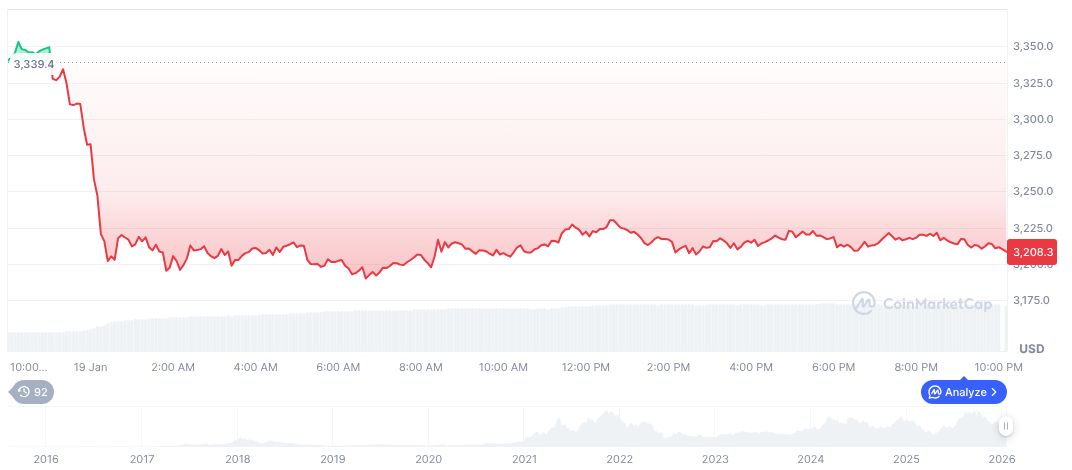
Ether is valued at $3,203.84, with a market capitalization of $386.69 billion USD and a dominance of 12.32%, according to CoinMarketCap data for 2026. Influenced by market dynamics, Ether has experienced a 4.29% drop in the last 24 hours yet maintains a 3.38% increase over the week. Furthermore, China's comprehensive governance on cryptocurrency continues to shape digital finance trends.
Additionally, insights from the Bank of Japan suggest that movements in the Chinese CBDC framework can indirectly affect bond yields and rate hikes, potentially influencing broader financial sectors in Asia.