



Key Developments from the Fusaka Upgrade
The Ethereum network has undergone a significant transformation with the recent Fusaka upgrade, which introduced a new blob fee mechanism. This upgrade has resulted in a substantial increase in blob fees, reportedly by 15 million times, a change designed to better reflect the actual costs associated with network usage.
This reform is anticipated to improve overall network efficiency and has the potential to significantly boost the rate at which Ether (ETH) is burned. The economic implications for Layer 2 (L2) platforms and their users are expected to be considerable, likely leading to adjustments in transaction costs.
EIP-7918 Drives Eightfold Increase in Ether Burn
The Fusaka upgrade's core component, EIP-7918, has fundamentally altered Ethereum's fee structure by directly linking blob fees to Layer 1 (L1) costs. This reform establishes a minimum blob fee, replacing the previous nominal charges of 1 wei.
By anchoring blob fees to real-world operational costs, the upgrade is projected to increase Ether (ETH) burn rates by as much as eight times. This fee adjustment aims to create a more equitable resource consumption model across all L2 platforms operating on Ethereum.
The changes introduced by the Fusaka upgrade have elicited diverse reactions from the Ethereum community. Institutions such as Bitwise and Fidelity Digital Assets foresee the creation of a new revenue stream for ETH holders. However, this development may also lead to higher transaction costs for Layer 2 platforms, presenting economic challenges and potentially impacting user expenses.
Under Fusaka, the blob fee gets a floor tied to execution fees, roughly the execution base fee divided by 16, creating a more consistent revenue stream for ETH holders. - Ryan Sean Adams, Research Analyst, Bitwise.
Impact on Layer 2 Economics and User Costs
Following Ethereum's Fusaka upgrade, the increase in blob fees is expected to help align scaling advancements with greater value accrual for Ether. This situation echoes the significant impact of EIP-1559, which was implemented in 2021.
As of December 6, 2025, Ethereum (ETH) is priced at $3,033.78, with a market capitalization of $366.16 billion, representing 12.01% of the total market dominance. The 24-hour trading volume has decreased by 55.46% to $12.73 billion. Over the past 24 hours, the price has seen a 0.20% increase, a 1.25% rise over the last 7 days, but a 29.17% decline over the past 90 days.
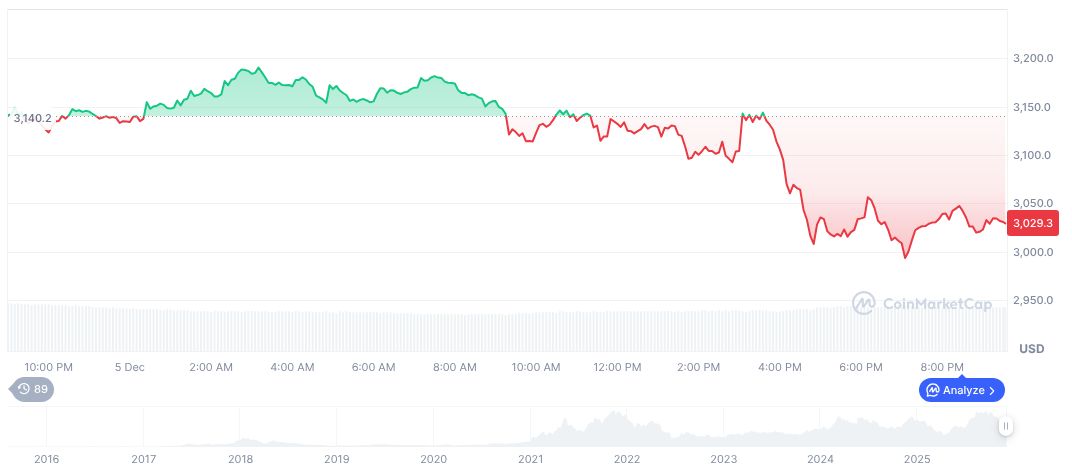
According to research from the Coincu team, Ethereum's latest upgrade could enhance its deflationary characteristics. This is achieved through elevated blob fees and improved L2 data capacity, which may boost network value and efficiency, contributing to its long-term resilience. The revised pricing model is designed to realign network economics with ongoing scaling advancements.