



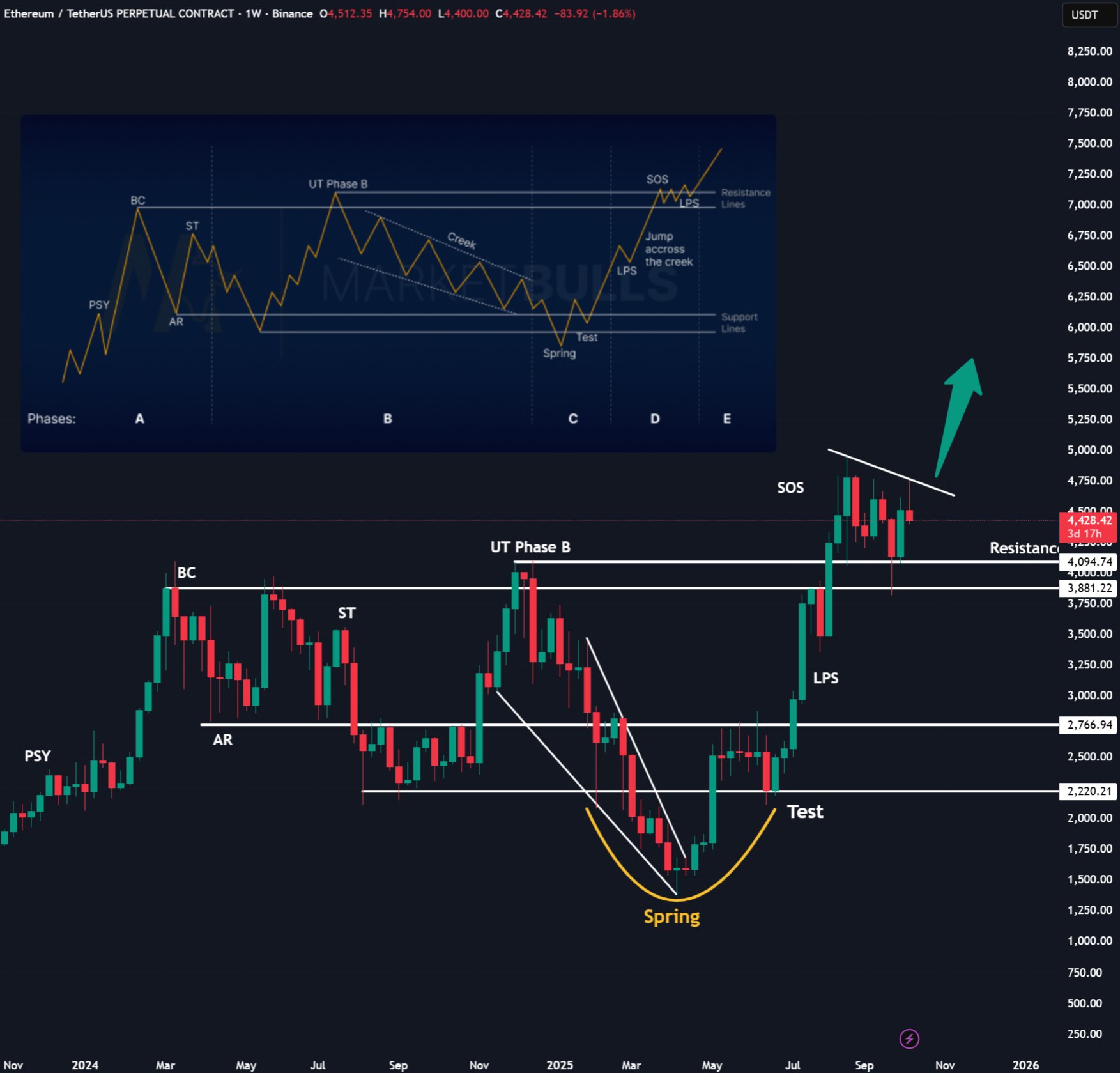
Ethereum, the second‑largest asset in the cryptocurrency market, hovers around $4,350 as analysts identify two critical indicators suggesting potential for the asset to surpass the $8,000 threshold by the year’s end. Despite a 24‑hour trading volume exceeding $41 billion, Ethereum faces a 2% daily and 3% weekly price drop. The Wyckoff accumulation structure and the descending wedge formation on the weekly chart highlight a breakout scenario. Institutional demand and the cost basis of active investors are poised as short‑term directional determinants.
Double Technical Catalysts: Wyckoff and Wedge
ZYN, a prominent analyst, remarks that the accumulation phases on the weekly chart have concluded, with a clean “spring” and “test” below $2,500. The price nears the $4,750 resistance. According to ZYN’s scenario, the $3,880 and $4,100 regions now serve as supports. The final target indicated is $8,000 by the quarter’s end, and $10,000 by the cycle’s culmination. The analyst credits the transition of supply from weak to strong hands and an accelerated trend post‑breakout for the structure’s efficacy.
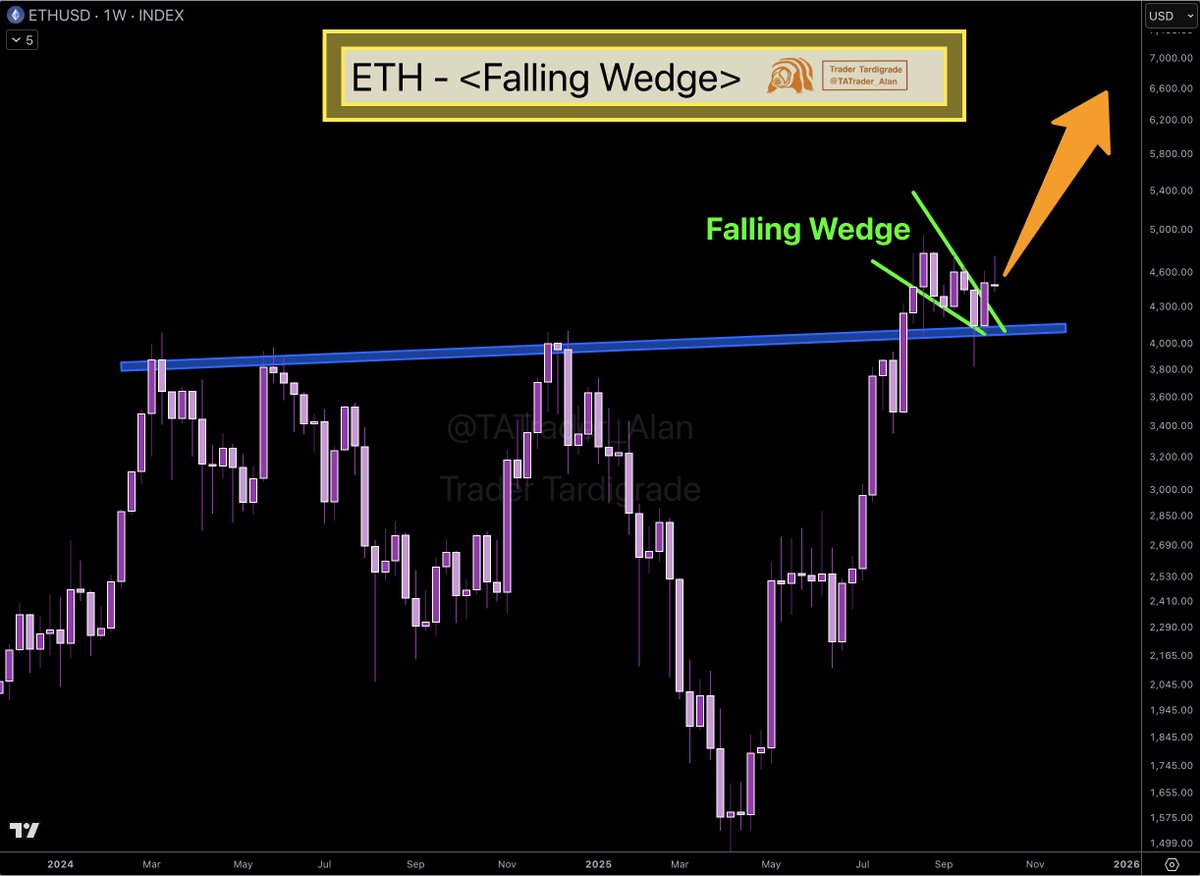
Trader Tardigrade notes the breach of the descending wedge’s upper band around $4,100 following a robust ascent. When momentum aligns with the formation rule, a measured move toward the $6,500–$7,000 range is anticipated. A resistance‑support conversion at $4,100 simplifies trend following, provided weekly closes exceed $4,750.
What Do On-Chain Data Reveal?
CryptoQuant contributor Crazzyblockk notes that for addresses transacting over 100 times in the past 30 days, the realized price hovers around $4,280. Sustaining above this threshold could signal additional accumulation, while dipping below may prompt short‑term selling. This threshold acts as a momentum breather point.
Market commentator Ash Crypto highlights persistent large player purchases, even as prices revert to early October levels. BlackRock, on behalf of clients, acquires approximately $1.4 billion via an ETH ETF.
In the short term, $4,240 presents a support level, with $5,000 standing as the initial strong resistance. The order book structure implies acceleration towards $6,000 if attacks surpass $5,000. As the year concludes, ETF inflows, supply withdrawn from pools, and on‑chain accumulation signals are closely monitored for timing.