



Key Developments and Objectives
Ethereum's Fusaka hard fork has successfully completed its testing phase on the Hoodi testnet, positioning it for a mainnet debut scheduled for December 3. This critical upgrade is designed to significantly enhance Ethereum's scalability, security, and data handling capabilities, promising substantial benefits for both the main network and its Layer 2 solutions.
The Fusaka upgrade is poised to introduce a suite of protocol enhancements, including optimizations that could bolster Layer 2 throughput. This development is particularly important as the Ethereum ecosystem continues to grow and evolve, with expectations of profound systemic shifts in how the network manages data, notably through the integration of PeerDAS technology.
Technical Enhancements and Scalability Improvements
The Fusaka hard fork has progressed through its final testing stages on the third Hoodi testnet, following successful deployments on the Holesky and Sepolia testnets. This meticulous testing process is a crucial step leading up to the anticipated mainnet activation on December 3, 2025. The upgrade encompasses at least a dozen Ethereum Improvement Proposals (EIPs) aimed at refining the network's performance and security architecture.
Key features of the Fusaka upgrade include an increase in block gas limits and an advancement in blob capacity, both of which are fundamental to enhancing scalability and fortifying the network's security. Vitalik Buterin, a co-founder of Ethereum, has highlighted the transformative potential of the PeerDAS innovation. He emphasized that PeerDAS will enable Ethereum to support a significantly larger volume of Layer 2 transactions by reducing the data verification burden, allowing the network to handle more data efficiently.
PeerDAS will radically shift the bottleneck for L2s—blobs will be lighter to sample rather than heavy to verify. This math means it's time for Ethereum’s data capacity to jump forward.
Market participants and developers are closely monitoring the Fusaka enhancement. Tim Beiko, Protocol Lead at the Ethereum Foundation, has indicated that the stability of the Hoodi testnet is paramount for the successful rollout of Fusaka. There is widespread optimism within the blockchain community regarding the potential for substantial performance gains and cost reductions across the Ethereum network following this upgrade.
Economic Implications and Market Outlook
The introduction of PeerDAS is anticipated to revolutionize Ethereum's data availability network, representing a pivotal advancement comparable to the impact of the Shanghai upgrade, which saw a significant increase in staking inflows in early 2023. This upgrade is expected to unlock broad economic opportunities for Ethereum's Layer 2 networks.
Recent market data indicates that Ethereum is trading at $3,986.00, with a market capitalization of $481,102,261,475.00 and a market dominance of 12.66%. While the past 24 hours have seen a 3.26% price decrease, the network has experienced a 2.83% rise over the last week. The trading volume over the past day has declined by 3.96%, totaling $39,706,335,797.00.
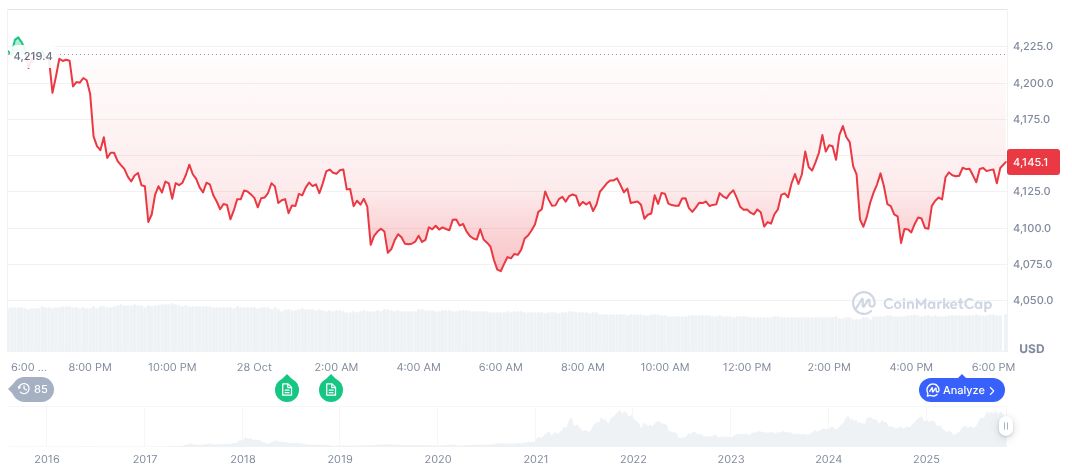
Insights from the Coincu research team suggest that the Fusaka upgrade could significantly enhance the activity and economic potential of Ethereum's Layer 2 solutions, potentially mirroring the positive impact seen with upgrades like Dencun, which drove substantial growth for tokens such as ARB and OP. The ultimate success and market reception will depend on the smooth and effective execution of Fusaka's mainnet launch.