



Unverified Remarks Stir Discussion on Protocol Evolution
Allegations of Vitalik Buterin's comments at the Devconnect conference remain under scrutiny as no official verification exists. Reportedly, Buterin suggested reducing core protocol changes to enhance stability and security while encouraging innovation within Layer 2 ecosystems, wallets, and privacy tools. The shift, as alleged, reflects a strategic evolution yet unconfirmed by primary evidence.
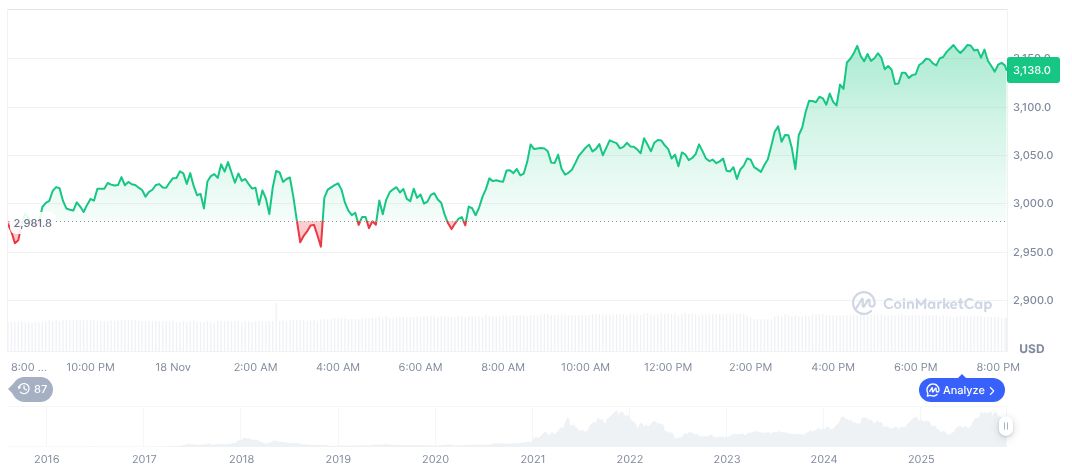
Market implications are limited as Ethereum and Layer 2 networks show stable metrics. No significant shifts appear in trading volumes or liquidity, suggesting the lack of primary-source verification prevents tangible impact on financial markets. Ethereum price remains stable, and there is no observable reaction from major exchanges or blockchain projects.
"Ethereum's architecture must move towards ossification to ensure stability and predictability." - Vitalik Buterin
Community and industry reactions to these unverified claims are muted with key figures like CZ of Binance and Arthur Hayes making no statements. Crypto community platforms show no official discussions on the topic. The broader cryptocurrency sector maintains its focus on technological advancements and scalability solutions regardless of this unverified news.
Historical Context, Price Data, and Expert Analysis
Did you know? In past Ethereum updates, such as EIP-1559, the Ethereum Foundation provided detailed guidance and community involvement. Unverified reports at conferences like Devconnect historically held minimal market influence without foundational confirmation.
CoinMarketCap data reveals Ethereum (ETH) currently valued at $3,105.83 with a market cap of $374.86 billion, represents 11.84% market dominance. Despite a 4.36% increase over 24-hours, price shows declining trends over 90 days by 28.02%. As of this update, the trading volume is $37.72 billion, showing a 13.51% decrease.
The Coincu research team notes that any formal confirmation of Buterin’s remarks could potentially instigate market adjustments and policy discussions. Technological migration to quantum-resistant cryptography presents a significant yet unimplemented security measure. Regulatory and financial responses remain speculative without primary confirmation or institutional acknowledgment.