



The European Commission has proposed transferring significant regulatory powers to the European Securities and Markets Authority (ESMA), impacting key financial infrastructures and cryptocurrency service providers. This announcement was made on December 4th in Brussels, signaling a move towards consolidating EU market supervision.
This centralization aims to enhance regulatory efficiency across the European Union. However, the proposal is expected to face opposition from member states who are concerned about preserving national regulatory autonomy.
ESMA's Expanded Role in Financial Regulation
The European Commission's recent proposal seeks to strengthen ESMA's authority by transferring regulatory powers currently held by national entities. These changes will expand ESMA's oversight to include clearing houses, central securities depositories, and cryptocurrency companies, aligning with the Markets in Crypto-Assets (MiCA) regulation. The proposal requires approval from the European Parliament and Member States, with Cyprus set to play a pivotal role in 2026.
This initiative includes initial funding from the EU, with ongoing costs to be covered by market participants such as exchanges and crypto service providers. The revision aims to streamline inter-European operations, extend ESMA's jurisdiction, and limit the imposition of additional national requirements on financial market players.
While prominent figures have not yet commented publicly, responses within the sector indicate scrutiny from member states concerned about centralized control. Verena Ross, ESMA Chair, has emphasized the authority's ambitions to simplify EU market operations and enhance regulatory enforcement. Ross stated, "We aim to pursue a holistic strategy to streamline rules, enhance risk-based supervision and ensure proportionate reporting requirements."
Implications for EU's Cryptocurrency Landscape
The EU's MiCA framework, initiated less than a year ago, laid the groundwork for this centralization of cryptocurrency oversight under ESMA's authority.
Ethereum is currently priced at $3,197.48, with a trading volume of $30.95 billion. It holds a market dominance of 12.15%, having experienced a negative change of -8.16% over the past 30 days. The circulating supply is approximately 120.70 million tokens.
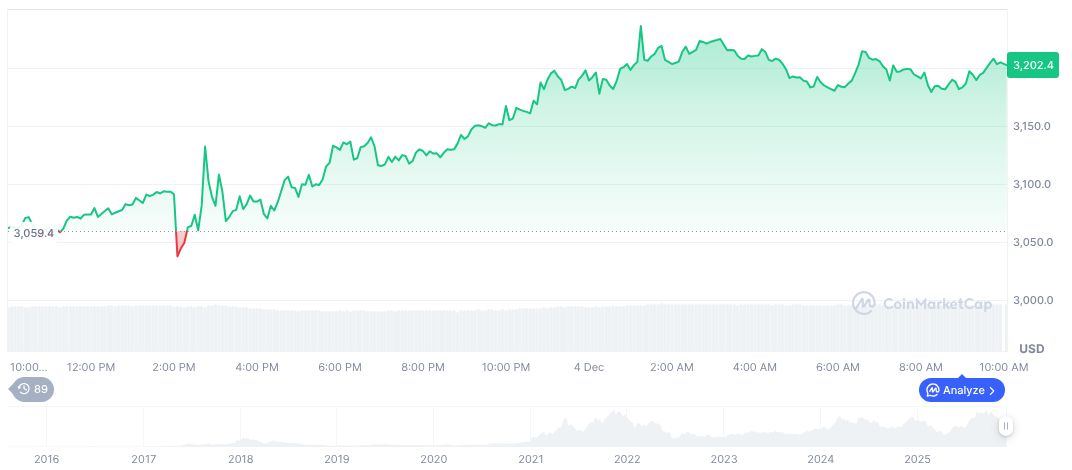
Insights suggest that the EU's regulatory centralization may enhance market efficiencies and foster innovation, although it also presents challenges. Historical trends demonstrate that EU policies significantly shape global regulatory landscapes, particularly concerning digital assets.