



Musk Alleges Unjust Enrichment and Deviation from Original Mission
A federal judge in California has denied OpenAI and Microsoft's request to dismiss Elon Musk's lawsuit seeking up to $1.34 trillion in 'unjust enrichment' damages. The case highlights ongoing tensions between profit motives and original nonprofit missions in AI development, underscoring potential financial and ethical conflicts impacting industry stakeholders and innovation trajectories.
Jury to Decide Fate in Musk's $134 Billion Legal Battle
The legal proceedings involving Elon Musk's lawsuit against OpenAI and Microsoft will advance to trial. A federal judge in California ruled in favor of Musk's claims, mandating further examination by a jury. Musk's legal team seeks compensation totaling up to $1.34 trillion, arguing unjust enrichment from his seed funding and contributions.
Musk contends that OpenAI strayed from its initial altruistic goals, now functioning as a for-profit entity with close ties to Microsoft. OpenAI's valuation reportedly stands at $500 billion, and Musk aims to reclaim a proportional share from his prior investments and strategic help.
The industry responded with mixed signals, as OpenAI remains steadfast in its defense. A court filing labels Musk's lawsuit "baseless" and anticipates court validation of their stance. Microsoft and OpenAI challenge the calculations for compensation, disputing the credibility of Musk's claims.
Musk's Lawsuit Sparks AI Funding Scrutiny
The current legal tangle between Musk and OpenAI emerges in stark contrast to their mutual foundation, initially established with a steadfast commitment to democratizing artificial intelligence research.
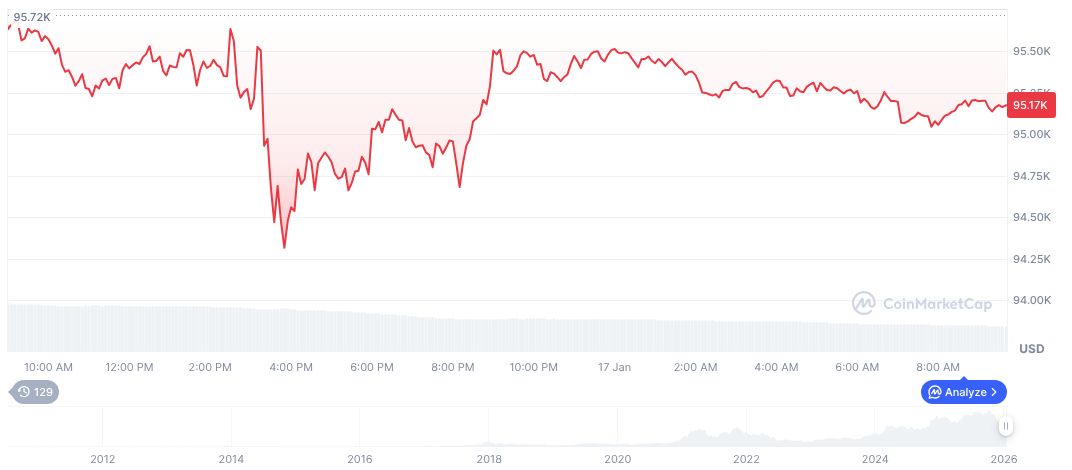
CoinMarketCap data as of 07:38 UTC on January 18, 2026, places Bitcoin's current price at $95,008.28, with its market cap reaching $1.90 trillion. Bitcoin's 24-hour trading volume dropped by 39.70%, with the price falling by 10.56% in this period.
Researchers suggest that Musk's lawsuit could prompt reevaluations of financial practices in AI startups. As litigation progresses, firms may face higher scrutiny over funding sources and management choices, impacting broader regulatory landscapes and investor confidence.