


Key Points
- •Dallas Fed President Lorie Logan has expressed concerns about the possibility of cutting interest rates in December.
- •Significant disinflation or a cooling labor market would be necessary to support a rate cut.
- •Market expectations have shifted, reducing the likelihood of a December rate cut.
Federal Reserve's December Rate Cut Faces Challenges
Dallas Fed President Lorie Logan has indicated that the current economic outlook does not support a reduction in interest rates. Logan stated that she would find it difficult to approve another rate cut in December unless there is clear evidence of disinflation or a more rapid cooling of the labor market.
These remarks have influenced market expectations, leading to a significant decrease in the probability of a December rate cut. Following Logan’s statements, the U.S. Dollar Index saw a modest increase, and the likelihood of rate cuts diminished. Other Federal Reserve officials, such as Kansas City Fed President Jeff Schmid, have also advocated for a cautious approach, emphasizing the persistence of inflation pressures.
This economic outlook didn't call for cutting rates. And I'd find it difficult to cut rates again in December unless there is clear evidence that inflation will fall faster than expected or that the labor market will cool more rapidly.
— Lorie Logan, Dallas Fed President, Federal Reserve.
Inflation Concerns: Impact on Crypto and Forex Markets
The heightened caution from U.S. Federal Reserve officials often precedes temporary downturns in both cryptocurrency and traditional markets, particularly during periods where extended tightening measures are announced.
As of November 2, 2025, at 09:02 UTC, Bitcoin (BTC) is valued at $110,835.25 with a market capitalization of $2.21 trillion and holds 59.32% market dominance. The trading volume for Bitcoin decreased by 38.56% in the last 24 hours. Over the same period, Bitcoin's price saw a 0.63% shift, and it has dropped 7.77% over the last 30 days.
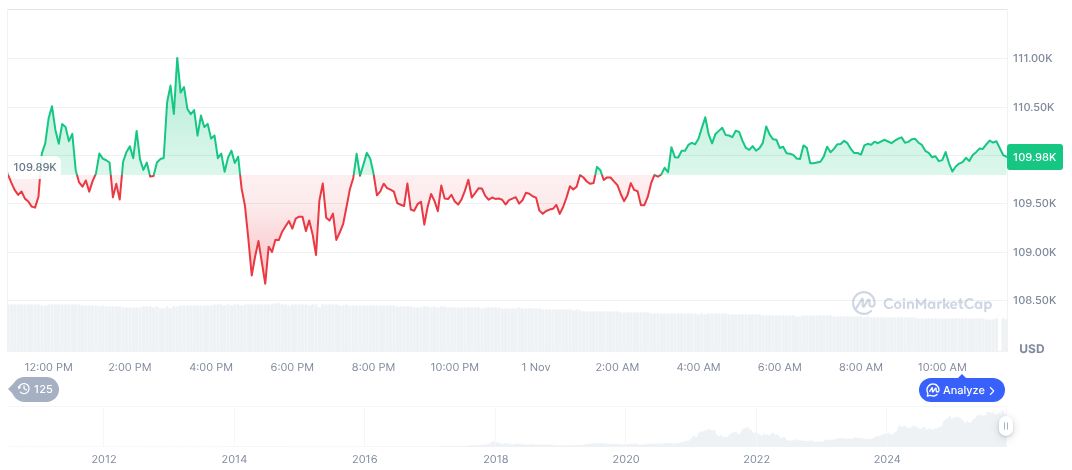
Coincu's research team suggests that a prolonged hawkish monetary policy from the Federal Reserve could lead to a dampening of liquidity, which would likely affect both traditional and cryptocurrency markets. Forex markets might experience an increase in dollar strength, while crypto assets such as Bitcoin (BTC) and Ethereum (ETH) could face downward pressure due to reduced macro liquidity flows.