


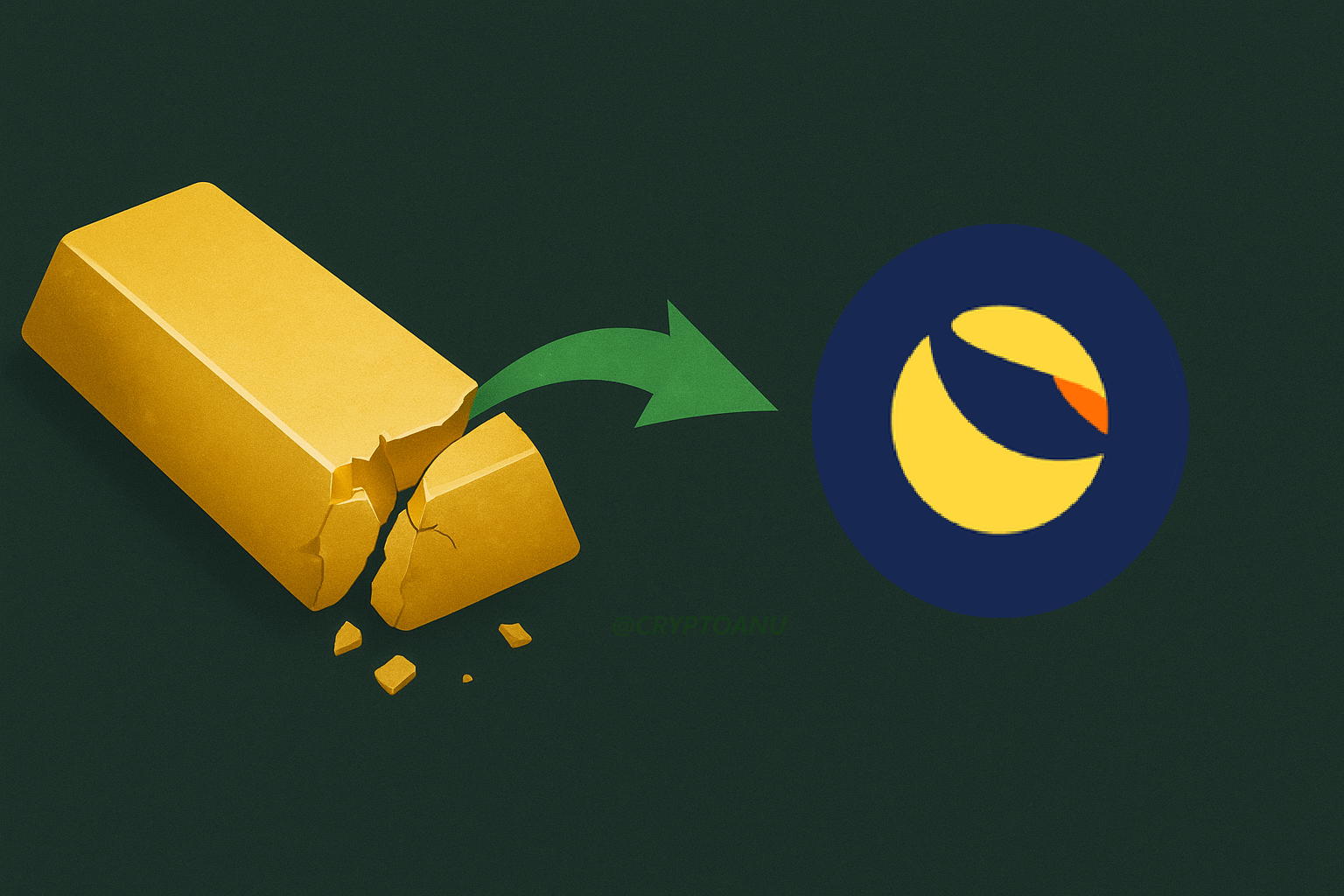
The global financial markets are in transition. Gold — the centuries-old store of value — just hit what many analysts call a cyclical peak, followed by a sharp 6% decline in a single session. This isn’t just a price correction; it’s a signal that capital is moving — and the next destination might be clear: crypto.
Gold's Peak: A Turning Point for Traditional Safe Havens
After months of strength driven by geopolitical uncertainty and inflation hedging, gold has finally met exhaustion. The sudden sell-off represents more than traders taking profits; it’s a shift in risk appetite.
Investors are realizing that while gold remains a safe asset, it offers no yield, no innovation, and limited scalability in a digitized world. In contrast, crypto — particularly blockchain ecosystems with active communities like Terra Classic ($LUNC) — provides both speculation and technological growth potential.
Liquidity Doesn't Disappear — It Transforms
Every decline in one asset class fuels another. When capital exits gold and other metals, it doesn’t vanish; it searches for higher beta opportunities.
Historically, when gold cools, risk assets surge. Stocks benefit first, but crypto often follows with a delayed yet amplified response. With traditional markets saturated and real yields compressing, digital assets look ready to absorb that liquidity flow.
Why This Cycle Could Be Different
Unlike previous cycles, crypto has matured — both structurally and psychologically. Institutional adoption, stablecoin integration, and AI-driven market infrastructure now create deeper liquidity and smarter capital allocation.
Add to that a suppressed crypto market, where valuations remain historically low, and we have a spring-loaded setup:
There can’t be a bear market without a bull market before it.
This is the compression phase — and when liquidity flows back in, the rally could be one of the most explosive we’ve ever seen.
Enter $LUNC: Undervalued, Underestimated, and Waiting
Terra Classic ($LUNC) embodies resilience. After surviving one of the biggest crashes in crypto history, the ecosystem rebuilt itself around burns, governance, and community-driven development.
Now, as liquidity rotates out of traditional assets, projects like LUNC could benefit disproportionately because:
- •It has a deflationary burn mechanism.
- •It trades at micro-cap levels relative to its previous highs.
- •It represents the redemption narrative — one of crypto’s most powerful emotional drivers.
If capital rotation intensifies, LUNC could become a high-volatility beneficiary — the kind of token that thrives in liquidity surges.
The Big Picture: A Historic Market Pivot
Gold’s decline may mark the start of a larger macro rotation — from static assets to programmable assets. Where gold once represented stored value, crypto now represents stored potential.
With AI-driven DeFi platforms, real-world asset tokenization, and DEX evolution, the ecosystem is no longer purely speculative — it’s infrastructural.
As traditional liquidity migrates into digital form, the crypto bull market of 2025–2026 may be remembered as the moment the old guard finally yielded to the new.
Conclusion
Gold’s fall isn’t the end of safety — it’s the end of stagnation. Liquidity is leaving the vaults and entering the blockchain.
If this thesis holds, the next market phase could be the largest liquidity migration in financial history, with coins like $LUNC and $USTC positioned at the intersection of volatility and opportunity.
This isn’t just another rotation. It’s a paradigm shift — from metal to code, from storage to movement, from value to velocity.
The moon might not be made of gold after all — it might be built on-chain.