


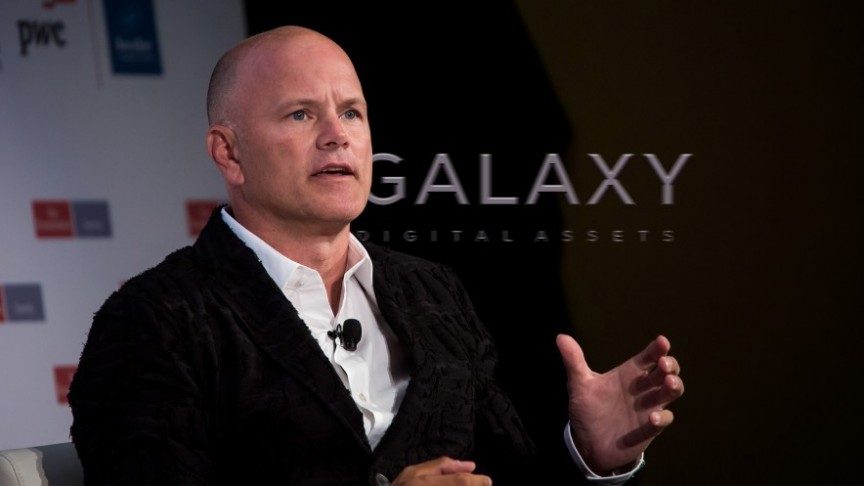
Galaxy Digital reported the strongest quarter in its history, with profit up 1,546% to $505 million. This significant increase was lifted by record trading volumes, treasury inflows, and early returns from its artificial-intelligence infrastructure business. Core earnings rose to $629 million from $211 million in the prior quarter, while total assets increased 27% to $11.5 billion, according to the company’s report on Tuesday.
Galaxy added $4.5 billion in new digital-asset-treasury mandates, pushing platform assets to $17 billion. The surge in inflows and trading activity helped the firm capitalize on renewed institutional appetite for crypto exposure amid a wider rebound in digital markets.
Founder and CEO Mike Novogratz stated that the results reflect eight years of building across both digital-asset markets and physical infrastructure. He told investors, "We’re half a data-center company and half a digital-assets company. Helios is the cornerstone of our future."
Galaxy’s results highlight the growing convergence of crypto finance and AI infrastructure — two of the fastest-growing segments in digital markets.
Helios Pivot Pays Off
The company’s 800-megawatt Helios campus in Texas, which was once among North America’s largest bitcoin mines, is currently being converted into an AI-compute facility. This conversion is being undertaken under a long-term lease with CoreWeave. Galaxy has successfully closed $1.4 billion in project financing for the first phase and raised an additional $460 million this month to accelerate the conversion process. Revenue from Helios is anticipated to begin contributing to the company's finances in the first half of 2026.
Novogratz’s strategic bet on AI infrastructure has gained significant traction following BlackRock and Nvidia’s $40 billion acquisition of Aligned Data Centers last week. This acquisition valued power capacity roughly 160% higher than comparable bitcoin miners, serving as a validation for Galaxy’s pivot away from mining towards higher-margin AI infrastructure.
“Helios is now fully financed and leased,” Novogratz commented, describing it as a long-term engine for cash flow. The company’s strategic shift aligns with a broader market trend that recognizes data-center power and compute capacity as crucial strategic assets in the burgeoning AI economy.
Breakout in Trading and Asset Management
Galaxy’s digital-assets division generated $318 million in adjusted gross profit, a performance significantly aided by a 140% surge in trading volumes and a substantial single $9 billion bitcoin transaction executed for a client. The asset-management business also experienced rapid expansion, with inflows primarily concentrated in institutional treasury programs. CFO Chris Ferraro described the period as “a breakout quarter for Galaxy,” citing record results across trading, investments, and infrastructure.
The company concluded the quarter with $1.9 billion in cash and stablecoins and $3.2 billion in total equity. This financial position provides a strong foundation for scaling both its trading and infrastructure units. Galaxy’s diversification strategy, which spans across market cycles by combining digital-asset management with real-world compute investments, has allowed it to achieve a market footprint that few crypto-native firms have attained.
Galaxy’s earnings surge reflects the return of institutional capital to the crypto market and the market’s revaluation of data-center assets as AI demand drives infrastructure scarcity.
Stock Reaction and Market Outlook
Following the release of its results, shares of Galaxy climbed to a record high of $44.30 before easing to around $42, according to data from The Block. The stock has seen a significant increase of over 330% since April, when it traded below $10. Analysts suggest that investors are responding positively to the firm’s dual exposure to digital assets and AI-driven infrastructure, two sectors that continue to attract substantial institutional allocations.
Galaxy’s next challenge will be to effectively translate its AI buildout into consistent income as the Helios facility becomes operational in 2026. For the present, the company’s strong performance solidifies its position as one of the few hybrid players successfully linking blockchain finance with real-world compute demand—a combination that Wall Street appears eager to support.