


Grammarly, the AI writing assistant that has become a staple for millions of professionals and students worldwide, has announced a significant new chapter in its evolution. The company revealed today that it is officially changing its name to Superhuman, marking a major transformation into an AI-native productivity powerhouse.
This announcement signals one of the most significant rebranding moves in the AI productivity sector this year. The new identity unites Grammarly, Coda, and Superhuman Mail under a single, unified brand: Superhuman. Its mission is to "unlock the superhuman potential in everyone."
According to the company, the new name and structure reflect a broader vision that extends beyond writing assistance. Superhuman now aims to serve as a comprehensive platform that integrates AI agents and productivity applications to help users work faster, smarter, and more efficiently.
Launched in 2019, Grammarly revolutionized writing by offering real-time grammar correction and stylistic feedback powered by natural language processing. Over time, the company expanded its offerings to include tone detection, rewriting tools, and generative AI features.
However, the technological landscape has changed dramatically in the past two years. The rise of generative AI tools such as ChatGPT, Google Gemini, and Anthropic’s Claude has reshaped how people write, communicate, and collaborate. Grammarly’s leadership recognized that to remain relevant and competitive, it needed to evolve beyond text correction into something far more powerful.
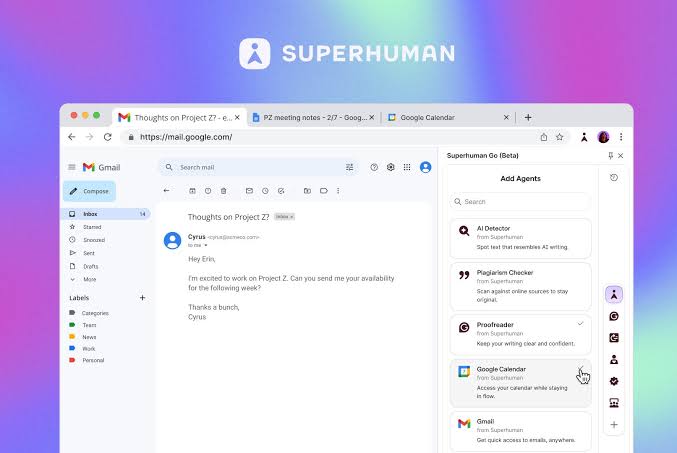
The rebrand to Superhuman signifies this pivotal shift. It represents an AI-native ecosystem that extends beyond words to encompass productivity, creativity, and automation across various applications.
In a statement, the company said, "The new Superhuman unites the best of Grammarly, Coda, and Superhuman Mail into a single AI platform. Our mission is simple: to make AI easier to use so that everyone can work better and faster."
Superhuman will now serve as the umbrella brand for all its products, offering users seamless integration between writing, collaboration, and communication tools.
Grammarly to Superhuman: What’s Changing and What’s Next?
Under the new Superhuman brand, users can expect three main pillars:
- •Superhuman Suite – A collection of productivity tools powered by AI, designed to simplify workflows across writing, communication, and data organization.
- •Superhuman Mail – A reimagined email experience that blends intelligent automation with human-like assistance, building on the success of the original Superhuman app.
- •Superhuman Go – A new offering that connects users with AI agents capable of automating routine digital tasks across various platforms.
The rebranding also consolidates teams and technologies from Grammarly, Coda, and Superhuman Mail, enabling deeper collaboration and innovation under one unified vision.

While the company has not yet confirmed whether the Grammarly name will continue to exist as a sub-brand, industry insiders expect it to transition into “Superhuman Writing,” maintaining its strong recognition while aligning with the unified identity.
This move is part of a growing trend among AI firms to merge multiple tools into a single, cohesive ecosystem. Similar strategies have been observed from companies like Notion, Anthropic, and OpenAI, which are building AI platforms that integrate across writing, research, and productivity applications.
Superhuman’s leadership team believes that unifying under one name will help users better understand its evolving capabilities. The company stated, “This isn’t just a rebrand; it’s a redefinition of what it means to be productive in the age of AI.”
Why the Rebrand Matters
For years, Grammarly has been synonymous with writing assistance. Its browser extensions, desktop apps, and integrations served over 30 million users globally. The brand became so embedded in daily digital communication that its name became a verb, often used colloquially as "I’ll Grammarly this before I send it."
However, as the boundaries between writing, communication, and productivity increasingly blur, Grammarly’s core value proposition is overlapping with other AI tools. By rebranding to Superhuman, the company positions itself as more than just a writing assistant; it is becoming an orchestrator of digital work.
The inclusion of Coda, a collaborative document platform, and Superhuman Mail, the high-speed email app favored by tech professionals, reinforces this strategic shift. Together, these components form a suite that connects text, communication, and data through the power of AI.
Analysts suggest that this move could establish Superhuman as a major contender against AI-native productivity platforms such as Notion AI, Microsoft Copilot, and Google Workspace AI. By combining its linguistic expertise with automation and workflow intelligence, Superhuman has the potential to become a go-to platform for hybrid professionals who rely on multiple tools to manage their daily tasks.
Superhuman’s promise to “make AI easier to use” points to a future where users will no longer need to switch between multiple applications or interfaces. Instead, AI agents embedded within Superhuman’s platform could anticipate user needs, summarize information, draft documents, manage communications, and even execute tasks autonomously.

The company has not yet disclosed specific pricing or release dates for its newly unified services. However, its announcement hints at upcoming launches under the Superhuman Suite and Superhuman Go, which are likely designed to integrate smoothly with existing enterprise tools.
The brand also unveiled a refreshed visual identity, featuring a minimalist design and vibrant tones to reflect its "human-meets-machine" philosophy.
While some long-time Grammarly users may require time to adjust to the new name, this shift could represent one of the most strategic moves in the ongoing AI productivity race. Superhuman is betting on a future where individuals not only write better but also work smarter, think faster, and operate with augmented intelligence at every step.
As Superhuman stated in its launch announcement: "AI should empower people, not replace them. Our mission is to unlock the superhuman potential in everyone."