



Grayscale Highlights Institutional Shift in Bitcoin Market
Grayscale Investments has reported that Bitcoin's traditional pricing model, which was tied to its four-year halving cycle, is becoming obsolete. This is due to institutional capital now driving the market. This shift marks a pivotal change in Bitcoin's market dynamics, signaling the waning influence of speculative cycles and aligning with broader institutional investment strategies.
Grayscale Research indicates a diminishing influence of Bitcoin's traditional four-year halving cycle because of rising institutional participation. The market is pivoting away from retail speculation. Grayscale's analysis highlights the shift towards institutions dominating market trends, underscoring the diminishing role of the halving cycle.
Grayscale's report stresses the importance of institutional capital, as its influence grows in shaping Bitcoin's price behavior. This shift contrasts with past cycles that were dominated by retail speculation and emphasizes a controlled bull run with significant institutional backing. According to Grayscale Research, "ETF and long‑term holder demand now reshape supply more than halvings alone."
Market participants have taken note of these insights, as Grayscale's analysis suggests a pivot in market dynamics. This evolution is characterized by professional investment strategies rather than retail-driven volatility, which enhances Bitcoin's market stability in the current cycle.
Bitcoin's Price Trends Amid Institutional Influence
As institutional participation reshapes Bitcoin's market, its current price movements reflect a more controlled trend, diverging from the dramatic rallies seen in 2013 and 2017.
Bitcoin's price is currently around $90,324.72, maintaining a market capitalization of approximately $1,802,841,365,525. Recent data indicates a 0.86% decline over the past 24 hours. With a 58.62% market dominance, recent trends show a 4.21% rise over seven days, despite a 18.89% drop over 90 days.
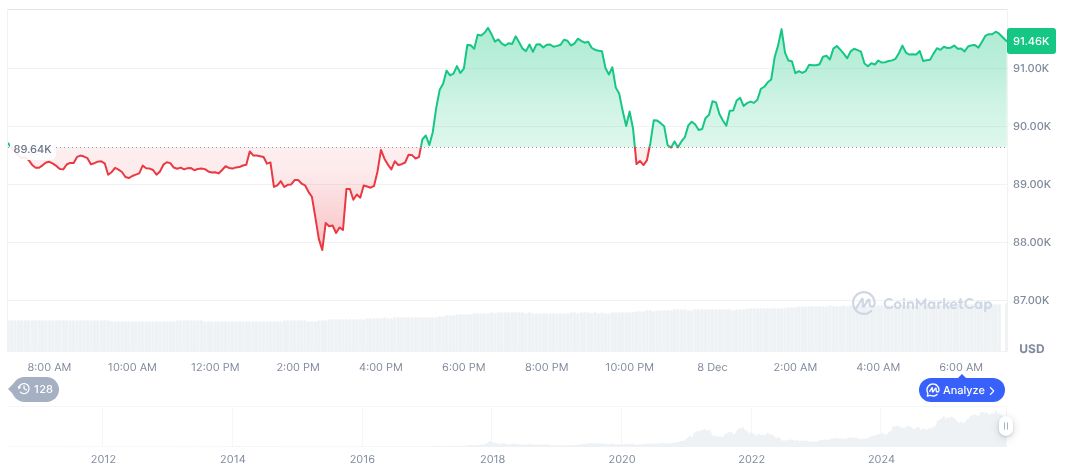
The growing influence of institutional capital is considered pivotal to Bitcoin's market trends. Technological advancements and regulatory clarity may further enhance Bitcoin's structural stability, contrasting previous cycles that relied on retail market dynamics.