



Think of most DeFi protocols like nightclubs that pay people to show up. The music’s loud, the drinks are free, and the place looks packed. But the second the free bar closes, everyone leaves for the next spot offering better deals. That’s emission-based yield. It’s not real demand. It’s paid attendance.
Ampleforth built something different. A protocol where yield comes from people actually using the system, not from bribing them to pretend they care. Real economic activity generating real returns. And that changes everything.
The Emission Trap
Emission-based yield is essentially subsidized growth that looks impressive until the tokens stop flowing. Then liquidity evaporates, APYs collapse, and everyone moves to the next farm offering better rates. It’s not yield. It’s a promotional budget with extra steps.
Compound and Aave pioneered this model during DeFi summer 2020. They had to. There was no other way to cold-start these markets. But what began as a necessary bootstrap mechanism became the entire playbook. Protocols competed not on utility but on who could print the most attractive rewards.
The problem compounds over time. Literally. Each wave of emissions dilutes existing holders. The yield you’re earning gets paid for by eroding the value of the token you’re accumulating. You’re running on a treadmill, and the treadmill is slowly sinking.
Usage-Based Yield Changes Everything
Ampleforth’s model generates yield from actual market dynamics, not token inflation.
Here’s how it works:
AMPL’s elastic supply gets channeled through the rotation vault, splitting into two tranches: stAMPL and SPOT. stAMPL carries the volatility. SPOT maintains stability. Between them runs a funding rate that redistributes value based on real market conditions.
When markets expand and demand surges, value flows from stAMPL to SPOT. Holders providing stability during high-leverage periods get compensated. When markets contract, the flow reverses. SPOT holders compensate stAMPL for absorbing downside volatility.
Nobody’s printing new tokens to make this happen. The yield emerges from the system’s internal mechanics. From actual participation. From genuine economic activity.
What Changed
Imagine you and your cousin both inherit some farmland. But you want different things. You want steady, predictable income. Your cousin wants to swing for the fences and doesn’t mind risk. So you make a deal. The farmland stays in the family, but you split the results. When harvests are good, your cousin gets the big payday. When harvests are bad, you’re protected and your cousin takes the hit.
That’s basically what Ampleforth’s rotation vault does.
AMPL’s price stays around a dollar, but the supply moves up and down based on demand. More demand means you get more tokens. Less demand means you have fewer tokens.
Some people love that. Some people hate it.
The rotation vault splits AMPL into two flavors: stable SPOT and volatile stAMPL.
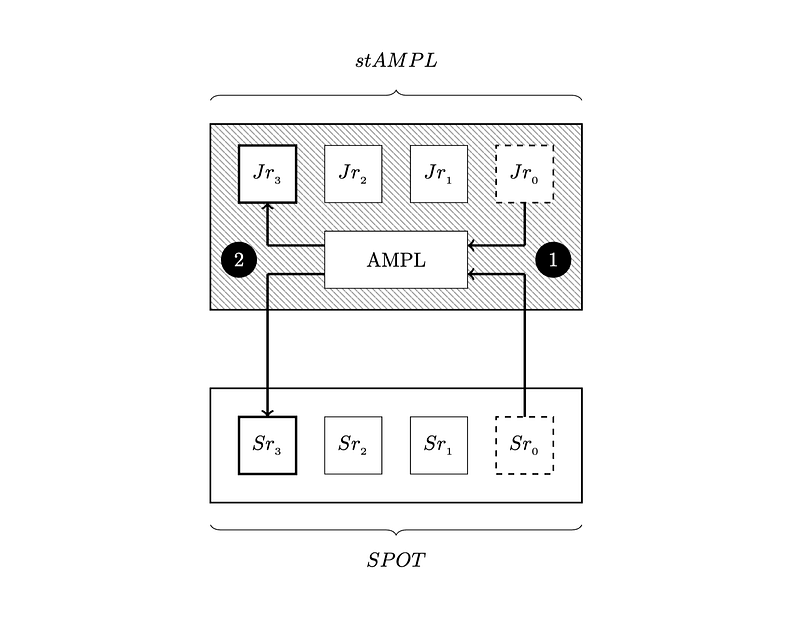
SPOT holders get smooth, steady growth. They’re protected when things contract. stAMPL holders get amplified gains when things expand, but absorb the volatility when they don’t.
Why Both Sides Win
SPOT holders pay stAMPL holders to absorb the wild swings. stAMPL holders get compensated for taking that risk. Nobody’s printing free tokens. The yield comes from actual people with different goals making a trade. One side wants stability. The other wants maximum exposure.
The system just facilitates the exchange and automates the math.
The Automatic Part
Every week, the vault refreshes itself. Old positions mature. New positions get created. It’s like rotating crops so the soil stays healthy. You don’t have to do anything. It happens in the background. You just pick which side you want to be on: stable or volatile.
What Makes It Different
Traditional DeFi pays you with newly printed tokens. That’s like a store giving you monopoly money as a discount. Works until everyone realizes it’s not real. Ampleforth pays you with actual value redistribution. The volatility doesn’t disappear. It just goes to people who want it, and they compensate the people who don’t.
Real economics. Real yield. No printing press. Traditional yield dies when emissions stop. Ampleforth’s yield exists as long as markets move. And markets always move. Volatility is the one renewable resource in crypto.
From Extraction to Contribution
The progression from emission-based to usage-based models mirrors how financial systems evolve from extractive to contributory.
DeFi 1.0 extracted yield through dilution. You earned tokens, but those tokens lost value as more got printed. Net result: unclear at best.
DeFi 3.0 earns yield through contribution. You get compensated for providing real utility to the system. Stability when markets need stability. Volatility absorption when markets need that. Real economic functions that keep the system balanced.
Ampleforth channels user participation into productive outcomes. Rewards are earned through use, not granted through subsidy. The protocol doesn’t bleed value to simulate growth. It captures value from genuine throughput.
The Closed Loop Advantage
What makes this sustainable is the architecture. Ampleforth operates as a closed-loop system. Value doesn’t leak out through emissions. It circulates internally based on market conditions and user behavior.
The funding rate mechanism creates equilibrium. When one side becomes overcrowded, returns shift to incentivize the other side. The system self-corrects. It reaches balance not through external intervention but through its own economic design.
This is what mature DeFi looks like. Not protocols desperately bribing users to stick around. But systems where participating creates value, and that value gets distributed to participants based on what the market actually needs.
Why Ampleforth Specifically
Ampleforth had a head start because it was born different. AMPL’s elastic supply meant it could never compete in the traditional yield farming game. It couldn’t just print more tokens to attract liquidity without changing fundamental dynamics.
That constraint forced innovation. The rotation vault emerged as a solution to channel elasticity into structured, productive yield. What looked like a limitation became an advantage.
Now Ampleforth sits at the intersection of several trends: the shift from emission-based to usage-based yield, the maturation of DeFi infrastructure, and growing demand for sustainable yield sources that don’t rely on ponzi dynamics.
What This Means Going Forward
DeFi’s early phase required speculation and emissions to bootstrap. It couldn’t be avoided. But that phase is ending.
The next chapter will be defined by usage and equilibrium. By protocols that generate yield from actual economic activity rather than monetary inflation. By systems where participation creates value instead of just redistributing it. Ampleforth built the architecture for this. The rotation vault proves usage-based yield can work at scale. It can compete with emission-based rates without the long-term decay.
Whether Ampleforth becomes the future of yield or just demonstrates a model others will copy doesn’t matter as much as the shift itself. Emission-based yield is dying. It has to. The math doesn’t work long-term. Usage-based yield is what survives. What scales. What builds actual economies instead of temporary extraction schemes.
Ampleforth got there first. And in finance, being early to the right model matters more than being loud about the wrong one. The future of yield is earned through use. Ampleforth proved it’s possible. Now watch how fast the rest of DeFi follows.