


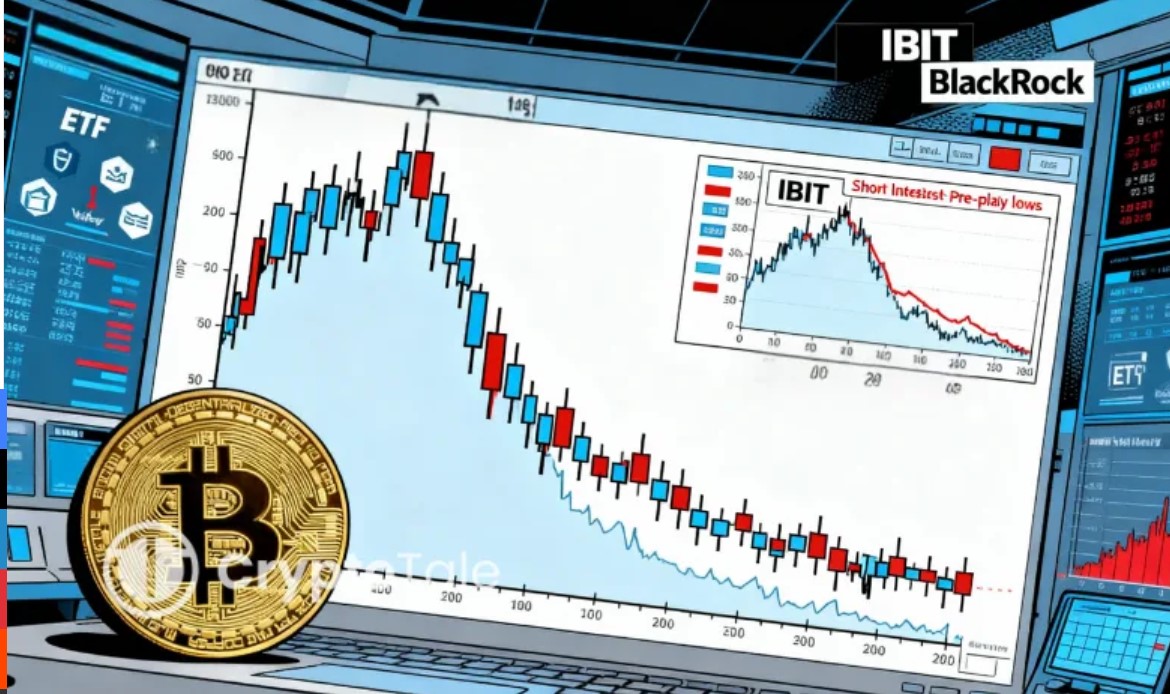
Short Interest Collapse and Hedge Adjustments
Bloomberg analyst Eric Balchunas observed that IBIT short interest "plummeted" this week, with data from S3 Partners indicating a significant decrease in positioning, falling back toward April lows. Analysts suggest this move reflects traders covering their hedges rather than initiating new bearish bets.
Balchunas noted that IBIT short interest declined from approximately 2% of outstanding shares to a much smaller fraction. According to S3 Partners, traders typically engage in shorting during market upturns and cover their positions during downturns. This pattern has re-emerged as traders reduced their exposure while Bitcoin experienced its monthly slide.
He clarified that while IBIT shorts never reached extreme levels, the speed of the decline was notably distinct. Balchunas explained that this activity pointed towards the unwinding of hedges rather than the establishment of new directional bets. Consequently, this reset has brought positioning back to levels observed before April's earlier rally phase.
Regarding future performance, Balchunas stated that he could not predict specific outcomes. However, he referenced IBIT's historical ability to recover from sharp downturns and subsequently reach new highs.
For context, Bitcoin had previously fallen from $109,000 in January to approximately $75,000 during the early April market tensions. Short interest also eased during that period before Bitcoin later recovered to surpass $112,000.
Heavy Outflows Intensify Pressure on Crypto ETFs
Meanwhile, broader market data has revealed substantial redemption activity across crypto investment products. Global crypto ETPs recorded net outflows totaling $1.9 billion in the past week alone. U.S. spot Bitcoin ETFs accounted for $1.2 billion of these outflows, with IBIT being a significant contributor.
IBIT alone registered nearly $1.1 billion in redemptions during the recent wave of outflows. Furthermore, figures from November indicated that $3.5 billion exited U.S.-listed Bitcoin ETFs. This brought the monthly outflow activity close to February's record of $3.6 billion.
BlackRock's fund, which holds approximately 60% of total ETF assets, experienced $2.2 billion in redemptions during November, marking its worst month since its launch in early 2024.
Lookonchain reported daily updates detailing net Bitcoin ETF outflows of 2,588 BTC. Within this total, BlackRock accounted for 1,452 BTC in withdrawals. These figures illustrate persistent selling pressure coexisting with declining short interest.
Falling Shorts and Institutional Repositioning
However, the reduction in short exposure signifies a clear shift in trading sentiment. Traders have moved towards more neutral positioning as bearish pressure began to recede. Therefore, the decrease in short volume aligns with institutions stepping back from aggressive downside protection.
This month's market retreat also coincided with Bitcoin recording its most significant monthly performance decline since the industry collapse in 2022. Notably, the ETF market has reflected this downturn through a reduction in short positioning.
The timing of these events bears resemblance to the correction observed in April, when similar short resets occurred before renewed price movement. Despite this, current figures indicate sustained selling pressure rather than a rapid recovery. Consequently, traders continue to react to price pressures and broader liquidity stress.
The broader sector has undergone continuous adjustments as large funds methodically recalibrated their risk exposure. Thus, the balance between outflows and reduced short-term activity has become more apparent. This dynamic illustrates how institutions have navigated the volatility within the Bitcoin ETF market.
The decline in IBIT short interest to pre-April levels, coupled with record redemptions, points to deliberate hedge unwinding and careful repositioning by institutional investors. The observed outflows, falling Bitcoin prices, and steady reductions in short-term activity reflect controlled responses rather than aggressive trading expansion. These developments collectively outline a market that is resetting its exposure while managing sustained selling pressure.