


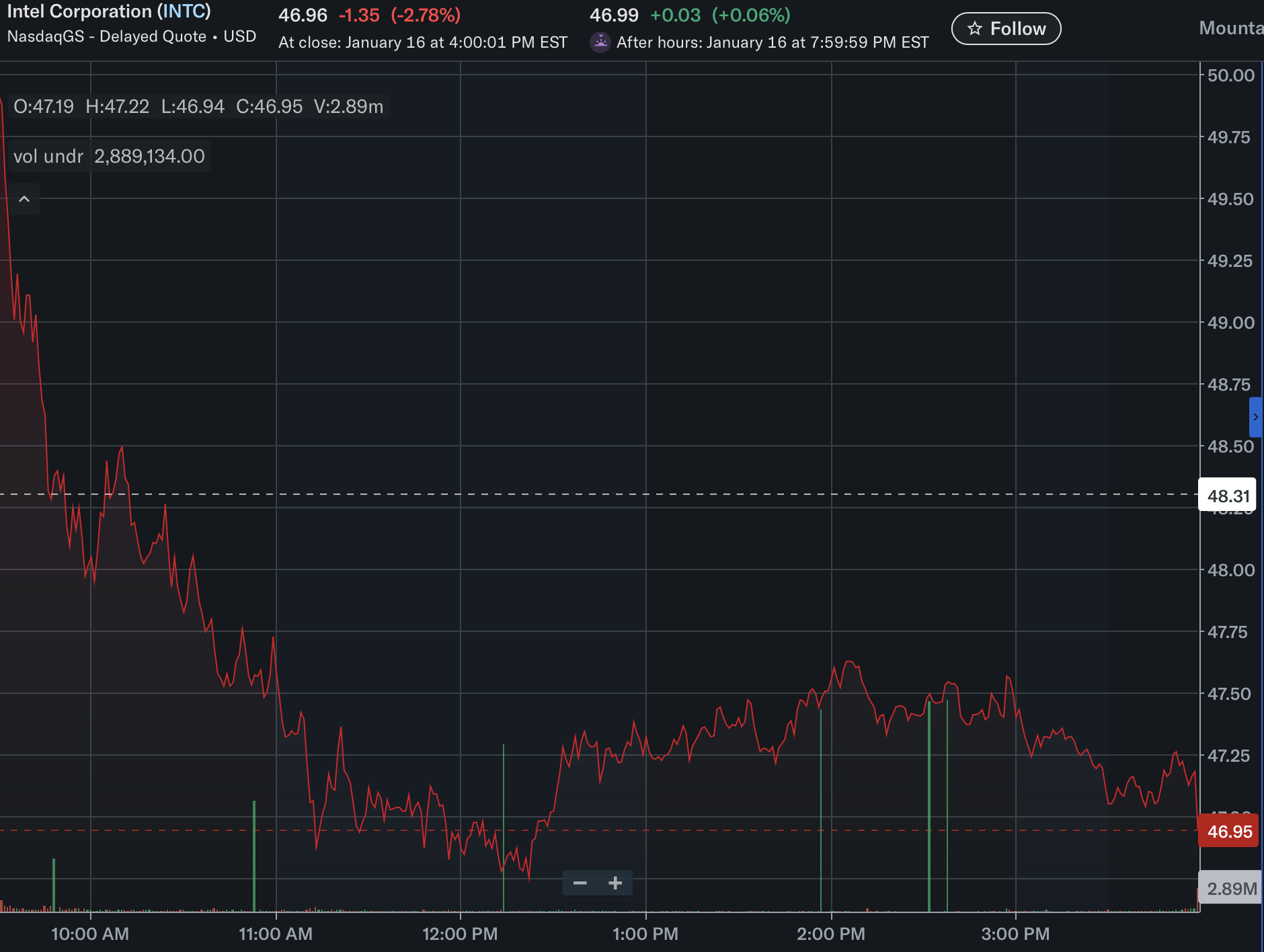
Shares of Intel Corporation closed at $46.96 on Friday, January 16, 2026, as the stock continues a powerful rally fueled by a wave of bullish analyst upgrades.
After years of lagging rivals, sentiment on Wall Street has shifted decisively, with analysts increasingly confident that Intel’s foundry strategy and exposure to artificial intelligence infrastructure are beginning to pay off.
The renewed optimism comes just days ahead of Intel’s Q4 earnings report on January 22, a catalyst investors see as critical for validating the company’s operational turnaround.
Wall Street Turns Constructive on Intel
Several major research firms raised ratings and price targets over the past week, pointing to improving fundamentals across Intel’s manufacturing and data center businesses.
- •KeyBanc Capital Markets upgraded Intel to Overweight (Buy) with a $60 price target, citing reports that Intel’s server CPU capacity for 2026 is effectively sold out. The firm also highlighted potential new manufacturing agreements with large customers, including Apple.
- •Citigroup lifted its rating from Sell to Neutral, raising its price target to $50. Analysts pointed to tight advanced packaging capacity at competitors, particularly TSMC, which could push more customers toward Intel Foundry.
- •Melius Research upgraded Intel to Buy with a $50 target, emphasizing improving execution and better visibility into future margins.
- •Jefferies raised its price target from $40 to $45, while maintaining a Hold rating.
Collectively, these moves signal a clear shift away from the deeply bearish positioning that surrounded Intel for much of the past several years.
Foundry and AI Catalysts Take Center Stage
At the core of the bullish thesis is Intel’s foundry business and its relevance to the AI hardware boom.
Intel’s 18A manufacturing process has now entered production, with Panther Lake chips expected to debut later this month. Analysts tracking early performance report yields approaching ~60%, a level considered commercially attractive for external chip designers evaluating Intel as a manufacturing partner.
At the same time, demand for server CPUs tied to AI data centers remains extremely strong. Intel management has acknowledged that it cannot fully meet early-2026 demand, even after reallocating internal manufacturing capacity. This scarcity dynamic is reinforcing pricing power and improving long-term visibility for the data center segment.
Policy Tailwinds and Strategic Positioning
Investors are also increasingly viewing Intel as a strategic beneficiary of U.S. industrial policy. Expectations around continued government incentives and a renewed focus on domestic semiconductor manufacturing have strengthened the narrative that Intel sits at the center of an “America-first” chip supply chain.
That policy backdrop, combined with tightening capacity at overseas fabs, has elevated Intel’s importance as both a national asset and a viable alternative for global chip customers.
Risks Still Linger
Despite the renewed momentum, caution remains. Intel continues to face intense competitive pressure from Advanced Micro Devices and Arm-based processors in both PCs and servers. Market share recovery is not guaranteed, and execution risks around new process nodes remain a key concern for skeptics.
Still, heading into earnings, Wall Street’s tone has clearly changed. For the first time in years, Intel is no longer being priced purely as a legacy chipmaker, but as a potential long-term winner in foundry manufacturing and AI infrastructure.