



Crude oil has never been a market that rewards comfort. Its long price journey tells a story shaped by sudden reversals, sharp rallies, and painful drawdowns that arrive without warning. Looking across multiple years rather than single moments reveals a pattern that feels chaotic on the surface but is surprisingly consistent underneath.
This underlying structure becomes clearer through an analysis of the annual percentage returns of Brent crude oil from 2010 to 2026. This examination frames crude oil not as a steadily compounding asset but as one driven by powerful boom and bust cycles that repeat over time.
Crude oil price history makes one thing obvious: stability has never been part of the equation. The data shows years where prices surged by more than 50%, followed closely by crashes approaching or exceeding 40%. These violent moves appear repeatedly across the timeline, reinforcing the idea that crude oil operates in cycles rather than trends.
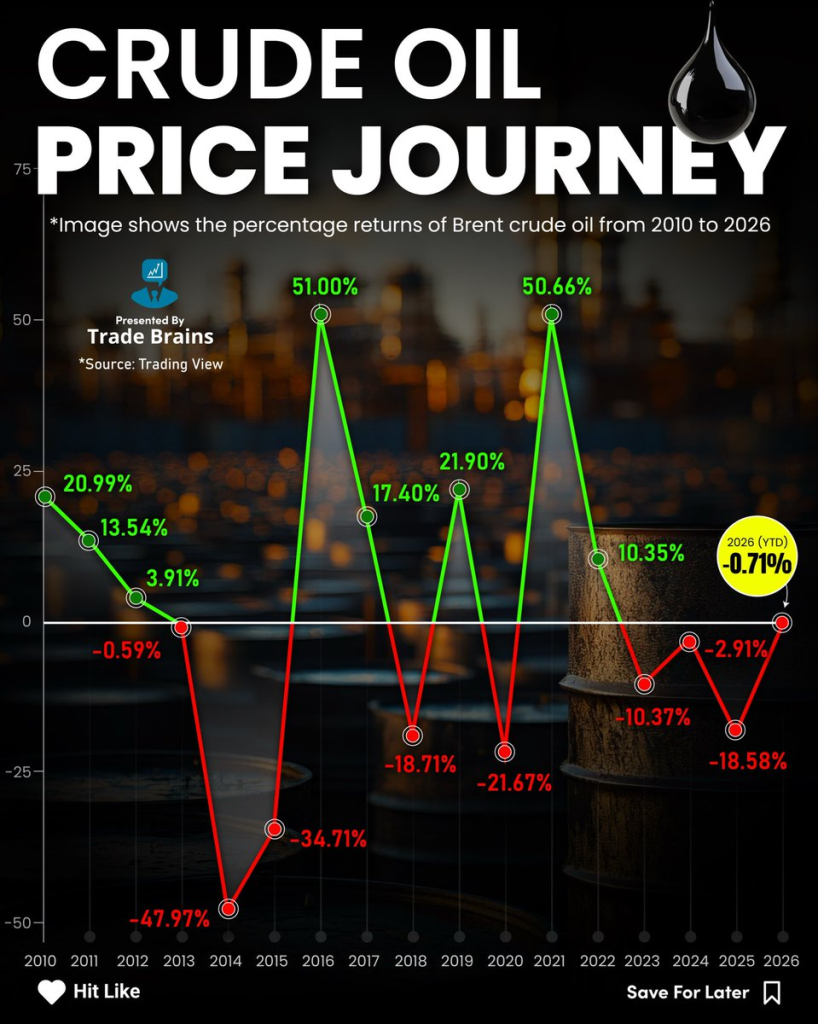
Gains of 51% in 2016 and over 50% again in 2021 did not emerge from calm conditions. Each rally followed periods of stress, pessimism, and prolonged weakness. This recurring setup explains why crude oil price analysis must focus on context rather than isolated price points.
Crude Oil Price Analysis: The Significance of Down Cycles
A key insight is that downturns are not merely destructive phases. The sharp decline of nearly 48% in 2014 reset the market before the strong rebound that followed. A similar sequence unfolded in 2020, when a deep collapse was followed by one of the strongest recoveries in modern oil history.
From this perspective, the recent stretch of softer returns fits neatly into crude oil’s historical rhythm. The current weakness can be viewed as part of a broader multi-year down cycle rather than a sign of permanent decline. Past data shows that these cooling phases often precede some of the most aggressive upside moves.
Crude Oil Price Prediction: Timing the Cycle
Crude oil price prediction, as presented through this analysis, is less about calling exact turning points and more about recognizing where the market sits within its cycle. The data suggests that once downside momentum fades and fundamentals begin tightening again, price reactions tend to be swift rather than gradual.
This interpretation raises a compelling question: If previous down cycles led to rallies exceeding 50%, could the current phase be laying similar groundwork? History does not guarantee repetition, yet the structural resemblance is difficult to ignore.
It is consistently emphasized that crude oil rewards those who respect volatility rather than fear it. The market has never delivered smooth returns, yet it has repeatedly offered explosive moves following periods of exhaustion.
Crude oil price analysis rooted in long-term data does not promise certainty; it offers perspective. The same boom-bust behavior that defined the last 16 years continues to shape expectations today. Watching how this cycle resolves may reveal whether crude oil is quietly preparing for its next defining move.