


Cardano has long been recognized for its research-driven approach to blockchain development. However, a recent network split, triggered by a single transaction from a staking pool operator, has significantly impacted this perception. This temporary chain fork, a rare occurrence in Cardano's history, was exacerbated by founder Charles Hoskinson's decision to involve the FBI in investigating potential malicious intent. This has led to investor concerns about the future trajectory of Cardano's price.
The Network Split That Changed Everything
The incident occurred when a staking operator, known as "Homer J," utilized an AI-generated code snippet for a delegation transaction. While the transaction was valid according to Cardano's established rules, it revealed a previously undiscovered vulnerability. This resulted in a split of the blockchain, with some nodes accepting the transaction and others rejecting it, leading to two competing versions of the network.
Although developers swiftly released a patch and validators successfully rejoined the main chain, the event highlighted a critical vulnerability: even a blockchain designed for formal verification, such as Cardano, is not entirely immune to edge-case failures. In the realm of decentralized finance, where perception plays a crucial role, this incident has undoubtedly shaken market confidence.
Charles Hoskinson's decision to bring the FBI into the investigation elevated the situation from a mere technical glitch to a potential criminal matter. The event is now being viewed as a possible attack vector rather than an accidental error, introducing an element of legal uncertainty that further unsettles investors already concerned about the declining ADA price.
Cardano Price Prediction: ADA Stuck Below Key Resistance
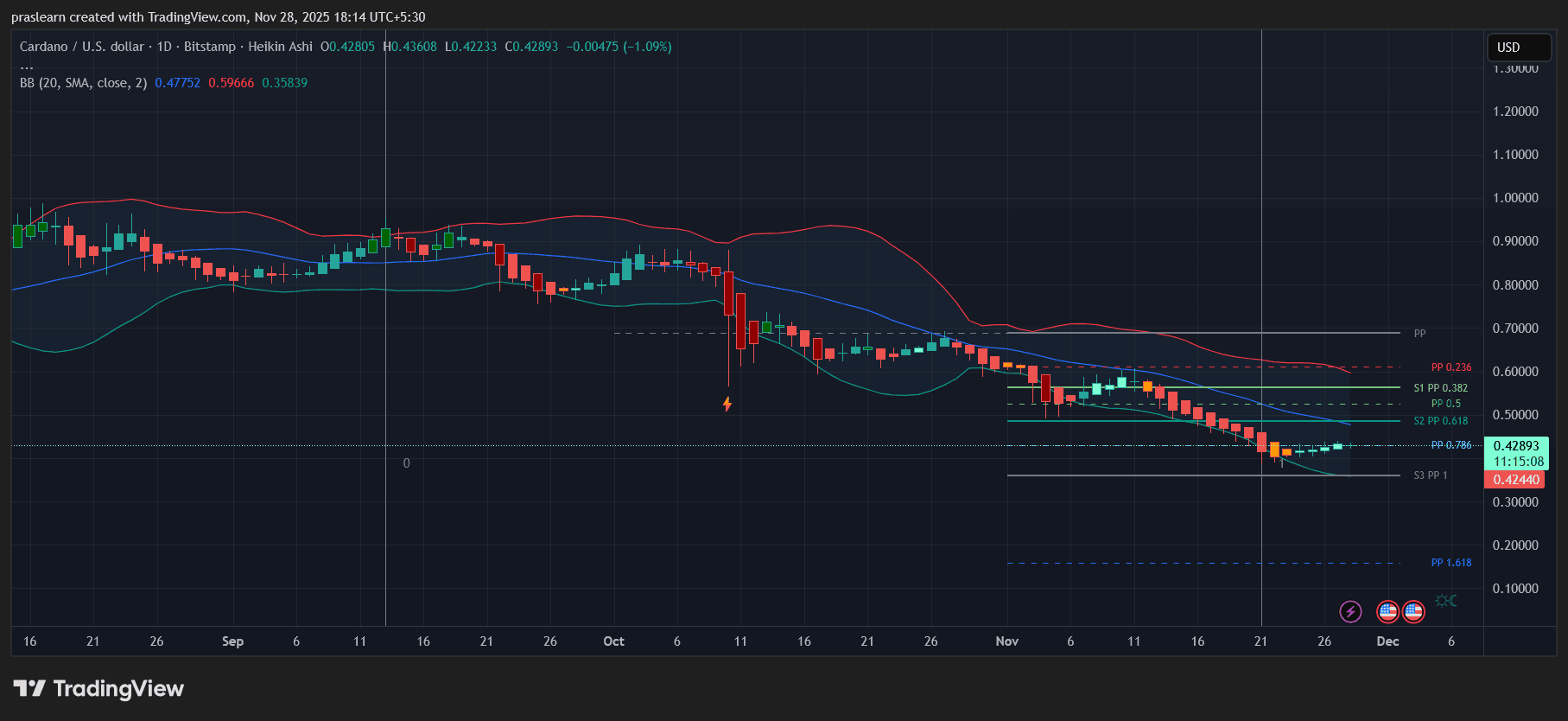
Analysis of the daily TradingView chart indicates that the ADA price is currently facing resistance below both the 20-day and 50-day moving averages, which are both trending downwards. The Heikin Ashi candles reflect a consistent selling pressure that has been in effect since early October, with only brief periods of upward movement that failed to break the established downtrend.
The Bollinger Bands are showing signs of tightening, suggesting an impending period of compression and potential volatility. ADA is trading around $0.42, positioned below the midline of the lower Bollinger band, which is now acting as immediate resistance at $0.47. A sustained upward movement above $0.50 is necessary for bullish sentiment to return.
Fibonacci retracement levels further underscore this weakness, with the 0.382 level near $0.55 and the 0.618 level near $0.61. To reverse the current trend, ADA must reclaim these price zones. On the downside, support is observed near $0.36, and a breach of this level could lead to a decline towards $0.30, which corresponds to the S3 pivot area.
The current market structure strongly suggests a bearish channel, where every upward bounce is met with selling pressure. Momentum indicators are signaling exhaustion, and if ADA fails to recover above $0.47 in the near future, a capitulation wick may precede any significant reversal.
Macro Headwinds: Fear Is Back in the Market
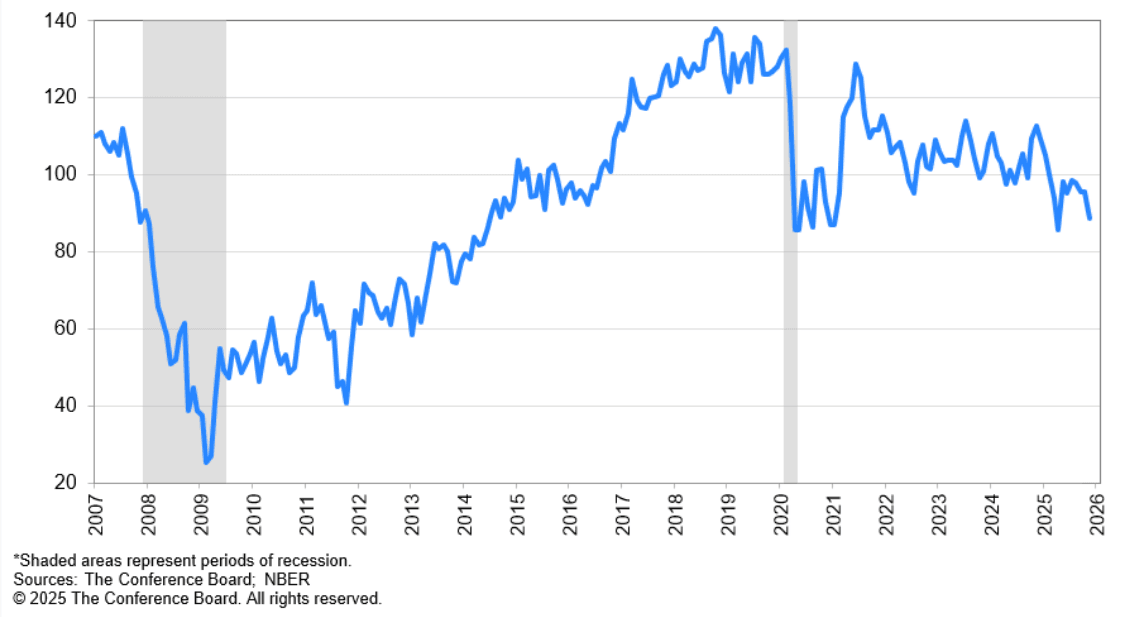
The broader macroeconomic environment is also contributing to the pressure on ADA. U.S. consumer confidence has fallen to its lowest point since April, with households expressing increased anxiety regarding job security and inflation. Historically, a decline in consumer sentiment has correlated with a reduced appetite for speculative investments in cryptocurrency markets.
As risk assets face increased pressure, investors tend to withdraw liquidity from altcoins first, and ADA is currently experiencing the consequences of this trend. The combination of a technical failure within the Cardano network and prevailing macroeconomic pessimism has created a challenging environment that favors sustained downward price pressure.
The Bigger Picture: Is This Truly the End?
Every blockchain network encounters critical junctures that define its future. For Cardano, this current situation may represent such a moment. The occurrence of a network split, coupled with an FBI investigation and a declining price, are significant challenges.
Whether this marks a terminal decline for Cardano hinges on the ecosystem's response. If IOHK and the developer community leverage this event as an opportunity to enhance Cardano's resilience—by improving testing protocols, AI-audit frameworks, and code validation processes—ADA could potentially emerge stronger. The underlying fundamentals of its staking economy and smart contract ecosystem remain intact. However, investor patience is limited, and regaining lost credibility is a difficult undertaking.
Cardano Price Prediction: Short-Term Pain, Long-Term Rebuild
From a technical perspective, the ADA price may test the $0.36–$0.38 support zone before finding stabilization. A decisive close above $0.50 would indicate a potential trend reversal, possibly leading to a move towards $0.61 in December. Conversely, if selling pressure continues and the $0.36 support level is breached, ADA could enter an extended bear phase, potentially declining towards $0.30 or even $0.25.
Psychologically, the Cardano community is at a pivotal moment. While the exposure of the bug is unsettling, it could catalyze a re-evaluation of governance and auditing models, particularly concerning the validation of AI-generated code. In the long term, Cardano's ability to foster transparency and demonstrate resilience will be crucial in determining whether it overcomes this crisis or becomes irrelevant.
This situation does not signify the end of Cardano, but it represents the most significant test it has faced since its inception. ADA's price chart is showing weakness, investor sentiment has been shaken, and the network's previously unquestioned reliability is now under intense scrutiny. Nevertheless, markets often have short memories, and if Cardano can transform this incident into a lesson for more robust blockchain design, it may not only recover but also redefine the very meaning of "trustless" systems.