



Key Concerns Regarding Bitcoin's Future Security
Jefferies' global equity strategist, Christopher Wood, has made a significant adjustment to his model portfolio by removing a 10% allocation to Bitcoin. This decision is primarily driven by concerns surrounding the potential security risks posed by advancements in quantum computing.
The reallocation from Bitcoin to gold-based assets signals a growing awareness among investors about the long-term viability of Bitcoin as a secure store of value. This development raises questions about the cryptographic vulnerabilities that could be exploited by future quantum computing capabilities, leading to a cautious market sentiment. Currently, there are no new regulatory updates addressing these specific concerns.
Strategic Shift from Bitcoin to Gold
Christopher Wood of Jefferies has recently reallocated his Bitcoin holdings, transferring a 10% stake from Bitcoin to gold-based assets. This strategic move is a direct response to concerns over the accelerating progress in quantum computing, which could potentially undermine Bitcoin's fundamental cryptographic security.
The growing capabilities of quantum computing represent a significant threat to Bitcoin's established role as a reliable store of value. This evolving technological landscape is prompting major considerations among investors and may lead to a broader market shift towards traditional assets such as gold.
David Duong, Head of Investment Research at Coinbase, stated, "Bitcoin's long-term security may be transitioning into a new phase as quantum computing progresses."
While market reactions to this development are varied, David Duong of Coinbase has highlighted that Bitcoin's long-term security is indeed facing new scrutiny. Investor Will Carter observed on Twitter that a significant number of investors are actively seeking solutions to these emerging quantum-related risks, while developers appear to be largely unaware of the potential threats.
Quantum Computing and the $1.9 Trillion Bitcoin Market
Historically, Bitcoin's cryptographic security has faced various risks, but the rapid advancements in quantum computing mark a distinctive pivotal moment. This technological leap is prompting a significant realignment of traditional portfolio strategies.
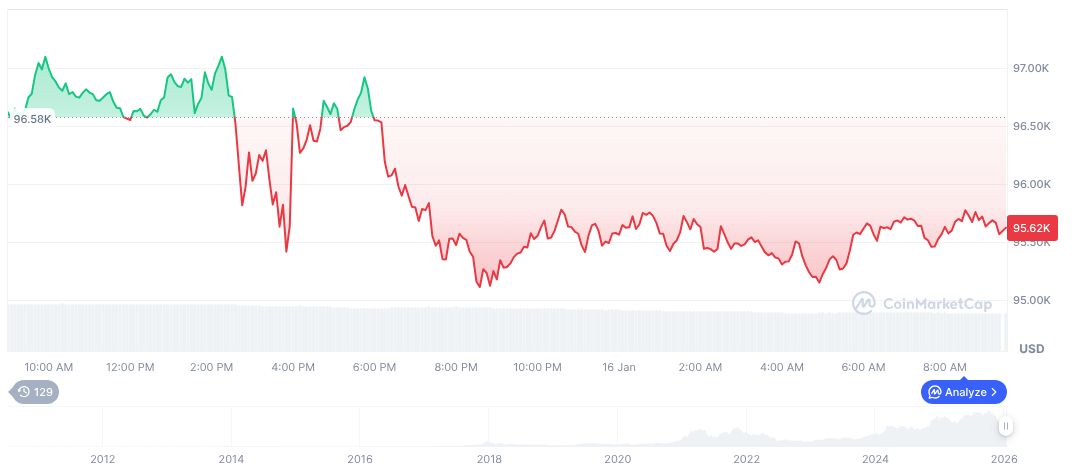
As of January 16, 2026, Bitcoin (BTC) is valued at $95,135.06, with a market capitalization of $1.90 trillion, representing 59.10% of the market dominance, according to data from CoinMarketCap. Over the preceding 24 hours, the price of Bitcoin decreased by 0.90%, accompanied by a trading volume drop of 32.55%, totaling $37.61 billion.
The Coincu research team suggests that the ongoing progress in quantum computing could accelerate the implementation of regulatory measures and significantly influence various financial sectors, ultimately leading to more diversified investment strategies. While Bitcoin has historically demonstrated resilience in its performance, the evolution of technology may introduce new regulatory interventions and necessitate market recalibrations.