


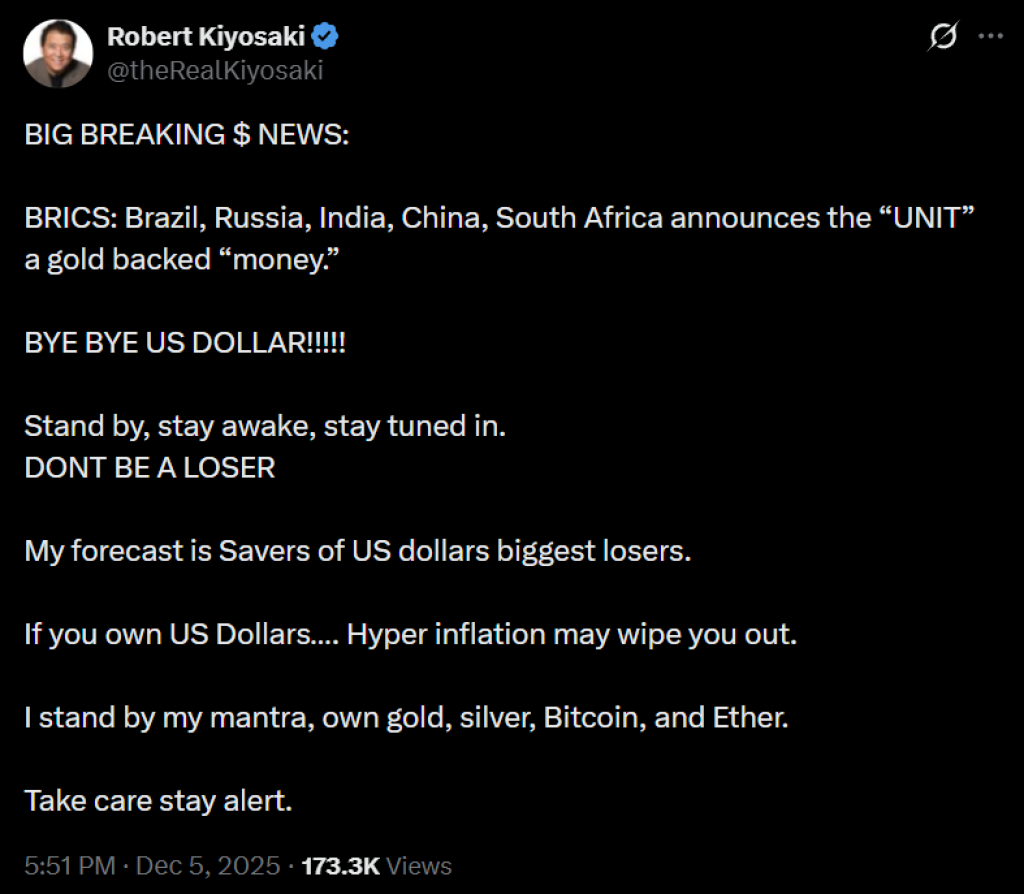
Robert Kiyosaki has once again ignited a significant debate within the financial community following reports that BRICS nations (Brazil, Russia, India, China, and South Africa) are reportedly developing a new gold-backed currency, tentatively named the "UNIT." In a recent statement, Kiyosaki characterized this development as a substantial threat to the US dollar, cautioning that individuals holding cash could face severe losses due to hyperinflation.
Kiyosaki's stark warning was unequivocal: "My forecast is savers of US dollars biggest losers. If you own US Dollars… hyper inflation may wipe you out." Consistent with his established financial philosophy, he strongly advised holding assets such as gold, silver, Bitcoin, and Ethereum as alternatives to traditional fiat currencies.
The core of Kiyosaki's argument lies in the perception of diminishing global confidence in the US dollar. He posits that a gold-backed BRICS currency could hasten this decline. His reasoning is straightforward: if major global economies begin conducting transactions using a stable asset backed by gold, the demand for the USD could decrease significantly. Theoretically, this would diminish the dollar's international influence and potentially exacerbate inflation domestically, particularly if the United States continues its current trajectory of high money printing.
Kiyosaki has been a long-standing critic of fiat currency systems, expressing concerns for years about their inherent dangers. He contends that the US is engaging in excessive spending, incurring record deficits, and relying on the Federal Reserve for artificial economic support. He believes that a competing global currency, backed by a tangible asset like gold, would effectively highlight the vulnerabilities of fiat-based economic models.
Is the US Dollar Under Threat?
There are several layers to consider regarding the potential impact on the US dollar. It is true that BRICS nations have openly discussed the creation of an alternative to the dollar, and a gold-backed framework would likely appeal to countries seeking to move away from US monetary dominance. The trend of global de-dollarization has been gradually unfolding over several years, making the concept of a competing settlement currency plausible.
However, replacing the US dollar is a complex undertaking. The global financial system remains heavily reliant on USD-denominated systems for banking, international trade, debt issuance, and overall liquidity. Even China, a prominent member of BRICS, holds substantial reserves in US Treasury securities. While the creation of a gold-backed alternative is achievable, gaining widespread global adoption presents a significantly greater challenge.
Despite these challenges, Kiyosaki's central point warrants serious consideration. As more countries explore diversification away from the dollar, it places increased pressure on the United States to effectively manage inflation and its national debt. A gold-backed currency that achieves significant adoption could indeed undermine the dollar's long-term dominance, even if it does not lead to its outright replacement.
The Role of Cryptocurrency in Kiyosaki's Strategy
Kiyosaki's classification of Bitcoin and Ethereum as "life rafts" aligns with his long-term investment perspective. Bitcoin, with its predetermined supply cap and decentralized network, operates independently of government inflationary policies. Ethereum, on the other hand, provides a foundational layer for a new financial ecosystem built upon smart contracts. For an investor who views fiat currencies as inherently unstable and inflation as inevitable, cryptocurrencies represent a logical hedge, especially in an environment where major economic blocs are actively exploring alternative currency systems.
This does not automatically imply that a BRICS "UNIT" currency would cause an immediate surge in Bitcoin's value or a swift decline in the dollar's strength. Nevertheless, it underscores a broader trend of fragmentation in global finance. An increasing number of nations are seeking alternatives to the current US-dominated system, and decentralized digital currencies like Bitcoin are well-positioned to benefit from this evolving landscape.
While Kiyosaki's pronouncements are often dramatic, this is characteristic of his communication style. Beneath the heightened rhetoric lies a critical discussion: the US dollar is facing more significant competition than it has in recent history. Regardless of whether the BRICS "UNIT" emerges as a true contender, this initiative signals a global search for alternative financial mechanisms.
In such a dynamic environment, assets like gold, Bitcoin, and Ethereum naturally become integral components of long-term financial strategies.
Should the BRICS plan mature into a functional settlement system supported by actual gold reserves, it could signal the commencement of a gradual but impactful shift away from US dollar supremacy. However, at present, this development is more accurately viewed as a warning shot rather than a direct replacement for the existing global reserve currency.