


Upbit Hack Triggers Altcoin Surge in South Korea
South Korean crypto traders are significantly influencing local altcoin prices after a major hack at the Upbit exchange, according to CryptoQuant CEO Ki Young Ju.
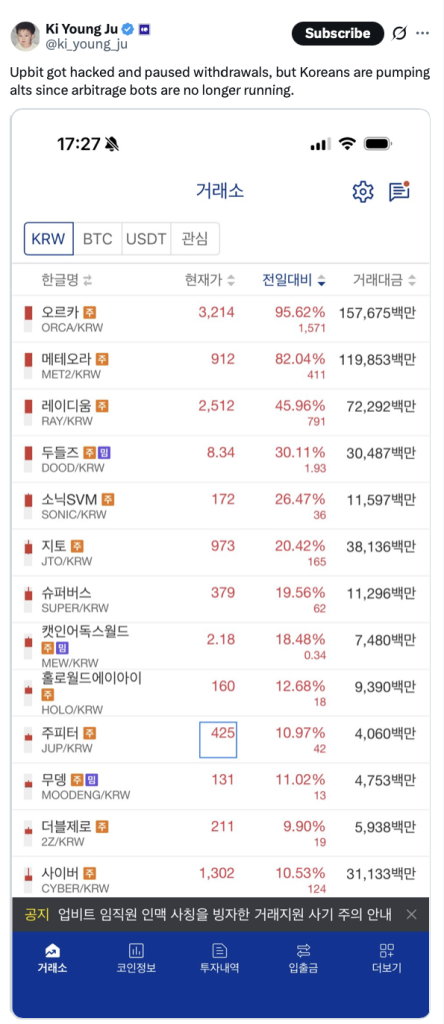
Upbit experienced a hack that led to the suspension of withdrawals. Ki Young Ju stated in an X post that Koreans are currently pumping altcoins because arbitrage bots are no longer operational. The exchange halted transaction activity after detecting an abnormal transaction equivalent to approximately $36 million USD.
With arbitrage activity suspended, local buy orders are exerting more significant pressure on prices. This allows Korean-listed altcoins to surge, as the selling pressure that typically caps price increases has disappeared.
Crypto trader R2D2 remarked, "Unbelievable scenes here." Crypto analyst A79 added, "Hack happens, and Koreans just flip it into a rally."
Upbit announced on Thursday that it had suspended deposits and withdrawals after identifying an unauthorized transaction worth approximately 54 billion won ($36 million USD). The affected assets were primarily Solana-based and were transferred to an unidentified wallet address.
Assets reportedly impacted by the hack include BONK (BONK), Official Trump (TRUMP), MOODENG (MOODENG), and Render (RENDER).
Upbit to Cover Loss to Prevent Damage to User Assets
The exchange clarified that while its hot wallet was compromised, its cold wallets, which store the majority of user funds, remained secure.
Oh Kyung-seok, CEO of Dunamu, stated, "We immediately identified the extent of the digital asset outflow caused by the abnormal withdrawals and will cover the entire amount with Upbit assets to prevent any damage to our members assets."
Some industry participants were initially confused by the positive interpretation of negative price movements. StarkWare ecosystem lead Brother Odin questioned this, prompting Ju to explain that red signifies an upward trend in Korea, while blue indicates a downward trend.
This incident occurred shortly after Dunamu announced a $10 billion acquisition deal with fintech giant Naver.
Notably, this hack happened exactly six years after Upbit was compromised in November 2019, resulting in a loss of nearly $50 million in an attack attributed to the North Korean hacking group Lazarus.
China Shows Signs of Strong Bitcoin Mining Recovery
Bitcoin mining activity in China is reportedly picking up again, despite a nationwide ban. This resurgence is attributed to cheap electricity and significant data-center expansion in power-intensive regions, according to a recent report.
China has gradually regained its position as the world's third-largest Bitcoin mining hub. Its share of global mining had briefly dropped to zero following the ban in 2021, Reuters reported on Thursday.
One miner, identified only as Wang for privacy reasons, began mining Bitcoin last year. He explained that surplus power in regions like Xinjiang makes mining economically viable.
"A lot of energy cannot be transmitted out of Xinjiang, so you consume it in the form of crypto mining," Wang said.
Despite the ban, Wang anticipates that the growth of mining will continue, with new projects under construction. "What I can say is that people mine where electricity is cheap," he added.
Patrick Gruhn, CEO of Perpetuals.com, a crypto market infrastructure provider, commented that Chinese policy flexibility emerges when economic incentives are strong in specific regions.
Thailand Moves to Shut Down Worldcoin Operations
Thai regulators have initiated steps to shut down Worldcoin operations in Thailand, citing violations related to the collection and use of sensitive biometric data.
The Personal Data Protection Committee (PDPC) has ordered TDIC Worldverse, Worldcoin's local operator, to delete biometric and personal data belonging to approximately 1.2 million users, according to the Bangkok Post.
Thai regulators stated that the crackdown aims to prevent potential illegal transfers or misuse of the data.
They further explained that Worldcoin's practice of collecting iris scans in exchange for WLD tokens violates Thailand's Personal Data Protection Act (PDPA). This is particularly due to insufficient safeguards in place for obtaining consent regarding sensitive biometric information.
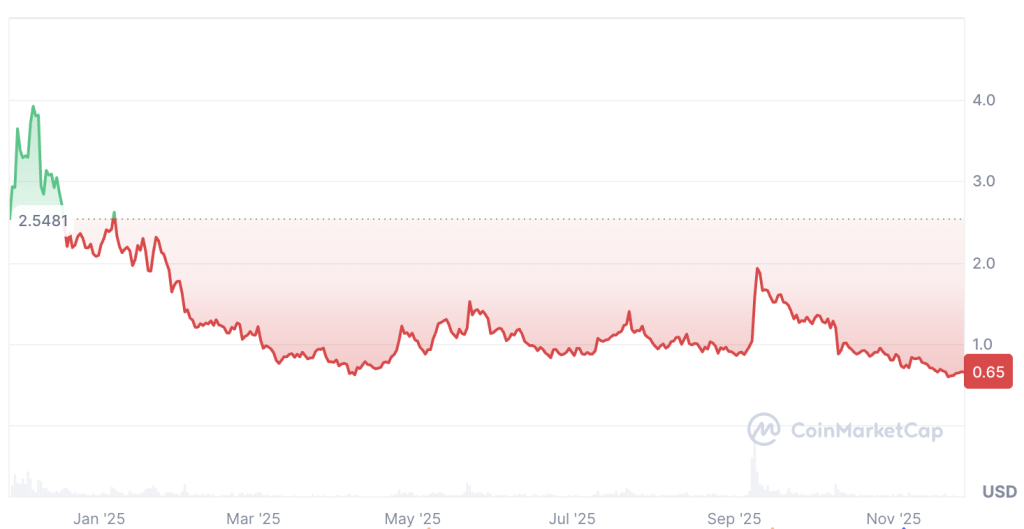
Co-founded by OpenAI creator Sam Altman, Worldcoin utilizes a device called "the Orb" to scan users' irises and generate a cryptographically secured digital identity.
Participants receive Worldcoin tokens in return, a model that has faced increasing regulatory pushback worldwide.
Thailand joins a growing list of countries that have taken action against Worldcoin due to privacy and data protection concerns. These nations include Kenya, Spain, Portugal, Brazil, and Germany.
However, Dhiraphol Suwanprateep, a lecturer at Bangkok University, suggested that the fines in Thailand will likely be less severe compared to those imposed in other countries.